18 December 2025
Political theatre of Chinese Panchen ceremony demonstrates China’s priorities in counter-influence campaign against the Dalai Lama.
China has staged a high-profile commemoration marking the 30th anniversary of the enthronement of Beijing’s appointed Panchen Lama, Gyaltsen Norbu, and a formal seminar in Shigatse on the “system of reincarnation of living Buddhas.” Framed as a religious event, the ceremony on 9 December was a tightly choreographed political exercise involving senior United Front, Party and religious affairs officials, hundreds of monks, and coordinated messaging across state media, academic commentary and monastery committees.
The scale, symbolism and coordination of the anniversary event do not only represent an intensification of existing policy, but have been interpreted by close Tibetan observers as a rehearsal of Beijing’s long-standing strategy to assert state authority over Tibetan Buddhist reincarnation — most notably the future reincarnation of the Dalai Lama. The timing — just months after the Dalai Lama publicly stated on 2 July that his institution would continue and that his successor would be born outside Communist Party-controlled Tibet — suggests a calculated response to a strategic setback.
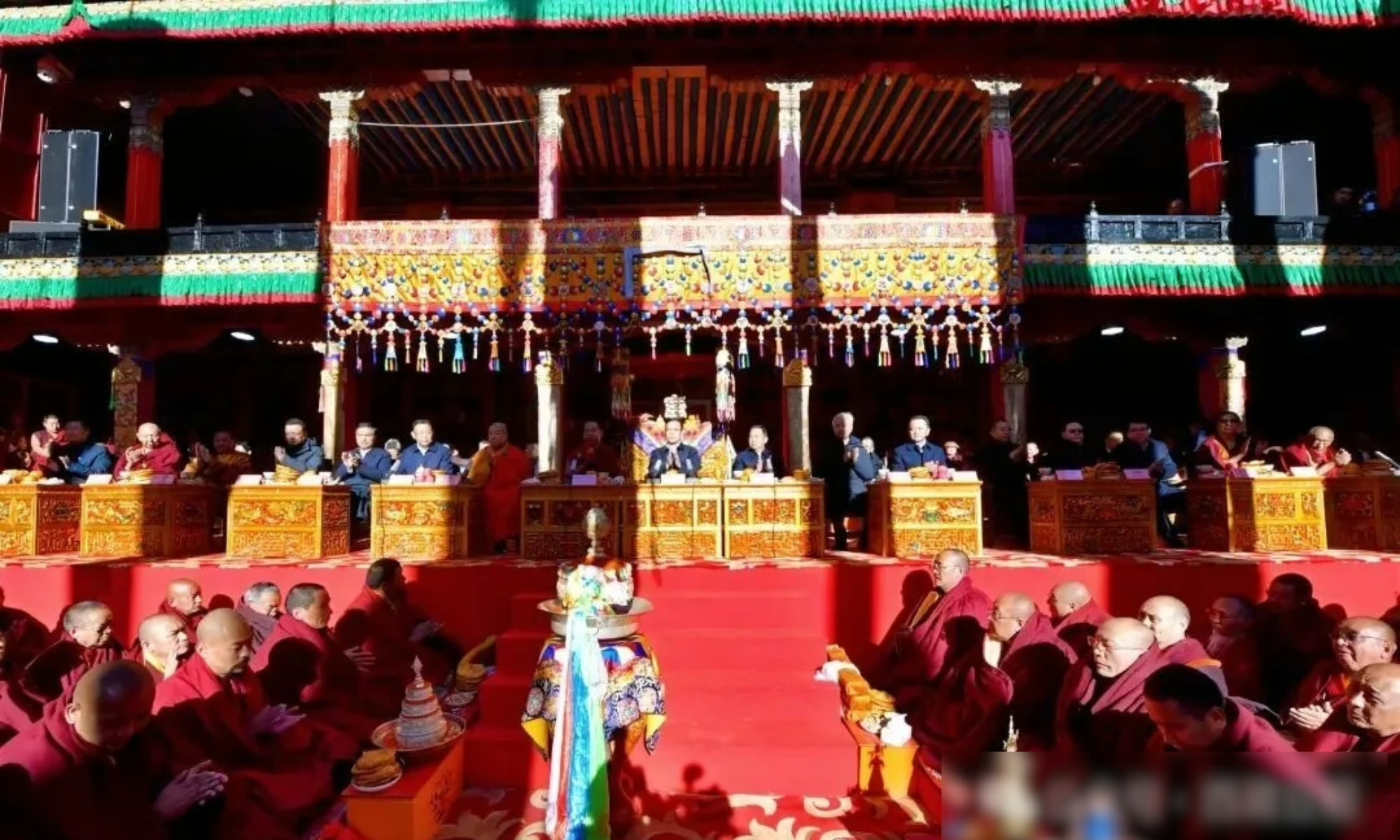
A ceremony at Tashi Lhunpo monastery in Shigatse was held on 9 December to mark the 30th anniversary of China’s enthronement of its official Chinese Panchen, Gyaltsen Norbu. Tibetan monks attending the ceremony appeared anxious and upset. The Panchen Lama recognised by the Dalai Lama was abducted by China at the age of five in 1995 and has not been seen since. Image from Chinese state media.
“Tibetan monks attending the event appeared visibly tense and upset, suggesting they were gathered under pressure and understood the political symbolism of the occasion,” said a Tibetan analyst who viewed the official footage. “It seemed to be a way for Beijing to test how it will manage, display and enforce compliance around the future Dalai Lama.
“To China, the Dalai Lama’s statement in July was like the martial arts adage, ‘a needle wrapped in cotton’. Seemingly gentle on the outside, His Holiness’ declaration held great power, and was tantamount to piercing the Communist Party’s carefully constructed narrative, pointing to the loss of its control over the selection of reincarnations outside Tibet. What we are now seeing is China’s response: a combination of legal claims, historical revisionism, coercive religious management and internal discipline of the monastic community.”
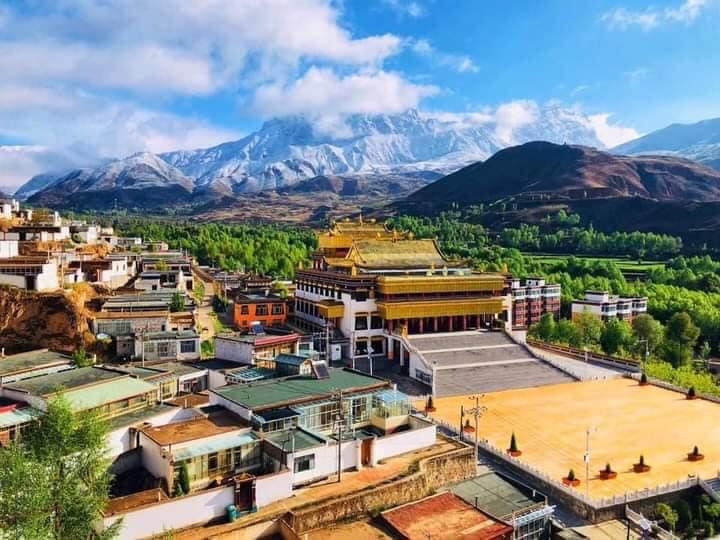
The ceremony marking the 30th anniversary of the Panchen Lama’s enthronement was held at Tashi Lhunpo monastery in Shigatse, historically the seat of the Panchen Lama and central to the Dalai Lama–Panchen Lama relationship. It followed a Kalachakra empowerment conducted by China’s Panchen Lama in October, which also brought together lamas, monks and laypeople from across the plateau. Senior Chinese officials — notably Lin Rui, Vice Minister of the Central United Front Work Department, and Wang Zhigang, Deputy Director of the National Religious Affairs Administration — attended the event, according to official Chinese media.
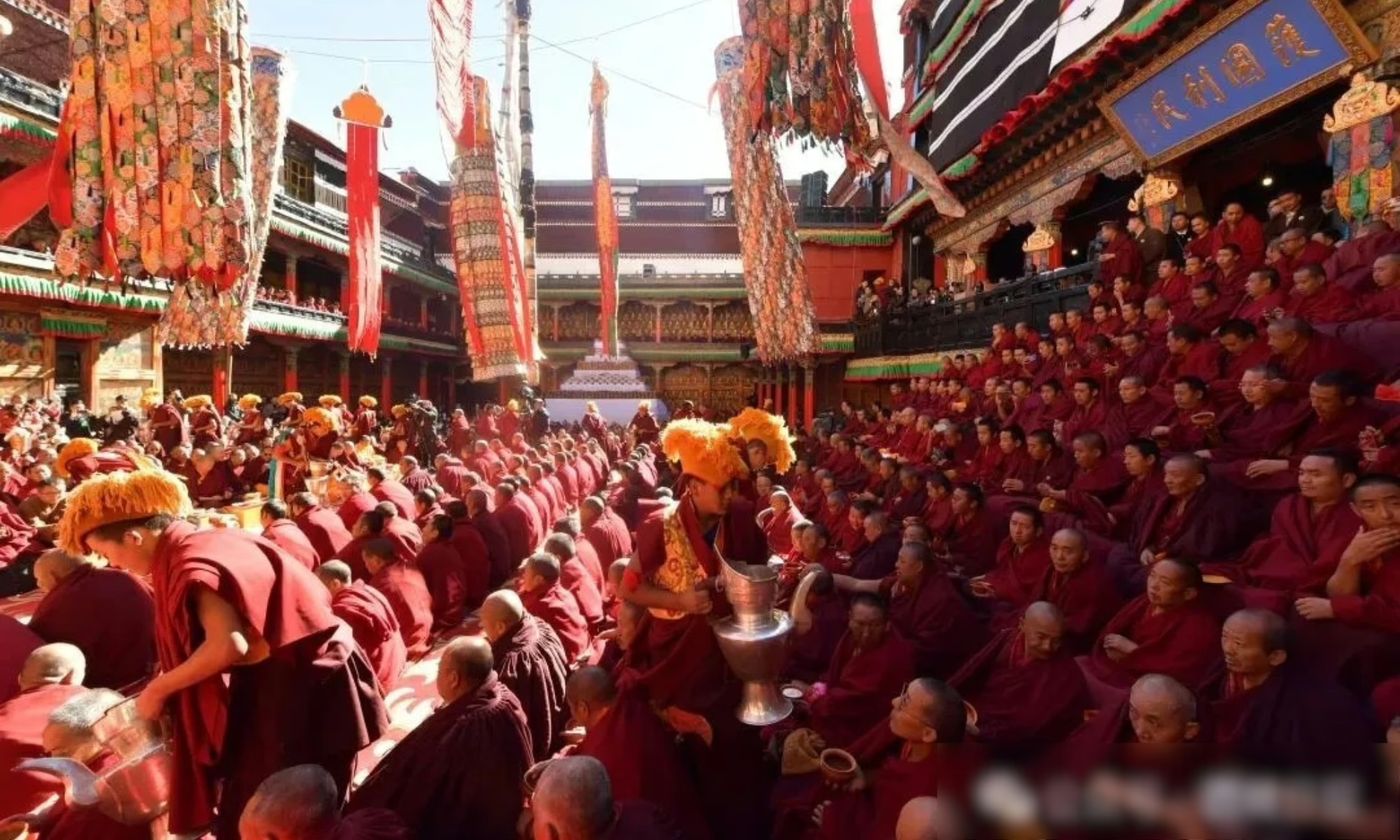
A ceremony at Tashi Lhunpo monastery in Shigatse was held on 9 December to mark the 30th anniversary of China’s enthronement of its official Chinese Panchen, Gyaltsen Norbu. Tibetan monks attending the ceremony appeared anxious and upset. The Panchen Lama recognised by the Dalai Lama was abducted by China at the age of five in 1995 and has not been seen since. Image from Chinese state media.
Meanwhile, it is still not known whether Gedun Choekyi Nyima, the Panchen Lama recognised by the Dalai Lama, is alive or where he is, 30 years after he was abducted at the age of five by the Chinese authorities. Since then, China has institutionalised its control by imposing regulations in the PRC that criminalise any individual or entity other than the Chinese state from identifying or recognising the reincarnation of a Tibetan Buddhist leader.
This policy was further underlined when Xi Jinping and top ideologue Wang Huning made a high-profile visit to Lhasa in August, a month after the Dalai Lama’s statement on his own reincarnation. During their “inspection tour”, Wang Huning — widely credited with shaping Xi Jinping’s authoritarian ideology — visited Tashi Lhunpo to emphasise Party control and reinforce the policy of “Sinicising” Tibetan Buddhism.
On 8 December, the day before the ceremony, Chinese authorities convened a symposium on the “Living Buddha reincarnation system”, also in Shigatse. At the event, the Chinese-appointed Panchen Lama reiterated the official line central to the Party’s counter-influence campaign against the Dalai Lama, stating that reincarnation “must not be subject to interference or control by any foreign organisation or individual.”[1]
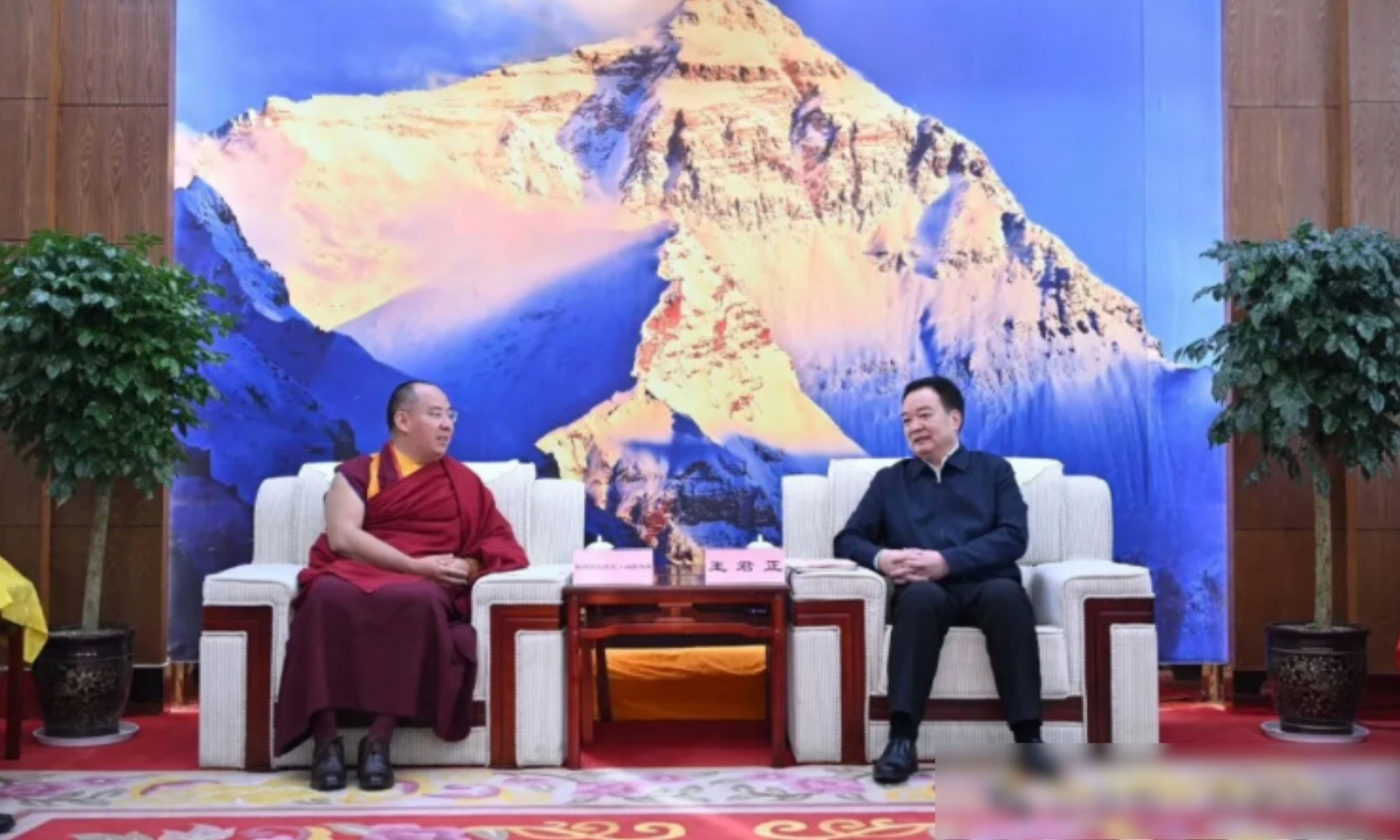
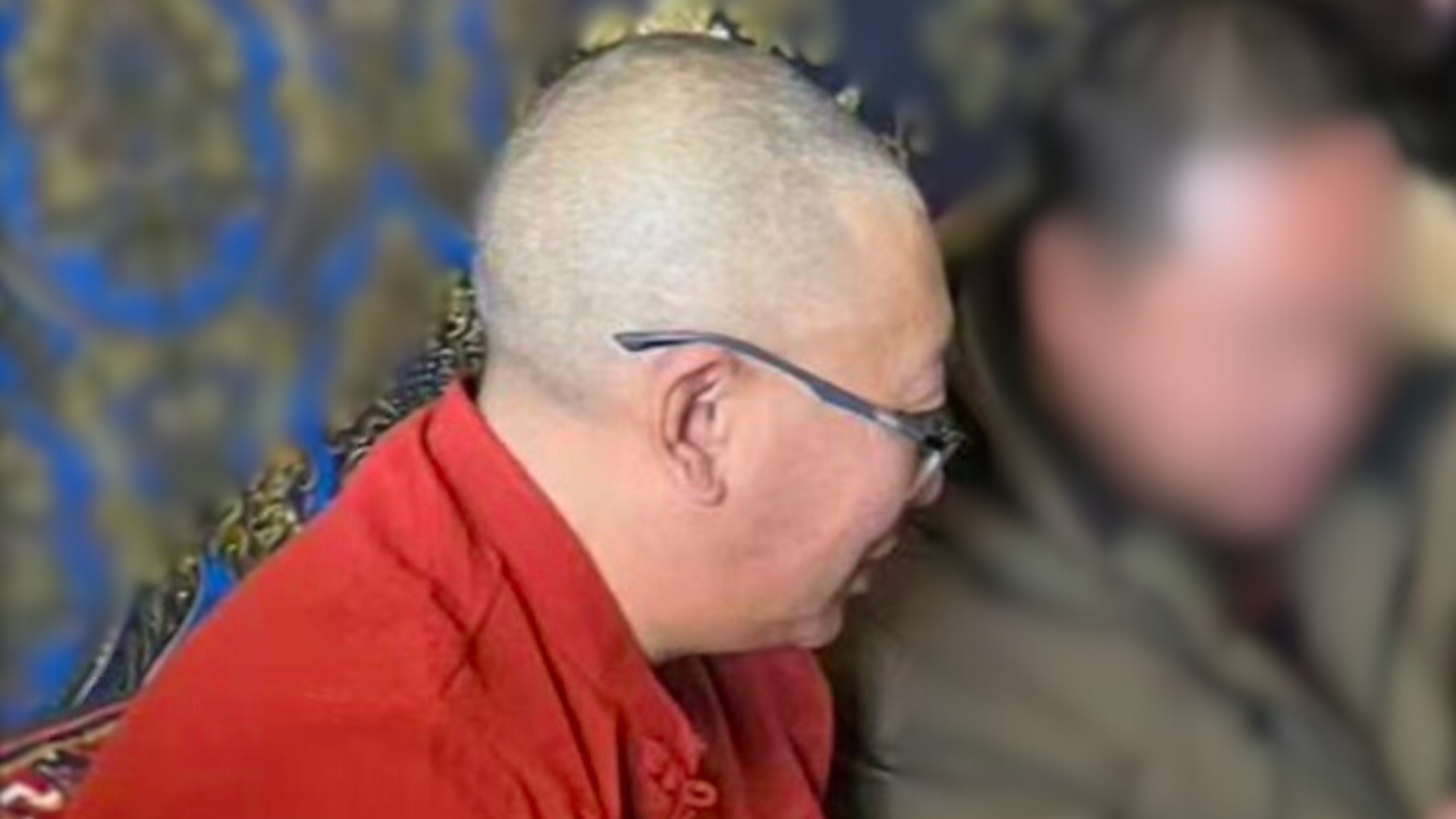
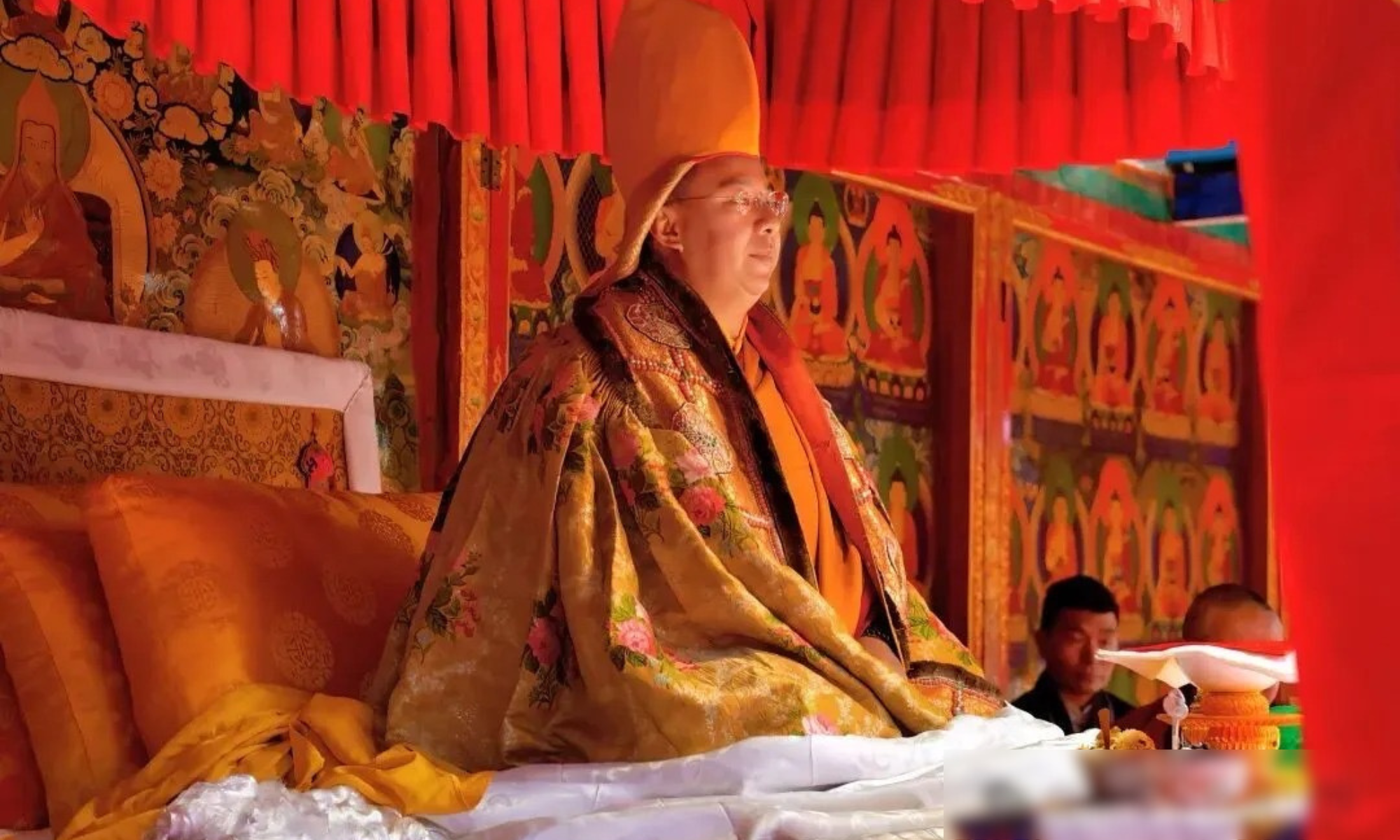
These images from Chinese state media depict Tibet Autonomous Region Party chief Wang Junzheng with the Chinese Panchen Lama Gyaltsen Norbu, and having an exchange with monks and officials over “the strengthening and innovation of monastery management”.
At the same time, Tibet Autonomous Region Party Secretary Wang Junzheng — who is sanctioned by several countries, including the UK, for human rights abuses — emphasised the importance of the Sinicisation of Tibetan Buddhism and praised Gyaltsen Norbu for “vigorously promoting the Marxist view of religion.”[2]
Following the Dalai Lama’s 90th birthday celebrations in July, marked in Dharamsala, India, and by events across the world, there has been a noticeable tightening of messaging across Party, academic and religious channels on reincarnation, sovereignty and law.
China frames Gyaltsen Norbu’s 1995 installation as a “successful implementation” of Party religious policy and a model for the future. Yet internal Chinese policy discussions have long acknowledged that the installation failed to secure legitimacy among Tibetans. Even Chinese analysts have admitted that his authority remains thin and dependent on state enforcement.
This failure explains why the Panchen Lama is now being repurposed as proof that the state can impose a reincarnation process, enforce compliance, and sustain it over decades regardless of popular belief. China’s official Panchen Lama functions less as a religious leader than as a demonstration of how Beijing intends to proceed with installing a Dalai Lama figurehead, even in the absence of authentic recognition.
Speeches at the “Living Buddha” seminar repeatedly insisted that Party procedures fully respect “religious rituals and historical conventions”, particularly the Golden Urn procedure. The Chinese Communist Party continues to regard this arcane method of drawing lots as central to its claim of historical legitimacy over reincarnation, and now describes it as the only legal means of selecting a Tibetan Buddhist leader.
An official White Paper issued by the State Council in 2021 stated: “The reincarnation of the Dalai Lama and other grand Living Buddhas had to follow the procedure of ‘drawing lots from the golden urn’ and the selected candidate would be subject to approval by the central government of China.” China’s leadership claims there will be “disturbances and chaos” if the next Dalai Lama is not chosen using the Golden Urn or in accordance with PRC regulations.[3] Yet the Dalai Lama has pointed out that the urn method was used in the selection of only one of his predecessors and played no role in his own recognition. It has never been central to legitimacy.
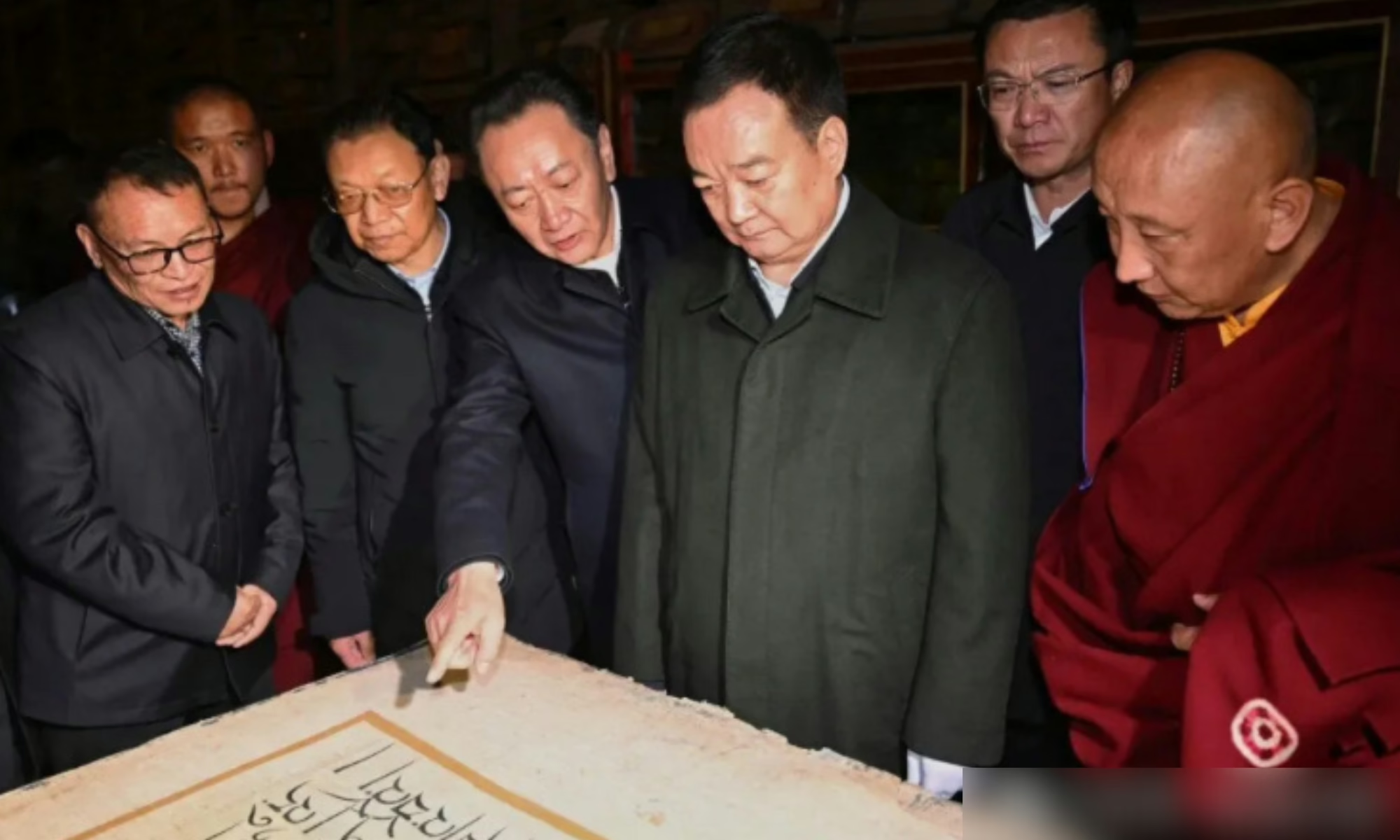
These images from Chinese state media depict Tibet Autonomous Region Party chief Wang Junzheng with the Chinese Panchen Lama Gyaltsen Norbu, and having an exchange with monks and officials over “the strengthening and innovation of monastery management”.
The manipulation of Gyaltsen Norbu’s selection is well documented. The Golden Urn ceremony at the Jokhang Temple on 29 November 1995 was staged in the middle of the night under armed guard, with one ivory lot deliberately lengthened using cotton padding to ensure the “correct” outcome. Former abbot Arjia Rinpoche, who was compelled to attend, later described how state television broadcast footage claiming the ceremony took place at 10 a.m. The director of the Bureau of Religious Affairs subsequently admitted to him: “When we made our selection, we left nothing to chance.”
Recent op-eds and official commentary — including an article by Li Hui of Nanhai University published shortly before the Dalai Lama’s announcement from exile — reinforce this reinterpretation, dismissing the Dalai Lama’s religious authority and framing exile institutions as illegal foreign interference.[4]
Policy papers and statements in official Chinese media increasingly describe the succession issue as a “protracted war”. Gyaltsen Norbu’s role is presented as part of what they term a “strategic” and “historic” opportunity to end Western support for Tibet and fragment the Tibetan exile movement in a “post-Dalai Lama era”.
Even so, some Chinese commentators acknowledge the difficulty of this task. “Concretely speaking, we must mould [the Chinese Panchen Lama] into a spokesman for Tibetans’ interests and a senior lama who promotes Buddhism, and not just a ‘mouthpiece’ for ‘Love the Country, Love the Religion’,” wrote Wang Yanmin of the Public Security University of China in a paper regarded as influential in Beijing. “Such positioning would strengthen the Panchen’s authority domestically, particularly among believers in Tibetan areas, and, when the time is right, could allow him to fill the ‘vanished idol’ role created by the West after the Dalai Lama dies. There will be great difficulty in achieving this goal.”[5]
The December ceremony and symposium illustrate that Beijing is not merely asserting its existing position, but actively rehearsing how it intends to manage the most sensitive succession issue in Tibetan Buddhism. The event underscores China’s reliance on coercion, spectacle and force to manufacture religious authority.
Endnotes
[1] Tibet Daily, 9 December, https://lasa.xzdw.gov.cn/xwzx_359/ttxw/202512/t20251209_630855.html
[2] Tibet United Front on WeChat (Weixin), 9 December, https://mp.weixin.qq.com/s/3dpYcAOCM1lIKNkhJWVK2Q
[3] Referring to the CCP’s appropriation of the Golden Urn, Chen Qinying and Chen Lijian, scholars at Beijing’s Chinese Centre for Historical Studies, warned: “Only if the system used historically is employed during the reincarnation process for a Living Buddha can it be completed, otherwise there will be disturbances and chaos”. ‘Huo fo zhuan shi ji qi li shi ding zhi’, paper by Chen Qinying and Chen Lijian, cited by Ben Blanchard: “Tibetans fear China’s hand in Dalai Lama succession. Reuters, 5 March 2010, https://www.reuters.com/article/us-china-dalailama-idUSTRE62404020100305. At around the same time, former governor of the TAR Padma Choling, speaking on the sidelines of the annual meeting of China’s rubber stamp Parliament, the National People’s Congress, said that the Dalai Lama does not have the right to alter the succession process and must follow the “historical institutions and religious rituals of Tibetan Buddhism”. Reuters report by Sui Lee Wei and Ben Blanchard: “China says Dalai Lama has to reincarnate”. 7 March 2011, https://www.reuters.com/article/world/china-says-dalai-lama-has-to-reincarnateidUSTRE72624L/
[4] It is notable that in Li Hui’s commentary he refers to only three Tibetan reincarnate lamas, the 16th Karmapa, the Sixth Reting Rinpoche, and the Tenth Panchen Lama, all of whom were chosen by traditional Tibetan religious practices without involvement from the Chinese Communist Party. Xinhua, 1 July 2025, https://global.chinadaily.com.cn/a/202507/01/WS68634535a31000e9a573979c.html
[5] Wang Yanmin, ‘A study of new changes in Tibet independence splittist activities in the post-Dalai era and countermeasures’, MA Dissertation, Public Security University of China, 7 April 2017, https://web.archive.org/web/20211221171904/https://wap.cnki.net/touch/web/Dissertation/Article/10041-1017861373.nh.html [Retreived via archive 4 October 2025]. Translation available at https://tibetnetwork.org/geopoliticsoftibetsreincarnation/