18 February 2026
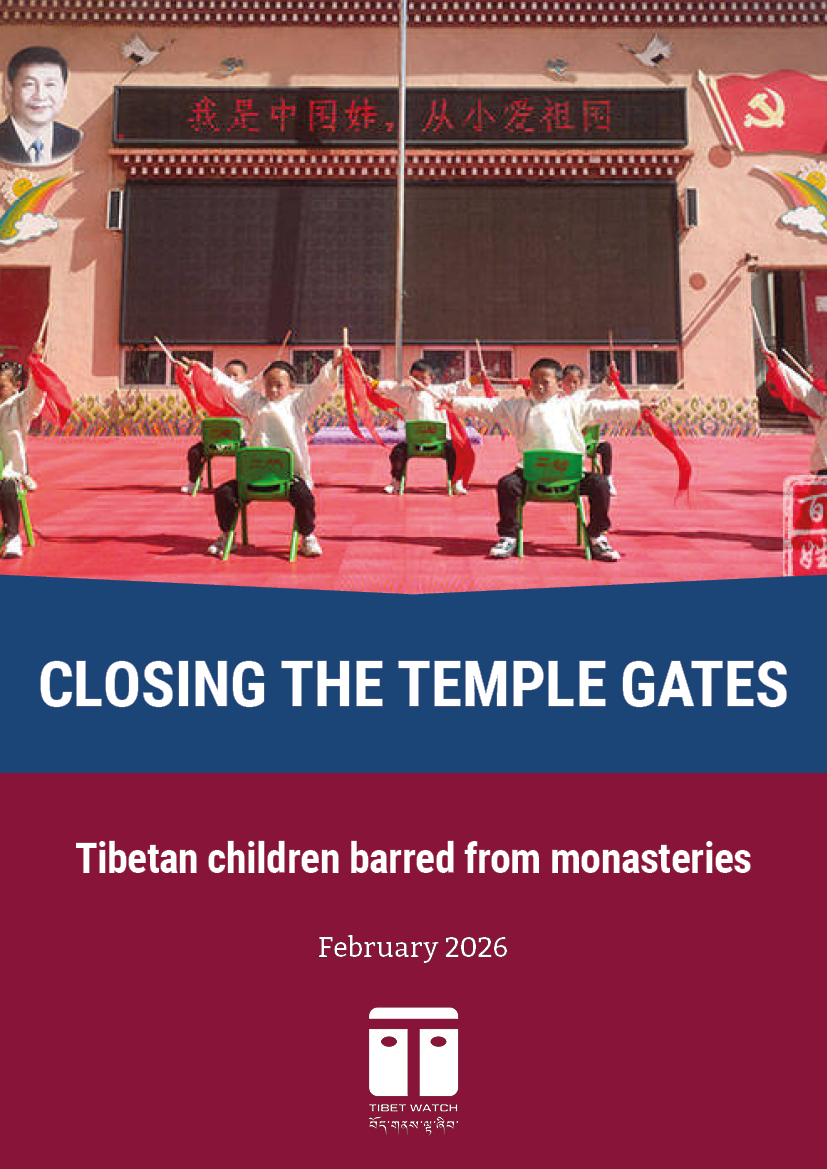
Public signage newly displayed at Tibetan Buddhist monasteries ahead of the Tibetan New Year (Losar) period last week prohibits children under 18 from entering the temple during the holiday period, amidst a new wave of school letters and Education Bureau announcements stating that children are not allowed to visit monasteries in school holidays. The new signs reinforce a Chinese government policy that forbids children under 18 from joining monasteries or receiving even informal language classes from monks.
For generations, Tibetan children have visited monasteries during school holidays with their families to make offerings together, particularly during Losar. Monasteries are not only centres of religious study but hubs of cultural transmission, language preservation, and community life.
At Woeser Monastery (འོད་ཟེར་དགོན།) in Mankang (Markham) County in Chamdo, the Tibet Autonomous Region, notices posted on pillars inside the monastery gate state in both Tibetan and Chinese: “Minors are prohibited from entering the monastery”. In images circulating on Tibetans’ social media, above the gate, banners proclaim: “Long live the great Chinese Communist Party” and on the mountain behind the monastery, the slogans “Listen to the Party, be grateful to the Party, follow the Party” are visible.
Now, Chinese authorities describe informal classes for children run by monks as “ideological infiltration among the young,” “dangerous,” and “harmful.”[1] [2] In one ruling issued to parents on 5 February, local authorities in the Tibetan area of Amdo warn that allowing children into monasteries “jeopardises their physical and mental wellbeing and future prospects” as “they are highly susceptible to influence from illegal religious activities and extremist ideologies when lured or coerced into religious beliefs or participation.”[3]
Tibetans responding online expressed deep distress, with one saying: “When you see this picture, what do you feel? I felt extremely sad. I believe this precious Tibetan Buddhist culture will gradually disappear.” Another said: “This is a method to completely destroy Tibetan religious culture. They have trampled on our faith.” While a third anonymous netizen asked: “The government claims every citizen has freedom of religious belief. If that’s true, why are children not allowed to go to monasteries?”
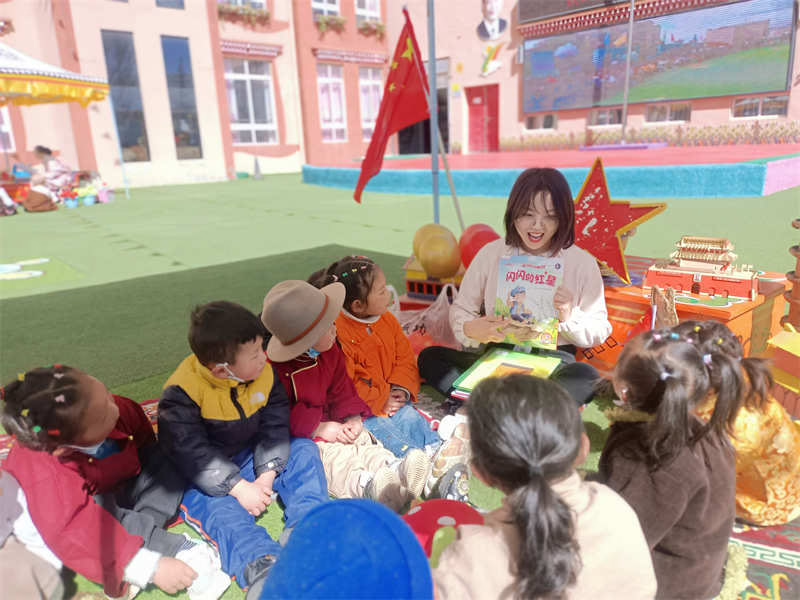
Children in Lithang, Kham (Sichuan) were given education on Communist revolution and military training, here depicted in a class with a Chinese volunteer teacher. Image: Chinese state media, Kardze (Ganzi).
Although enforcement against young monks has been underway for years, the prohibition is now formally embedded in national and local regulations. “Educating minors not to practise religion or enter religious venues constitutes a fundamental responsibility and obligation for both schools and parents,” stated a note circulated to parents on 5 February by the Themchen (Tibetan:ཐེམ་ཆེན, Chinese: Tianjun) County Education Bureau, Tsonub (Chinese: Haixi) prefecture in Qinghai Province (the Tibetan area of Amdo).[4] “Whether religious or non-religious, parents must educate their children not to enter religious venues, participate in religious activities, or attend religious training classes and summer camps.”
Ahead of the current winter break and Losar holiday, China has intensified enforcement of its ‘Double Reduction’ policy, which states that the reasons for the restrictions are to reduce homework and tuition pressure on children by banning extracurricular classes. While this is PRC-wide, in Tibet, this particularly affects the traditionally close relationship between communities and their local monastery.
The Chinese authorities have since 2021 issued notices outlawing off-campus tutoring, a move that disproportionately affects Tibetan students enrolled in state-run schools where Tibetan-medium education is deprioritised, and who have relied on monasteries for Tibetan-language instruction. Tibet Watch has previously reported on students being detained for offering tuition during school vacations, and textbooks in Tibetan being replaced with Chinese.
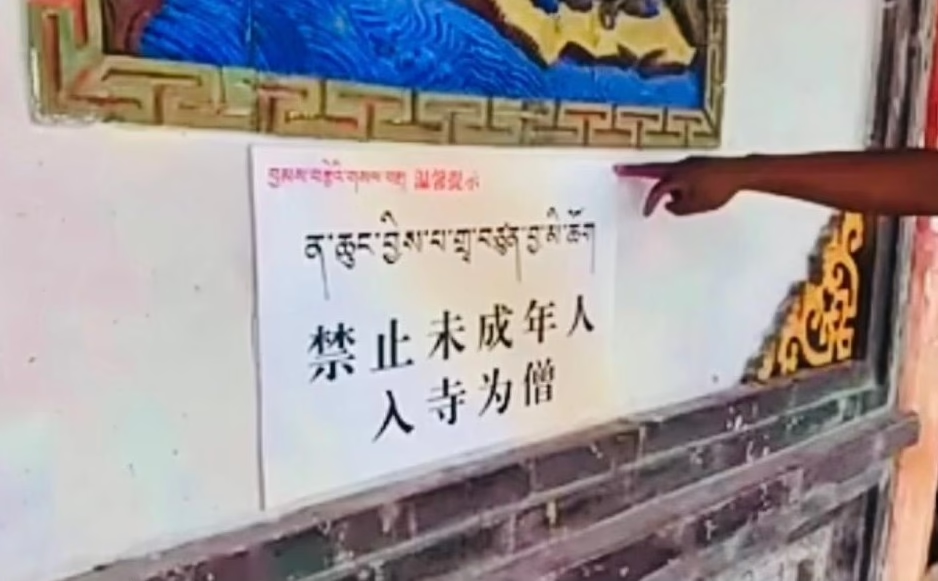
Signage at entrance of a monastery in Tibet forbidding children under 18 from entering, posted just before Losar. Image circulated on Tibetan social media.
The Measures for the Administration of Tibetan Buddhist Temples (Order No. 22), adopted in November 2024 and effective from 1 January 2025, replaces a previous 2010 version, significantly expanding state oversight.[5] Compared with the earlier Order No. Eight, Order No. 22 doubles the number of articles and introduces detailed provisions on penalties, bureaucratic approval processes, and tighter supervision of monasteries by local authorities and Buddhist Associations. The measures prohibit school-age children and adolescents of compulsory education age to study scriptures.
The ban on minors in monasteries may have one exception – boys recognised as reincarnate lamas (tulkus) who are authorised by China in an official ‘Living Buddha’ database, signalling China’s intensive efforts to control beliefs and practices at the heart of Tibetan Buddhist tradition. Article 19 of the regulations states: “Living Buddhas should generally reside in temples and be subject to the management of the temple’s management organization.” Under age ‘Living Buddhas’ however are required to receive a secular education, with the regulations stating: “For underage Living Buddhas approved by the government, the local religious and educational departments should ensure their access to compulsory education in an appropriate manner.”
‘I am a Chinese baby’: A broader campaign beyond monastic education
The ban on minors entering or joining monasteries forms part of a wider political and educational campaign. Framing religion as a threat to children’s development and national unity, the notice issued by the Education Bureau of Themchen (Tianjun) County in Qinghai Province in February stated: “Minors represent the future of our nation…The prohibition of minors from practising religion is a legal requirement upholding the principle of separation between education and religion.”
This messaging is reinforced in kindergartens. Reports from state media in Lithang (Litang) County in Kardze (Chinese: Ganzi) Tibetan Autonomous Prefecture, Sichuan Province, the Tibetan area of Kham, describe Tibetan children participating in “education on the history of revolution,” stating how the kindergarten was turned into a “military training experience site”, with children singing patriotic songs such as “Red Star Shines” and “Motherland, We Love You.” Photographs show banners reading: “I am a Chinese baby; I have loved the motherland since my childhood.”[6]
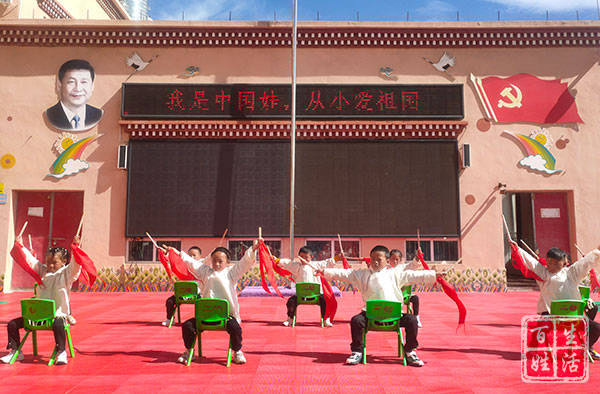
”I am a Chinese baby, I love the motherland since my childhood” is the wording on a LED placard between an image of Xi Jinping and a Chinese flag. Image: Ganzi Daily state media, 10 May 2022.
Families are also urged to speak only Chinese at home to their kindergarten age children. Instructions issued by a Lhasa nursery last September stated: “The family is a child’s first classroom. Parents should communicate with their children in Mandarin at home, engaging in activities such as reading picture books and singing nursery rhymes together, allowing children to naturally learn standard pronunciation in a warm and loving atmosphere. This kind of companionship not only improves children’s language skills but also lets them feel the warmth and cohesion of the Chinese nation from a young age.”[7]
In this way, political and ideological education is being imparted at the earliest stages of schooling, and compounded by the restrictions in access to religious spaces.
Renowned private schools founded by monk educators, originally with the approval of the Chinese government, have also come under mounting pressure since the 2021 Private Education Law, with some being forced to shut down, separating monks, nuns, and lay students who had studied together in Tibetan language. In one case, a teacher was taken into custody while suffering from depression due to the closure of his school.[8]
Removal of children from monasteries documented over a decade
The removal of children from monasteries has been documented for over a decade, as part of a drive by the Chinese government to replace monastic education with secular schooling that emphasizes Communist Party propaganda. Monasteries in Sershul County in Kardze (Chinese: Ganzi) in Kham – where the crackdown on Tibetan identity has been particularly acute – have seen their monk students expelled, return, and be expelled again since its government issued in early 2015 ‘Measures for the Removal and Resettlement of Minors Entering Temples in Kardze Tibetan Autonomous Prefecture’.[9]
In October 2021, dozens of Tibetan student monks in Amdo’s Jakyung monastery were expelled from their monasteries,[10] and around 130 were deprived of monastic education after Chinese authorities of Drago (Chinese: Luhuo) County, in Karze Tibetan Autonomous Prefecture, ordered the demolition of Gaden Rabten Namgyaling School under the pretext of abuse of local land-use laws.[11]
In January 2024, Tibetan sources reported a total ban on all new monks, not only minors, in a Tibetan Buddhist monastery in Chamdo prefecture, the Tibet Autonomous Region, amid growing restrictions on religion. According to a Radio Free Asia report,[12] authorities issued an order forbidding the intake of any new monks into Khyungbum Lura Monastery in Markham county, one of the largest monasteries of the Gelug, or Yellow Hat, school of Tibetan Buddhism in the county, historically a part of Tibet’s Kham region.
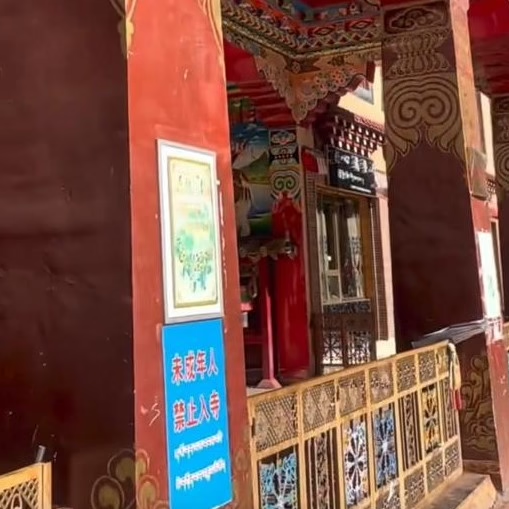
Signage at Woeser monastery in Chamdo, the Tibet Autonomous Region, forbidding the entry of children under 18. Image circulated on Tibetan social media.
One of the Tibetan sources said: “Without the regular intake of new monks, the move will lead to the eventual decline and closure of the monastery in the future, leaving local Tibetans with no nearby places of worship during important religious ceremonies and nobody to turn to to carry out important prayers and rituals, particularly on the death of loved ones.”
Similarly, in October 2024, Chinese authorities in Dzoge County in Ngaba (Chinese: Aba) in Sichuan (the Tibetan area of Amdo) ordered over 300 monk students aged between six to 18 to enrol in the government-run schools in Dzoge (Zoige/Ruoergai) County, after forcibly shutting down the Buddhist primary school of Taktsang Lhamo Kirti Monastery.[13] The United Front Work Department of Sichuan Province reported on “study sessions” having been conducted for monks, nuns, and heads of Monastic Management Committees in Dzoege County on Order No.22 that includes the ban on minors.
The combined impacts of China’s policy on education converge also with its promotion of standardised Chinese language even in kindergartens, which leaves Tibetan parents without any means to protect their children from assimilating into a culture divorced from their own.
For many Tibetans, the fear is not simply about access to monasteries today — but about whether the cultural and spiritual continuity of Tibetan Buddhism can survive into the next generation.

Endnotes
[1] Nangchen United Front announcement, 25 December 2018, https://www.hrw.org/sites/default/files/supporting_resources/nangchen_united_front_201901.pdf [Translated by Human Rights Watch, 30 January 2019].
[2] ‘China: Tibetan Children Banned from Classes’, Human Rights Watch, 30 January 2019, https://www.hrw.org/news/2019/01/30/china-tibetan-children-banned-classes
[3] Distributed by the Themchen (Tibetan: ཐེམ་ཆེན, Chinese: Tianjun) County Education Bureau in Tsonub (Chinese: Haixi) Mongolian and Tibetan Autonomous Prefecture, Qinghai: https://mp.weixin.qq.com/s/fiyYA5EA1FZOVSv3O7wMnQ . County-level work meetings have been convened across Tibet in order to underline the priority of banning Tibetan children from monasteries, for instance in Tongde (Guoluo) county in Hainan, Qinghai (the Tibetan area of Amdo) in 2023, when the United Front Work Department convened an official meeting to underline the regulations “governing the entry of minors into temples and illegal schooling according to law” stating that “minors must be resolutely prohibited from entering temples.” (https://mp.weixin.qq.com/s/CcDPSUV3ekfHOfZKVcSvkQ). In August 2025, Tibet Watch reported the death of a scholar monk at a monastery in Tongde following a crackdown at his monastery involving the expulsion of under age monks: https://tibetwatch.org/scholar-monk-commits-suicide-after-oppression-in-tibet-during-dalai-lamas-birthday/.
[4] The document was entitled ‘Initiative Prohibiting Minors from Entering Religious Premises to Participate in Religious Activities’.
[5] ‘Tibetan Buddhist Temple Management Regulations’, approved by the State Administration for Religious Affairs on 5 November 2024, in accordance with prescribed procedures, and to take effect on 1 December 2024, Order No. 22 issued by the State Religious Affairs Bureau, effective from 1 January 2025. https://www.gov.cn/gongbao/2025/issue_11806/202501/content_6999371.html
[6] Ganzi (Kardze) Daily, state media, 10 May 2022.
[7] Lhasa City Chengguan District No 12 Kindergarten, 15 September 2025, https://mp.weixin.qq.com/s/av6kXS9mpvfCmN1UARW4Kg
[8] ‘Prominent Buddhist Lama and educator detained’ school forced to close’, Tibet Watch, 12 December 2025, https://tibetwatch.org/prominent-buddhist-lama-and-educator-detained-school-forced-to-close/
[9] ‘China forces young Tibetan monks out of monastery into government-run schools as part of drive to replace monastic education with political propaganda’, International Campaign for Tibet, 12 July 2018, https://savetibet.org/china-forces-young-tibetan-monks-out-of-monastery-into-government-run-schools-as-part-of-drive-to-replace-monastic-education-with-political-propaganda/
[10] ‘80 Tibetan monks forcibly expelled from their monasteries’, Tibet Watch, 5 December 2021, https://tibetwatch.org/80-tibetan-monks-forcibly-expelled-from-their-monasteries/
[11] ‘Desecration in Drago County: Destruction of Tibetan religious heritage, arbitrary detentions and torture’, Tibet Watch, 31 January 2023, https://tibetwatch.org/desecration-in-drago-county-destruction-of-tibetan-religious-heritage-arbitrary-detentions-and-torture/
[12] ‘No new monks allowed at Buddhist monastery in Tibet’, Radio Free Asia, 3 January 2024, https://www.rfa.org/english/news/tibet/new-monks-01032024141448.html.
[13] ‘Primary school at Buddhist monastery forced to close’, Tibet Watch, 8 October 2024, https://tibetwatch.org/primary-school-at-buddhist-monastery-forced-to-close/