
23 September 2026
Summary
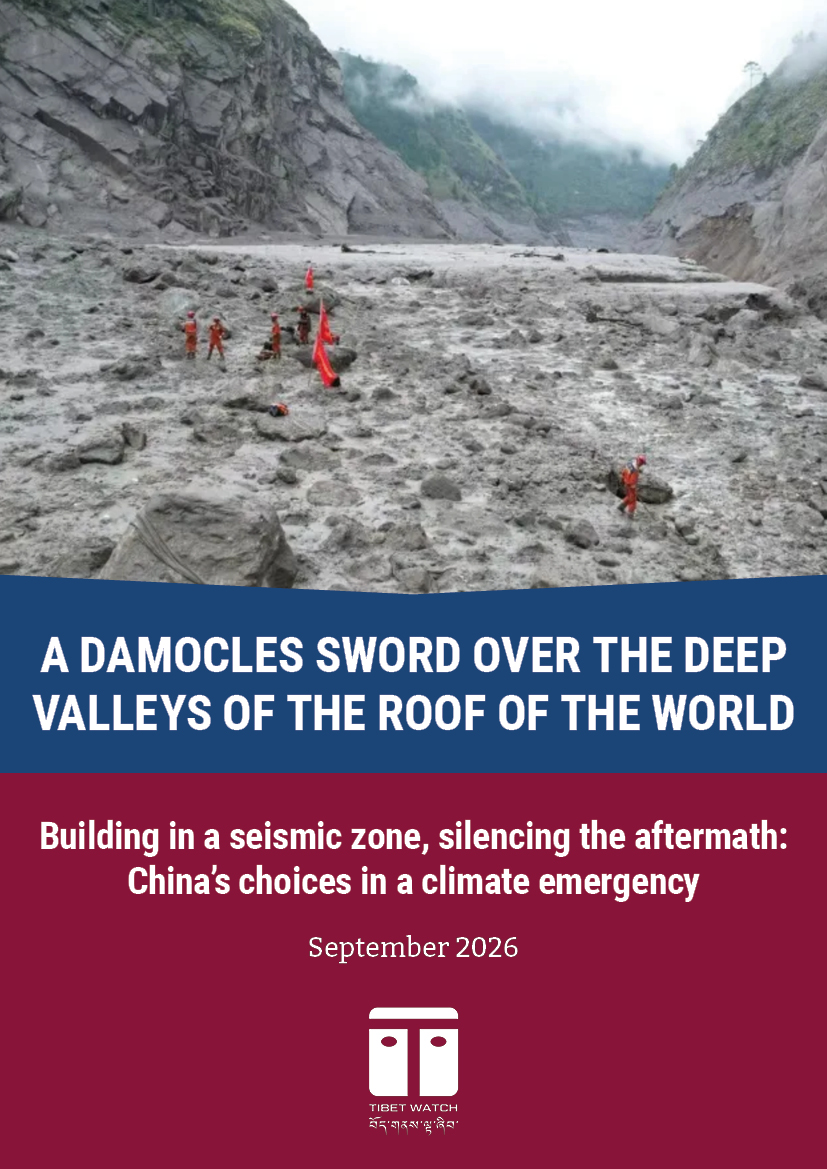
Nearly four weeks after a devastating flood of water, ice, rock and sediment swept down the valley at Kyirong on the border of Tibet and Nepal, a catastrophic loss of life has been compounded by a climate of fear as Chinese authorities threaten reprisals for anyone expressing views that may differ from those of the Party state. One netizen was penalised after they gave a higher figure for those missing than the official line and said that the disaster was “heartbreaking”.
The image that will outlast the Kyirong catastrophe is of the port’s immigration building being swept away in seconds as people fled on the morning of 26 August. Border ports are routinely described as places of transit and bridges between nations. For Tibetans this one was neither: a crossing effectively closed to them in both directions, sealing a frontier that for centuries was no barrier at all.
In the sequencing of official statements following the disaster, China’s propaganda narrative effectively placed responsibility across the border and on an abstract ‘climate’, leaving no room for the questions that fall within the state’s own responsibility: why the port was built where it was, what hazard assessments preceded it, and what warning was possible.
What was erased at Kyirong was one of the main land crossings Tibetans had left to Nepal after Dram – once the main exit point for Tibetan refugees escaping into exile – was rebuilt as a military garrison town with most residents relocated after the 2015 earthquake.[1] For centuries Kyirong was a trade corridor as much as a pilgrimage route. Caravans carried salt, wool and yak products down to the Nepali valleys as winter came, and brought grain and other goods back up. The decades-long sealing of this border cut that exchange.
Heightening the risks of catastrophe – and despite warning signs including a similar flood a year ago in July 2025 that swept away the bridge – extensive trade, pilgrimage, and tourism traffic have since been funnelled into one heavily securitised Himalayan valley.
On 16 September an international team from World Weather Attribution concluded that decades of warming set the stage for the ice-rock collapse that caused the floods. The glacier had thinned and shrunk over recent decades, particularly since 2010; the freezing line has risen by around 100 metres a decade; and July and August, the hottest on record locally this year, are now around 1.5°C warmer than they would be without climate change. Beijing has invoked the climate as a cause beyond its control. But China is the world’s largest emitter of greenhouse gases, and so the largest contributor to the heating now destabilising Himalayan ice.
What remains in question is what the Chinese state did with a risk that was foreseeable and partly of its own making. It is building dams, roads and tunnels at speed across the most seismically active mountains on earth, over India’s objections and against the warnings of its own geologists. It does this in a region where fewer than two dozen of tens of thousands of glaciers are monitored on the ground,[2] and which is closed to independent research.
After a carefully choreographed and selective foreign press trip was allowed in on 6 September, the story on Chinese state media shifted to reports that 444 of 499 evacuated villagers have gone home, while saying nothing about how many villages the flood struck, or how many people were killed in them. In one of the most heavily securitised regions on earth, the state’s own narrative is the only one that is safe to repeat.
Beijing’s control of information does not stop at Tibet’s borders: three months before the disaster, Nepal met Chinese officials in Kathmandu seeking closer cooperation on glacier hazards and water data, and came away without an agreement.[3] In a climate emergency, independent environmental assessment, hazard monitoring and cross-border information-sharing are not diplomatic courtesies but basic infrastructure for the hundreds of millions who live downstream of the plateau.
For Tibetan families the cost of that is not only grief but a religious crisis. Buddhist practice requires the body of the dead to be protected and prayers and rites performed over it in the days after death to secure an auspicious rebirth – an obligation Tibetans have taken extraordinary risks to meet. Since a wave of self-immolations in Tibet from 2009 onwards, many Tibetans have endangered themselves by seeking to retrieve the remains of those who set themselves on fire from Chinese police. Across the border in Nepal, while some families objected that temporary burial of those who died in the August floods disregarded Hindu rites, others performed funerals using kusha-grass effigies in place of bodies. In Tibet none of this is possible.
This Tibet Watch briefing finds that:
- Beijing invoked the climate while omitting its own part in it. Independent science places the trigger in Nepal, and independent scientists have now confirmed that warming primed the slope for collapse. On the day itself, before any scientific assessment was published, state media put “the Nepali side” at the centre of the story. China is the world’s largest greenhouse gas emitter. Wherever the ice-rock collapse began, the decisions that turned it into a catastrophe at Kyirong were the Chinese state’s own: concentrating nearly a third of China–Nepal trade in this valley, rebuilding there after 2025, failing to monitor, and keeping silent afterwards. A Chinese geologist now warns that a second unstable glacier about eight km from the port could send a flow to the border in minutes.
- China has frozen its casualty count and published no names. The combined total of dead and missing has stood at 562 since 29 August. Every update since has moved people one-for-one from ‘missing’ to ‘dead’, reaching 43 dead and 519 missing on 6 September, with no update since. There is no list of names, no village-level toll, and no breakdown of the 258 missing who are not foreign nationals. Nepal, by contrast, publishes a rising count and a searchable public database of the dead.
- The authorities are policing speech about the dead. Chinese authorities have publicly penalised at least 12 people, by detention, fines or “criticism and education”, for posting casualty figures that differed from the official ones or posting comments about the mudslide and rescues. Content creators have been told that all information on casualties must follow official releases. Every published case involves a Chinese name. Tibetans face a less visible and likely harsher regime that leaves no public record.
- The official record was set before independent observers were allowed in. Access to the site was restricted and filming barred without official arrangement. State television showed a single still from surveillance footage seen worldwide. The first selective and carefully managed foreign press trip came on 6 September, a week after the casualty total had stopped moving, and reporters were shown the search but not given a list of the dead.
- The state had the capacity to account for the dead. Within 48 hours the PLA Western Theater Command had dispatched and airlifted a command group and put satellite and drone surveillance over the valley. Following repairs, the G216 road reached the border post by 2 September. Officials say they have forensic teams working from DNA, fingerprints and immigration records. The state has still not published the name of a single missing person.
- The risk was documented in China before the disaster. After the July 2025 flood destroyed the port’s bridge, a Chinese state key laboratory reported 55 glacial lakes upstream with poorly stable moraine dams and recommended stronger early warning. The port reopened on 1 January 2026, about six months later. No warning system like the one China has run at Tseringma since 2021 has been reported at Kyirong. On 5 August 2026, the county rehearsed a glacial-flood evacuation in front of the port customs building with residents of Risur, the village where the port stands. A Tibetan resident has said that 26 people from Risur died three weeks later.
- Signs of the slope moving were in public satellite data. A Chinese state laboratory’s analysis of freely available satellite imagery found that the slope which failed may have been deforming for months, with movement accelerating after 12 August. There is no public evidence that the source area was being monitored, and that data from the source area was freely available. Nepali officials told Reuters that after talks in May, three months before the disaster, China shared less glacier and water data than they had sought.
- To Beijing, Kyirong is a “strategic corridor”, essential to China’s national security, a framing that erases more than a thousand years of Tibetan religious and cultural history. The valley that China rebuilt as a frontier asset is one of Tibet’s oldest routes to the Himalayan south, through which in tradition, the great Buddhist teacher Padmasambhava entered Tibet, while spiritual master Milarepa famously spent years in meditation in Kyirong.
The catastrophe in ‘Happy Valley’
On 26 August, a torrent of debris, mud and water swept down a narrow gorge and erased a multi-storey complex and other infrastructure on the Tibetan side of the border crossing with Nepal, Kyirong Port. The devastating flood appears to have been triggered by a sudden mass of bedrock and glacier ice breaking off a steep slope on the side of Langtang Lirung in Nepal linked to the warming of the plateau.[4] A new study published on 17 September said the disaster was the result of a “compound event” caused by rising temperatures, thinning glaciers, thawing permafrost and pre-existing geological weaknesses.[5][6]
“In Tibet, people are so afraid and so sad, they can’t speak about their grief,” a Tibetan source told Tibet Watch. “They don’t know about the fate of people who are missing, as they are not allowed to talk about it.” The same source said that after the disaster at Kyirong (Chinese: Gyirong), online surveillance across Tibet has become even more stringent, with authorities warning people not to post information online about the number of deaths linked to the floods at the Tibet–Nepal border.
Responding to news of penalties for posting views on the tragedy, a Chinese netizen said: If you guess [the death toll] right, it’s ‘leaking state secrets.’ If you guess wrong, it’s ‘spreading rumors.’ Either way, you’re screwed.”[7] This matters because information controls make it much harder for families to locate loved ones, and obstruct understanding of the disaster, risks and any future response.
Capacity was not the constraint. Beijing has cast Tibet as a national “security barrier” and its channel to South Asia, and Kyirong is where the two meet in a “strategic corridor” for trade and infrastructure.[8] Within 48 hours of 26 August, the PLA Western Theater Command had taken direct control of the response, airlifted a command group, put satellite and drone surveillance over the valley, and had the G216 corridor to the border reopened by 2 September. Analysts have described the operation as a live test of military readiness near the Line of Actual Control.[9] A state able to mobilise on that scale for a strategic corridor has not published the name of a single missing person and is penalising individuals for talking about the missing and the dead.
To describe Kyirong (སྐྱིད་གྲོང་) solely as part of the PRC’s “strategic corridor” omits a much more complex and rich cultural and religious history. Kyirong, in a deep, south-facing valley in southern Tibet at approximately 2,600–2,800 metres above sea level, has functioned as an important passageway for the movement of people and goods and transmission of cultural and religious influences between the Tibetan plateau and the Himalayan regions of Nepal and India from ancient times to the present. With its Tibetan name commonly understood as “Pleasant Village” or “Happy Valley,” reflecting the valley’s relatively mild climate and lush landscape, the Kyirong border is also associated with the movement of important Buddhist teachers and scholars, including Padmasambhava and the Indian Buddhist master Atisa, into Tibet. The great Buddhist master Milarepa spent years meditating in the valley of Kyirong.
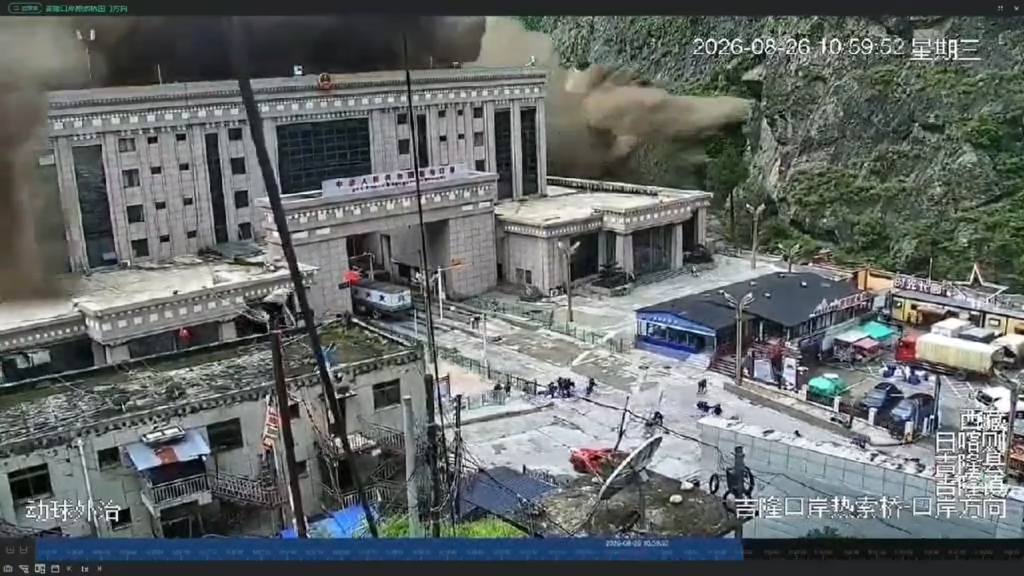
Cameras captured the terrifying moment that flash flooding hit the Tibet-Nepal border crossing.
Information controls, censorship, compound grief and loss
One of the most revealing features of China’s casualty reporting is not one single statistic but the relationship between the figures. After two days of small fluctuations, the combined total of dead and missing settled at 562 in the figures for 18:00 on 29 August, and has not moved since then. Each subsequent release has transferred people from ‘missing’ to ‘dead’, one for one: five on 2 September, ten on 4 September, 12 on 6 September. No new missing have been added, and the number rescued alive has stood at two since 27 August. The latest figures, 43 dead and 519 missing as of 18:00 on 5 September, were released on 6 September at a press conference attended by Chinese and international journalists after an overseas media visit to the site.[10] No update had been published at the time of writing.
Nepal’s figures are different. As of 16 September, missing had been revised to 6,150 and bodies retrieved stood at 1,403, of which 105 had been identified.[11] These are bodies recovered, including remains, not confirmed deaths. This was an open, accumulating count. China’s count of the missing has not risen since the day after the disaster, although Kyirong was a busy trading port and the missing include 261 foreign nationals from 23 countries, whose status would take time to establish. Nepal has published district-level breakdowns of recovered bodies including photographs of those who died.[12]
Given conditions on the ground, uncertainties remain about Nepal’s figures too. The contrast is between a public, revisable process and a closed one, not between accurate and inaccurate numbers.
The Chinese state has published no village-level death toll, no list of names, and no breakdown of how many of the missing are Tibetan.[13] This is not because the state lacks the means to identify people; officials say they have deployed forensic specialists and laboratories to the site and are working from fingerprints, genetic data, immigration records and location information.[14] But diplomats representing countries with missing nationals were given no detail on how DNA identification would proceed, and that China had not answered with video from its own side of the port that could help families identify the dead.[15]
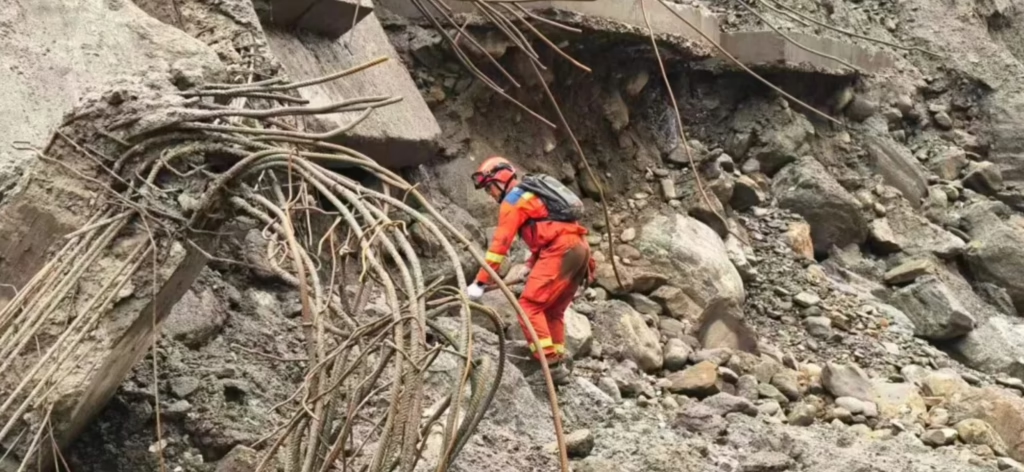
China’s closed-off approach to disaster relief and investigation leaves many questions about the true scale of this catastrophe.
Security authorities have announced penalties against at least 20 people for discussing or speculating about the figures for the dead and the missing that differed from the official count, or commenting about the causes of the mudslide.[16] In a list published by Tibet’s Cyber Police on 10 September, three individuals were punished for saying an earthquake triggered the collapse or that the mudslide was man-made, and one for unfavourably comparing the rescue with other countries.[17]
On 30 August, state websites published details of ten “typical cases” of online rumour-mongering connected to the disaster, prosecuted under the “Clean Net 2026” campaign,[18] while a further release on 31 August, issued through the ‘Tibet Online Reporting’ WeChat account and carried in the national rumour-rebuttal bulletin, put the figure at 12, adding two cases from Lhokha (Ch: Shannan), Tibet Autonomous Region.[19] All 12 were dealt with by education and administrative punishment — detention or fines imposed by police, without charge or trial. An official Lhasa police notice records seven days of administrative detention for one person, a 1,000-yuan fine for another, and legal education and criticism for three others; the two Lhokha cases were described as involving police interviews and criticism and education.[20]
Almost every one of the first 12 cases detailed gives a number, including: a user surnamed Qiu, in Chamdo, for writing that the news reported 1,400 dead when 3,000 had previously been missing; a user surnamed Liu, in Lhasa, for writing that over 3,000 had already died on the Chinese side; a user named Tan, in Lhasa, for writing that thousands at Kyirong Port lost their lives in an instant. One of them, a Chinese social media user in Nanchang, Jiangxi, was punished for a post saying: “826 people are now missing, it’s so heartbreaking!”
Every individual named in these lists is identified by a Chinese name. Tibetans who circulate information about the disaster are not processed as “administrative rumour” cases and are not announced in state media as “typical” examples; the offences available for use against them, and the sentences attached, would likely be regarded as more severe and would rarely leave a public trace. The visible enforcement regime is the more lenient one.
The absurdity of the position was not lost on Chinese readers, with one user observing on social media, “If only the flood victims had spread rumors right before they died, they might have been tracked down and rescued in time.”[21]
Alongside the state media count of the missing and the dead, China has published an inventory of 993 items of personal belongings it says it has recovered – while the list of the people those objects belonged to has not been published at all.[22]
On 31 August, five days after the mudslide, netizens were urged not to enter the core rescue control area to livestream, film or interview without arrangement by the front-line rescue command. In instructions issued to social media content creators, the Tibet Self-Media Association also ruled that all information on casualties, missing persons and rescue progress should follow official releases, with ‘rumours’ to be reported to cyberspace authorities and police; and called on them not to film or publish images of affected residents or families of the dead “at will.”[23]
In China, an unnamed source told a Western journalist: “You might live in constant fear and anxiety, never really knowing when you’ve made an inadvertent remark, which could get you in trouble. You don’t know where the boundaries lie, nor can we predict if and when our turn might come.”[24]
An information blackout on the border
Kyirong Port was a working border, and those likely to have been present at the time of the disaster include customs and immigration staff, border workers, construction crews, drivers, traders, travel guides, local residents, pilgrims heading for Mount Kailash and Lake Manasarovar, and foreign tourists.
In the absence of any list of names, fragments of information have reached the outside world from unofficial sources. A Tibetan resident told Radio Free Asia that 26 people had died in the village where the port stands, Risur (Chinese: Resuo) alone, and that with access to the immediate disaster zone restricted he had walked around the mountain for roughly three hours looking for relatives without finding them. A Chinese resident who had been away from the port when the mudslide struck said that around 800 people lived at the crossing and that shops and restaurants had been swept away; of those at the border checkpoint itself, he told RFA, “No one at the border checkpoint appears to have survived.”[25]
Further RFA reporting on 1 September carried accounts of the speed of the flow: one Tibetan resident said the flood reached the area around the customs office within about three minutes by his account, and that roughly 30 people were in the village at the time. Many people from the area had been working on road construction. The same reporting identified ten Tibetan travel guides from Lhasa and elsewhere as missing. They had been working in the Dram (Chinese: Zhangmu) area, transporting travellers and pilgrims between the Nepal–Tibet border and the sacred Mount Kailash and Lake Manasarovar.[26] According to Tibet Watch sources, two Tibetan tour guides from Labrang, in Amdo, were swept away by the floods and their bodies were later found in Nepal. Their families were reportedly notified and allowed to travel to Nepal.
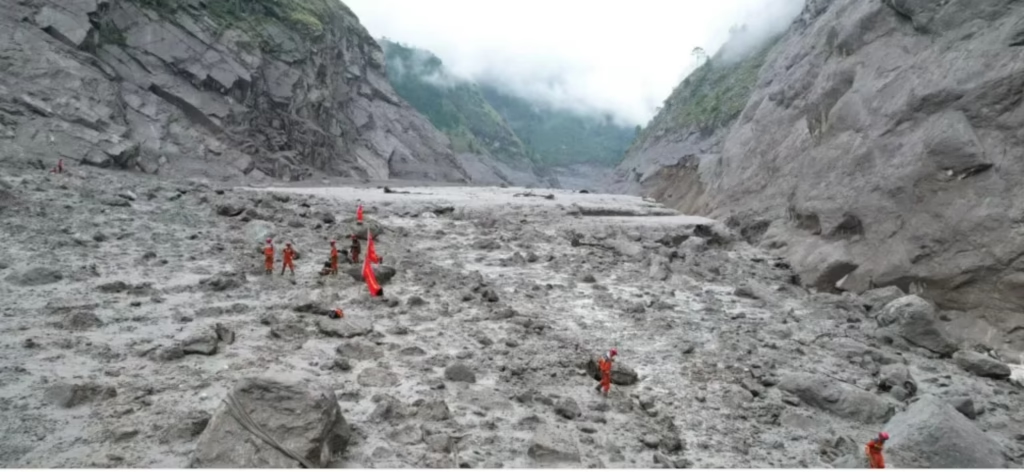
China’s information blackout extends beyond Tibet and into the Nepal border region, with the fate of those around the border crossing also remaining unknown.
A shift in the state media narrative: the fate of villagers unknown
The state media narrative shifted on 9 September to the news that 444 of the total of 499 residents evacuated on 27 August from five villages in Kyirong County near the border with Nepal in the aftermath of the floods had now returned home after the threat from a barrier lake was largely eliminated. But it is still not clear how many villages and people, if any, were actually hit by the flash floods and suffered destruction and loss of lives in that catastrophe.
The official account provides detail about evacuation and much less about what happened inside the affected communities during the disaster itself.
Authorities said the mudslide created a barrier lake above the core area of the port, posing a secondary threat to nearby settlements, and relocated 499 residents from five villages in Kyirong town and Sale township to temporary accommodation, where they received medical, educational, basic-living and psychological support, according to state media. By 8 September, Xinhua reported that 444 had returned home, the final group consisting of 180 residents of Guoba village in Sale township, with another 55 preparing to return.[27]
The reporting establishes that these villages were evacuated because of a post-disaster hazard. It does not establish that all five were struck by the original debris flow; equally, the absence of an official destruction figure does not establish that there was no village-level damage. The official releases reviewed by Tibet Watch provide no village-by-village missing-person total, and no public reconstruction of which homes were destroyed by the initial flow as against which settlements were evacuated because of the barrier lakes. Satellite comparison of the border area published in the first days after the disaster showed extensive damage, alongside restrictions on independent access and information inside Tibet.[28]
On 5 August, three weeks before the disaster, Gyirong County’s official WeChat account reported a live evacuation drill for a glacial lake outburst.[29] Video of the drill shows it being held in front of the port customs building, with elderly residents, women and children from Risur (Ch: Resuo), the village in which the port stands. According to the Tibetan resident quoted by Radio Free Asia, 26 people from Risur died on 26 August.
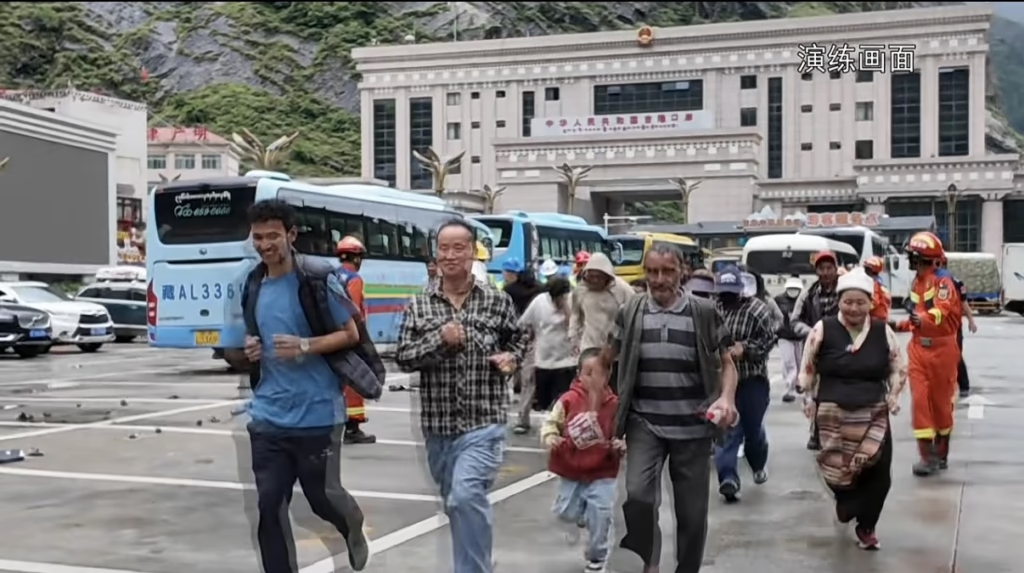
A live evacuation drill was held at the border crossing 5 weeks prior to the disaster, as a precaution for glacial lake outbursts.
Satellite analysis published two days after the disaster by a Chinese state laboratory found that the slope which failed may already have been deforming in the months beforehand, with movement accelerating after 12 August; the imagery it used is freely available.[30] The authorities had identified glacial floods as a threat to the port and rehearsed an evacuation for one. There is no public evidence that anything was monitoring the source area, and no warning reached the port.
The footage that circulated everywhere except China
Two surveillance videos from Kyirong Port travelled worldwide within hours: a wall of water and debris tearing through the crossing as people fled from the scene. They were captured by fixed cameras, spread on social media, and appeared on screens internationally. This footage alone appears to call into question China’s casualty figures.
China’s flagship state evening news bulletin broadcast a single still frame. The full video has been difficult to find on the Chinese internet, and first-hand survivor accounts are harder to find still — there are effectively no accounts from survivors in Tibet, and almost no user-generated footage of the event or its aftermath.[31]
What filled the space was official material, including AI-generated visuals purporting to show the likely origins of the mudslide.[32] On Weibo, a memorial hashtag was pinned to the top of trending topics alongside eight other disaster-related topics, the lead post being a state television newsreader reading the Politburo communiqué.[33] Trending topics were redirected towards the government’s response: a Politburo meeting on rescue and relief convened by Xi Jinping, and State Council Premier Li Qiang’s arrival in Kyirong.[34]
For the first days, foreign media were absent and independent reporting from the Chinese side was effectively impossible; the record was set entirely by state media. On 31 August, Xinhua’s own reporters were carried into the core disaster zone by a TAR Department of Emergency Management helicopter and stayed overnight.[35]
On 6 September, once the total had been fixed for a week and the casualty account settled, China’s Ministry of Foreign Affairs and the State Council Information Office jointly organised the first trip to Kyirong for international media, on an itinerary planned by officials. The group included CNN, Reuters, NBC, the Press Trust of India and a Brazilian correspondent; New York Times and others were excluded. That evening, senior TAR officials held a press conference in Kyirong town, fielded repeated questions on identification and information-sharing, defended their transparency and gave the most detailed account to date. The figures of 43 dead and 519 missing were released to that briefing.
While the issue of access to a remote area at a time of crisis are real, there is no doubt that access was withheld while the record was being established, and journalists were admitted to see the search but not the count.
Reporters were shown a site, a memorial of around a hundred yellow flowers and a briefing, but not given a list of the dead. In contrast, journalists in Nepal have been interviewing survivors and rescue workers freely.
Of the 519 missing, China says that 261 are foreign nationals. That leaves 258 people who were not classified. The published figure does not say how many are Tibetan, how many are Chinese nationals from outside Tibet, or how many were construction workers, pilgrims, border staff, traders, drivers, guides or local residents. The difference is compounded by a hierarchy of visibility. Foreign cases have an external diplomatic pathway: embassies can ask questions, consular officials can seek updates, families can press their own governments. Tibetan families are embedded entirely within the Chinese domestic information system, and the public record of Tibetan cases is almost impossible to establish independently.
The risk that was documented
Kyirong lies along an active fault belt on the southern flank of the Himalaya, in terrain classified as highly susceptible to geological disaster. A commentary carried across Chinese media on 26 August, the day of the disaster, described the valley as a 93-kilometre gorge dropping more than 2,400 metres along a north–south structural belt, where steep gradients supply the energy, fractured rock the material and the monsoon the water — and where the 2015 Nepal earthquake left damage the author was explicit in calling long-term and delayed, since shaken rock takes years or decades to restabilise.[36]
Published academic research, the commentary noted, finds that Himalayan debris flows develop mainly within eight kilometres of fault zones; Kyirong port was built on one.
The chain the commentary anticipates begins with a lake outburst in the Friendship Bridge catchment, whereas the immediate trigger on 26 August was an ice-and-rock collapse off Langtang Lirung inside Nepal most likely caused by warming of the plateau.[37] This was a different mechanism, and one that produced a seismic signal initially read as an earthquake before the US Geological Survey established that the collapse itself had generated it. What the Chinese-language material studied by Tibet Watch does establish is that the exposure of this valley was understood and documented in China before the disaster, by a state key laboratory, and discussed openly in Chinese media on the day it happened.
The Kyirong disaster in August had a precedent on the same river a year ago on 8 July 2025, when a flood washed away the Friendship Bridge at Kyirong Port. Chinese state media reported 11 people missing on the Tibet side of the border, nine of them construction workers and two road-maintenance labourers, and six Chinese nationals missing in Nepal.[38] Nepal’s disaster authority confirmed nine dead and 19 missing, a figure that includes the six Chinese nationals.[39] In 2025, the hazard ran the other way. Nepal’s Department of Hydrology and Meteorology and the International Centre for Integrated Mountain Development (ICIMOD) traced the flood to the outburst of a previously unnoticed supraglacial lake in Tibet, at 5,150 metres and some 36 kilometres upstream of the border.[40]
Chinese scientists agreed. Days after the July 2025 debris flow, the State Key Laboratory of Geohazard Prevention and Geoenvironment Protection at Chengdu University of Technology reported 55 glacial lakes in the basin upstream of the bridge, covering some 3.39 square kilometres, with moraine dams of very poor stability. It stated the July 2025 flood was a supraglacial lake outburst whose water entrained rock loosened a decade earlier, and recommended strengthened early warning and individual risk assessment. It also found that the area had warmed markedly over the preceding five years, at a rate well above the plateau average.[41]
This year, too, researchers identified unusually warm conditions before the glacier’s collapse. “When warming destabilises the roof of the world, no amount of local adaptation can fully shield vulnerable people downstream from this scale of destruction,” said Dr Friederike Otto, a climate science professor at Imperial College London, which carried out the study.[42]
The risk to this site was therefore not new, unforeseen or unrecorded. It had been documented, in public, by Chinese scientists, a year before.
A Chinese geologist has now warned that a second unstable glacier about eight km from the port could send a flow to the border in minutes. In an article published on 9 September in Chinese media, the geologist says that satellite imagery clearly shows a significant risk of instability at this glacier – in the event of a similar-scale icefall, the mudslide could reach the China-Nepal border within three minutes, potentially with even greater destructive force, writing: “This potential hazard urgently requires high attention from relevant authorities in post-disaster reconstruction and subsequent monitoring.”[43]
A young Chinese border officer at Kyirong, reported missing in early September, viewed the multiple instances of rebuilding at the port as a virtue, saying in a letter to a university friend that the Resuo (Friendship) bridge leading to Nepal has been moved to three or four different locations. Yang Shizi wrote: “According to the veterans here, construction here has never stopped. Every year, as soon as it is completed, it will be hit by various disasters. It is repaired and destroyed, destroyed and repaired again. Looking at the dense remnants of bridge piers and the layer upon layer of foundations for the port buildings, I deeply feel the tenacious revolutionary optimism of generations of border guards.” [44]

Yang Shizi was reported missing in early September, he had previously written about the dangers at the border.
Yang’s letter reflects a priority set at the very top of the Party. Xi Jinping has repeatedly invoked the principle that governing the country requires governing the frontier, and that governing the frontier begins with stabilising Tibet.[45] In Tibet, Xi has made “strengthening the border” one of four “major tasks”,[46] calling for border infrastructure and special policies so that people will put down roots on the frontier and guard the territory. Under a 2017 TAR plan, 628 border villages were to be built across 21 border counties, 427 of them in the first line, with residents relocated into them.[47] By 2025 Kyirong was named as one of three priority ports facing Nepal.[48] The cycle of building, destruction and rebuilding that Yang describes follows the same logic: the state’s presence on the border is not negotiable, whatever the terrain does to it.
Glacial hazards and warnings
Early warning of glacial hazards in the Himalaya is not a theoretical Chinese capability. In 2020 the Second Tibetan Plateau Scientific Expedition built a comprehensive monitoring and early-warning system at Tseringma glacial lake (Cirenmaco) close to the Nepal border in Nyalam county where a 1981 outburst killed some 200 people and destroyed the bridge at the border town of Dram (Zhangmu).[49] This system has been operational since October 2021, cost under half a million dollars, and its data, the designers wrote, would be shared with Nepalese authorities.[50] In November 2025 the expedition’s lead scientist told Xinhua the network had issued six successful warnings.[51] Tseringma/Cirenmaco drains towards Dram — the crossing China closed after 2015 — and not towards Kyirong. But even though one of the glacial lakes above Kyirong burst in July 2025 and destroyed the Friendship Bridge,[52] 13 months later, it remains unclear whether the China-Nepal early warning system had detected an anomaly before this disaster or issued an alert.
Chinese researchers have argued that no warning was possible: the ice-rock mass came off Langtang Lirung inside Nepal and reached the port in six or seven minutes at around 50 metres per second, from a source in a cross-border blind spot. But satellite imagery covering the slope was freely available, and a Chinese state laboratory found in it, after the event, signs that the slope was deforming. China had also not built on the ground the kind of monitoring it runs at Tseringma, nor agreed the data-sharing Nepal had asked for three months earlier. And the hazards in this valley come from both sides of the border: the flood that destroyed the Friendship Bridge in 2025 began at a glacial lake in Tibet, yet no warning system followed it. China nonetheless reopened the port within six months and kept nearly a third of its trade with Nepal flowing through the valley.
One of the fullest statements of this account from China came from Su Dechen, a researcher at the Institute of Geology of the Chinese Academy of Geological Sciences. In a widely circulated explainer published on 9 September, Su concluded that the absence of any warning was “not human error” but a problem shared by disaster science worldwide.[53] Yet his own account records signs of instability in the hours before the collapse, draws on the laboratory study that found the slope deforming in the weeks before it, and concedes that the source lay in a monitoring blind spot with no real-time data-sharing with Nepal: a gap China had not closed while rebuilding a major port directly downstream.
Chinese journalist Li Guang identifies “The two major pain points in cross-border disaster prevention” as “the lack of source monitoring data and the absence of a cross-border information exchange mechanism.”[54]
The scientific context can be set against the economics of the border crossing. Xinhua reporting, republished by the TAR government, puts the port’s 2024 trade at 4.248 billion yuan, first among the region’s ports and nearly 30 per cent of China–Nepal trade.[55] An official interviewed by China.com.cn said exports made up roughly 95 per cent of the port’s 2024 trade value, which makes Kyirong mainly an outlet for Chinese goods, electric vehicles and lithium batteries especially, according to Chinese media reports, rather than a two-way trade route.[56]
Chinese state media report that the port reopened on 1 January 2026, via a temporary bridge, after the July 2025 flood swept away the Friendship Bridge. The interval between reopening and the August 2026 disaster was less than eight months, and it is not known what geological, hydrological and engineering assessments were conducted before the port resumed operations, and how they may or may not have affected the location and design of the rebuilt facilities.
“Given that cross-border data sharing and emergency response mechanisms are not yet fully established, high-altitude glacial lakes that are not included in monitoring remain like the Sword of Damocles,” wrote Chinese journalist Li Guang. “[They hang] over the deep valleys of the roof of the world, regardless of which side of the border the glacier is located on.”[57]
This May, three months before the disaster, Nepali and Chinese officials and experts met to discuss risk reduction in the region, including inventories of glacial lakes and hazard mapping. But two Nepali officials told Reuters they did not receive as much information as they wanted from China on glacier risks and water levels afterwards, and that they feared insufficient data sharing could hamper their ability to anticipate and prepare for major disasters. A Nepali hydrologist was cited as saying, “What we actually wanted from them, and still want, is if there are early movements of glaciers and early movements around that area, we would want to know a bit early.”[58]
For years, Chinese scientists and journalists have pointed to the chain of risks forming on the Tibetan Plateau: global warming accelerates glacial melting, causing ice bodies to thin and lose their original stability; glacial lakes subsequently expand, and ice avalanches, glacial lake outburst floods, debris flows, and flash floods can become interconnected, transmitting a change that initially occurred deep in the high mountains dozens or even hundreds of kilometers away.[59]
Studies have shown that the increasing infrastructure in flood-prone areas has further amplified the consequences of the disasters. For instance, in 2020 there was a glacial lake outburst at Jiwengco (Jinwucuo) in Lhari (Jiali) county, Nagchu (Naqu) prefecture in the TAR, which caused around 10 million cubic meters of floodwater to rush downstream, severely damaging roads, bridges and buildings. “Given the clear role of continued glacial retreat in destabilizing the adjacent lateral moraine slopes and directly enabling the landslide to deposit into the expanding lake body, the glacial lake outburst process chain can be plausibly linked to anthropogenic climate change, while downstream consequences have been enhanced by the development of infrastructure on exposed flood plains,” wrote Chinese and European scientists who researched the disaster. “Such process chains could become more frequent under a warmer and wetter future climate, calling for comprehensive and forward-looking risk reduction planning.”[60]
People working at Kyirong port also sensed the danger. Yang Shizi, the same 26-year-old officer at the Gyirong Exit-Entry Border Inspection Station who wrote to a friend about the “endless construction”, wrote to a university friend in May 2026: “Falling asleep to the sound of the river every night, sometimes with heavy rain all night long and the mountains and valleys echoing, I would think, perhaps one day a disaster will happen, and I will be laid to rest here.”[56]
From Guangnan County in Yunnan, Yang had joined the station as a civil servant straight from university in 2025 and had only recently been posted to frontline duty at the port. He is among those reported missing after the mudslide.

Endnotes
[1] ‘High-level Chinese visit to Nepal highlights difficulties for Tibetan community’, International Campaign for Tibet, 28 August 2017, https://savetibet.org/high-level-chinese-visit-to-nepal-highlights-difficulties-for-tibetan-community/
[2] According to a new report, ‘A Resilient Himalaya: Protecting a Region at Risk and Securing Future Prosperity’, Systemiq, 9 September. “Less than 21 glaciers are currently monitored across the Hindu Kush Himalayas, including 16-17 in India (the Hindu Kush Himalaya region spans eight countries including China/Tibet); even where risks are known, science does not consistently translate into decisions.” The report also stated that Himalayan glacier mass loss was 65% faster in the last decade. https://www.systemiq.earth/wp-content/uploads/2026/09/Prosperous-Resilient-Himalayas-Report-1.pdf
[3] ‘Hit by deadly floods, Nepal renews push for Chinese data and early warnings’, Reuters, 30 August 2026, https://www.reuters.com/business/environment/beforeflood-catastrophe-nepal-asked-china-early-warnings-risks-mounted-2026-08-30/
[4] While the exact cause of the disaster is still being analysed by scientists, it appears to have begun with a massive rockslide that dragged part of the glacier downhill, or the glacier might have failed first, causing rocks to destabilize into a landslide, linked to the climate emergency. See Nature, 2 September, ‘Satellite images before Nepal disaster showed warning signs’, https://www.nature.com/articles/d41586-026-02746-4 and Umesh Haritashya on Prevention Web, 29 August: https://www.preventionweb.net/news/when-mountain-falls-how-ice-and-rock-triggered-nepals-catastrophic-flood-and-why-climate. Chinese scientists described it as “a cross-border complex disaster chain initiated by a high-altitude ice-rock avalanche, with multiple progressive evolution stages and escalating energy”. Su Dechen, the Chief Science Communication Expert of Shanxi Natural Resources and Researcher at the Institute of Geology, Chinese Academy of Geological Sciences, 9 September: https://news.qq.com/rain/a/20260909A07AGN00. Glaciers and permafrost are melting more quickly in Tibet, which is warming nearly three times as fast as the rest of the world.
[5] ‘Rapid Warming in the Himalaya Exacerbates Geohazard Cascades Beyond Adaptation Limits’, World Weather Attribution, 17 September 2026, https://www.worldweatherattribution.org/rapid-warming-in-the-himalaya-exacerbatesgeohazard-cascades-beyond-adaptation-limits/
[6] There is “absolutely no doubt that human-induced climate change played a role here in the preconditioning of the disaster”, said Dr Friederike Otto, a climatologist at Imperial College London who co-authored the study. Cited by the BBC, 17 September 2026, https://www.bbc.co.uk/news/articles/cmlyrzve5pwzo.
[7] ‘Netizen Voices, on Gyirong Floods: “Controlling Speech is One Area Where ‘China Speed’ is Actually Real.”’, China Digital Times, 7 September 2026, https://chinadigitaltimes.net/2026/09/gyirong-controlling-speech/
[8] Prominent U.S. Army Sinologist Joshua Arostegui concludes that in its response, ”The People’s Liberation Army (PLA) Western Theater Command used the August 2026 Gyirong mudslides as an unscripted mobilization testbed, bypassing intermediate headquarters to exert direct joint operational control over Tibet Military District forces […] Beijing’s prioritization of the G216 highway, which runs from Gyirong all the way up to the PRC’s border with Mongolia, concentrated its bilateral trade, fiber-optic linkages, and energy transit through a single river valley. Consequently, any prolonged closure of Gyirong turns a localized economic disruption into a threat for the PRC’s flagship economic corridor into South Asia. The rapid projection of military and engineering power to reopen this axis demonstrated that the PLA’s logistical apparatus is postured to defend vital infrastructure against Himalayan friction.” ‘Tibet Response Tests Joint Command, Military–Civil Fusion’ by Joshua Arostegui, Chair of China studies and the research director of the US Army War College’s China Landpower Studies Center, 16 September 2026: https://jamestown.org/tibet-response-tests-joint-command-military-civil-fusion/
[9] Ibid.
[10] Xinhua, 6 September, https://english.news.cn/20260906/5f4361dcad684956a3c1fd1425ba5aae/c.html
[11] AFP and Reuters, 17 September, citing Nepal’s disaster management authority, published by Al Jazeera: https://www.aljazeera.com/news/2026/9/17/climate-change-had-major-role-in-triggering-nepal-floods-scientists-say
[12] Part of the difference in recovery rates reflects geography. The flood struck settlements along a 72km stretch of the Trishuli in Nepal and carried bodies up to 240km downstream into India, while at Kyirong the debris flow buried the port under mud that officials put at up to 1.5 metres deep. At Nepal’s upstream epicentre, recovery has been similarly slow: on 1 September, 27 bodies had been recovered in Rasuwa against 865 missing.
[13] Both CNN and Reuters, whose correspondents were taken to Kyirong on the officially organised visit of 6 September, reported that the authorities have published no list of names for those believed missing on the Tibetan side of the border. A Xinhua report, ‘43 dead, 519 missing after mudslide hits border port in China’s Xizang’, 6 September gives the 43/519 figure as of 6 p.m. on 5 September and identifies 261 foreign nationals from 23 countries among the missing. https://english.news.cn/20260906/f478b135c5c84c98aec08323d2e3af50/c.html
[14] Reuters, Nicoco Chan and Tingshu Wang, ‘At flood-destroyed border, China teams scour ruins of once-busy port’, 6 September, https://www.reuters.com/world/china/flood-destroyed-china-nepal-border-no-sign-once-busy-port-reuters-witnesses-2026-09-06/. Reuters reporters on the government-organised visit reported 43 dead and 519 missing, 993 recovered personal items, fingerprint and tattoo recording, the use of immigration records and location data, officials’ statements on the transboundary nature of the disaster and the need for international cooperation, and diplomats’ unanswered questions on DNA procedures and surveillance footage. Also see CNN, 6 September 2026, on the government-organised visit, the Kyirong town press conference, and the absence of any published list of the names of those at the port or believed missing on the Chinese side: https://edition.cnn.com/2026/09/06/china/china-nepal-floods-gyirong-port-intl-hnk
[15] Reuters, ‘Families of missing pilgrims in Tibet demand answers from China’, 5 September, reports frustration among families and diplomats, DNA collection from relatives by foreign authorities, and questions about China’s identification procedures: https://www.reuters.com/world/china/families-missing-pilgrims-tibet-demand-answers-china-2026-09-05/
[16] Chinese public-security authorities. Ministry of Public Security, Network Security Bureau, “公安部公布10起涉吉隆泥石流网络谣言典型案例” ‘Ministry of Public Security publishes ten typical cases of online rumours concerning the Gyirong mudslide’, 31 August 2026. Lists ten administrative-penalty cases, including posts claiming 3,000 deaths, more than 1,000 people swept away, approximately 500 deaths, and 826 missing. Cited in: https://chinadigitaltimes.net/2026/09/gyirong-controlling-speech/
[17] They were presented as “typical cases of combating online rumors related to the Gyirong mudslide disaster” in order “to continuously purify the online environment and effectively deter the creation and spread of rumors related to the disaster”. Tibet Cyber Police WeChat account, 10 September: https://mp.weixin.qq.com/s/EFC1baQajYhCTwWW3dqxVA. Archived at: https://archive.is/QS12F
[18] Cyber Security Bureau of the Ministry of Public Security on 31 August. The original 30 August release is no longer readily accessible as a standalone official webpage. Captured by China Digital Times, https://chinadigitaltimes.net/2026/09/gyirong-controlling-speech/ Also see the national rumour-rebuttal platform, National Online Rumour Refutation bulletin, 31 August, sourced to the ‘Tibet Online Reporting WeChat account, expanding the list to 12 cases with the addition of two handled by cybersecurity authorities in Lhokha (Shannan), Tibet Autonomous Region and stating that those involved had been subjected to education and punishment. The same bulletin carries the Kyirong cases alongside an unrelated Chongqing hoax and a popular-science item on mudslide damage. The Ministry of Public Security’s cybersecurity bureau republished the same ten nationally on 31 August.
[19] Tibet Autonomous Region authorities, ‘Xizang Development and Reform Commission’, “西藏公布多起涉吉隆泥石流灾害网络谣言典型案例,” 31 August. This regional roundup lists 12 cases and records that local public-security departments imposed educational or administrative penalties: https://drc.xizang.gov.cn/xwzx/daod/202608/t20260831_556027.html
[20] The public notices document administrative enforcement rather than criminal prosecution; no criminal charges or court proceedings are reported in these 12 cases.
[21] China Digital Times, ‘Gyirong: controlling speech’, 9 September: https://chinadigitaltimes.net/2026/09/gyirong-controlling-speech/
[22] As of 2 September, China referred to 847 personal effects (China Daily, 2 September, https://www.chinadaily.com.cn/a/202609/02/WS6a982a5be4b06d4aa055c021.html); on 4 September, 987 (Xinhua, 4 September, https://english.news.cn/20260904/d13bacda3e004d43b5675eedff2b0334/c.html) , and on 6 September, 993. (Reuters, 6 September, https://www.reuters.com/world/china/flood-destroyed-china-nepal-border-no-sign-once-busy-port-reuters-witnesses-2026-09-06/).
[23] Tibet Self-Media Association, “Proposal to Self-Media Creators Across the Region,” WeChat, 31 August 2026 (reproduced by Guancha, Tencent News, 1 September, https://news.qq.com/rain/a/20260901A03CBQ00).
[24] NPR interview with correspondent Jennifer Pak, who cited the source as saying that: “If this was China back in the early 2000s, he would have gladly talked to us. But today, given the strong emphasis on loyalty to the Communist Party, one has to be extremely cautious about what is said.” 12 September: https://www.npr.org/2026/09/12/nx-s1-5961389/how-china-tried-to-control-the-narrative-on-the-devastating-floods-in-nepal-and-tibet
[25] Radio Free Asia, ‘China confirms 43 dead in mudslide, Tibetan resident says 26 dead in just one village’, 7 September: https://www.rfa.org/english/tibet/2026/09/07/tibet-gyirong-nepal-glacier-death-toll/
[26] Radio Free Asia, “Sources in Tibet and Nepal reveal stories of flood destruction, survival,” 1 September.
[27] Xinhua, ‘Evacuated residents returning home after mudslide hits border port in China’s Xizang’, 8 September: https://english.xzxw.com/xwzx/2026-09/09/content_6954658.html CGTN, Xizang Autonomous Region government briefing, 2 September, which stated that the 499 relocated residents were receiving medical, educational, basic-living and psychological support: https://news.cgtn.com/news/2026-09-02/news-1Q7dFaK9TKE/p.html
[28] RFA, 27 August, ‘Satellite imagery shows extensive damage from Nepal-Tibet border floods’: https://www.rfa.org/english/tibet/2026/08/27/tibet-nepal-flood-landslide-blackout/
[29] China Times Electronic News and other sources, 27 August: https://www.wenxuecity.com/news/2026/08/27/126755796.html Tsering Woeser published the news about the drill citing Chinese sources on 27 August: https://x.com/degewa/status/2092928900099981363
[30] On 28 August, the state key geohazards laboratory at Chengdu University of Technology published a preliminary assessment. Its analysis of Sentinel-1 radar imagery from 1 May to 24 August found a deformation anomaly of up to about 20mm near the collapse source, accelerating after 12 August, and concluded that the slope may already have been deforming before it failed. Sentinel-1 data is freely available. A Chinese state laboratory, using open data, has in effect identified a precursor signal in the fortnight before the collapse. State Key Laboratory of Geohazard Prevention and Geoenvironment Protection, Chengdu University of Technology, 《中尼边境”8·26″冰岩崩—泥石流灾害链事件初步研判》 [Preliminary assessment of the 26 August ice-rock avalanche–debris flow hazard chain on the China–Nepal border], 28 August 2026. Reported in Zhong Yuhao, 地灾国重实验室公布吉隆泥石流灾害初步研判报告:冰岩崩持续约88秒, The Paper, 29 August: https://m.thepaper.cn/newsDetail_forward_33972765
[31] Sky News, on the censorship of the surveillance footage inside China and the absence of survivor accounts, carried via Yahoo News: https://www.yahoo.com/news/world/articles/footage-tibet-floods-isnt-being-220545364.html
[32] Human Rights Watch, ‘Tibet flood victims have a right to be heard’, 31 August: https://www.hrw.org/news/2026/08/31/tibet-flood-victims-have-a-right-to-be-heard
[33] Weibo post circulating CCTV, 28 August, https://weibo.com/2656274875/Rftz7qcl2 Also see Human Rights Watch, ‘Tibet flood victims have a right to be heard’, 31 August: https://www.hrw.org/news/2026/08/31/tibet-flood-victims-have-a-right-to-be-heard
[34] For instance, Xinhua, 27 August: https://www.news.cn/politics/20260827/de25a6fb6b1b47a983215116b89dc56f/c.html
[35] Science and Technology Daily, 2 September, reporting that Xinhua reporters were flown into the core disaster zone by a TAR Department of Emergency Management helicopter on the evening of 31 August and stayed overnight. https://www.stdaily.com/web/gdxw/2026-09/02/content_573550.html The road to the core area was not opened until the morning of 2 September, seven days after the disaster. Chinese official sources. Xinhua, 7 September 2026, on the restoration of land access on the morning of 2 September: https://english.news.cn/20260907/0eb766c51bd24a58b237f0f489d03dca/c.html ; State Council Information Office, 8 September: http://english.scio.gov.cn/m/chinavoices/2026-09/08/content_118685085.html
[36] Tang Boyhu/Tang Bohu, “吉隆口岸为何频遭泥石流?问题藏在喜马拉雅深谷”, ‘Why does Gyirong port keep being hit by debris flows? The problem lies hidden in the deep Himalayan gorges’, originally published on the Ifeng News WeChat public account (凤凰新闻微信公众号), 26 August 2026; republished by China Daily Chinese the same day at https://cn.chinadaily.com.cn/a/202608/26/WS6a8ef8e9e4b09a165c7863c2.html, and carried by Ifeng (news.ifeng.com/c/8vuRNqcNXB9), Tencent News, Sichuan Online and Jiangsu China.
[37] Researchers identified unusually warm conditions before the glacier’s collapse, which sent an avalanche of 110m cubic metres (3,885 cu ft) of snow and ice into the valley below. World Weather Attribution report cited by The Guardian, 17 September: https://www.theguardian.com/science/2026/sep/17/climate-crisis-likely-behind-deadly-nepal-tibet-floods Some early reports of the flood placed the origins in Tibet, which is understandable. ICIMOD notes that the debris flow ran down the Lhende Khola, the border stream, and struck Rasuwagadhi and Kyirong port together where it meets the Kyirong–Bhotekoshi channel. It attributes early reports of a Tibetan origin to the fact that the Lhende rises in Kyirong county, but places the trigger on the Nepali side. The 2025 flood, by contrast, originated at the Purepu glacier in Tibet. See ICIMOD explainer, ‘Kyirong-Rasuwa Flood 2026: Nepal–China cryosphere risk’: https://www.icimod.org/kyirong-rasuwa-flood-2026-nepal-china-border/
[38] Jiemian news in Chinese, 8 July 2025, https://finance.sina.com.cn/jjxw/2025-07-08/doc-infeumnf5085512.shtml
[39] ‘Timeline: Nepal’s fatal history of major floods’, Nepal News, 30 August 2026, https://english.nepalnews.com/s/long-reads/timeline-nepals-major-floods-from-the-koshi-agreement-to-the-bhote-koshi-catastrophe/
[40] Kathmandu Post, 11 July 2025: https://kathmandupost.com/province-no-3/2025/07/11/supraglacial-lake-outburst-in-tibet-caused-bhotekoshi-flooding. Also Austin Lord for Stimson analysis, updated 22 July 2025, ‘Investigating an Emerging Climate Hazard: Transboundary Glacial Floods on the China-Nepal Border’: https://www.stimson.org/2025/investigating-an-emerging-climate-hazard-transboundary-glacial-floods-on-the-china-nepal-border/
[41] The Paper, Chinese language media, 26 August: https://www.thepaper.cn/newsDetail_forward_33954243. Also cited in Tang Boyhu/Tang Bohu, “吉隆口岸为何频遭泥石流?问题藏在喜马拉雅深谷”, ‘Why does Gyirong port keep being hit by debris flows? The problem lies hidden in the deep Himalayan gorges’, originally published on the Ifeng News WeChat public account (凤凰新闻微信公众号), 26 August 2026; republished by China Daily Chinese the same day at https://cn.chinadaily.com.cn/a/202608/26/WS6a8ef8e9e4b09a165c7863c2.html, and carried by Ifeng (news.ifeng.com/c/8vuRNqcNXB9), Tencent News, Sichuan Online and Jiangsu China.
[42] Dr Otto added: “Without much faster action to transition to zero fossil fuel emissions we will inevitably see more disasters of this scale occurring in the years to come.” Cited by The Guardian, 17 September: https://www.theguardian.com/science/2026/sep/17/climate-crisis-likely-behind-deadly-nepal-tibet-floods
[43] Su Dechen, Chief Science Communication Expert of Shanxi Natural Resources and Researcher at the Institute of Geology, Chinese Academy of Geological Sciences, 9 September: https://news.qq.com/rain/a/20260909A07AGN00
[44] Article by Chen Jiahui in China’s Southern Weekly on 2 September, and also carried in Tencent News: https://news.qq.com/rain/a/20260902A032J000
[45] “To govern the country well we must first govern the frontiers well, and to govern the frontiers well, we must first ensure stability in Tibet.” Xi Jinping remarks to delegation from Tibet Autonomous Region at the first session of the 12th National People’s Congress, March 9, 2013 http://www.xinhuanet.com/english/2019-03/28/c_137930954.htm
[46] During a 2021 visit to Tibet.
[47] According to the ‘Plan for the Construction of Well-off Villages in the Border Areas of the Tibet Autonomous Region (2017-2020)’, issued in 2017. ‘The first batch of planned investments in the well-off villages in border areas this year totaled 13.525 billion yuan’, People Daily, 13 May 2019: http://xz.people.com.cn/n2/2019/0513/c138901-32931795.html Some close analysts doubt that the target has been fully reached yet.
[48] ‘Tibet has continued to improve its port infrastructure, focusing on developing the three traditional ports to Nepal: Gyirong, Zhangmu, and Purang’; ‘Fully implement the Party’s strategy for governing Tibet in the new era’, Communist Party members website, posted in 2025, https://www.12371.cn/2025/06/21/ARTI1750469294433199.shtml
[49] Cirenmaco early-warning system, basin and specifications: Weicai Wang, Taigang Zhang, Tandong Yao, Baosheng An, ‘Monitoring and early warning system of Cirenmaco glacial lake in the central Himalayas,’ International Journal of Disaster Risk Reduction 73 (April 2022), 102914, doi:10.1016/j.ijdrr.2022.102914. Open access, CC BY-NC. All four authors at the Institute of Tibetan Plateau Research, Chinese Academy of Sciences; funded by the Second Tibetan Plateau Scientific Expedition and Research Programme. The 1981 precedent is detailed in the same paper: roughly 19 million cubic metres released, peak discharge 15,920 m³/s, destroying two bridges including the one at Dram (Zhangmu) Port, six kilometres of the China–Nepal road and a hydropower facility, with 200 deaths. There were three outbursts from this lake in 1964, 1981 and 1983.
[50] Ibid. System specification and status, same paper: built 2020, validated 2021, operational since October 2021; the first comprehensive early-warning system on a moraine-dammed lake in China; three water-level sensors reading every 30 seconds, three weather stations, six cameras, two GNSS units on the moraine dam; transmission by Beidou and Inmarsat with about two minutes’ delay; data centre at ITP CAS feeding the Tibet Autonomous Region disaster cloud platform. The commitment to share with Nepal is also detailed in the paper.
[51] Xinhua, 19 November 2025: 新华鲜报丨探秘第三极!第二次青藏科考新成果发布, https://www.news.cn/politics/20251119/abd62964a30142f98d4a718c898aa034/c.html
[52] The 55 glacial lakes above the Friendship Bridge and the 2025 chain: attributed to remote-sensing analysis by the State Key Laboratory of Geohazard Prevention and Geoenvironment Protection, Chengdu University of Technology, as reported in Tang Bohu’s 26 August commentary (China Daily Chinese, https://cn.chinadaily.com.cn/a/202608/26/WS6a8ef8e9e4b09a165c7863c2.html).
[53] Su Dechen, Chief Science Communication Expert of Shanxi Natural Resources and Researcher at the Institute of Geology, Chinese Academy of Geological Sciences, 9 September: https://news.qq.com/rain/a/20260909A07AGN00
[54] Writing for Guangdong state-owned business weekly Time Weekly,‘The tragedy of Gyirong: Unstoppable transboundary glaciers, and the need to establish a cross-border early warning system’, 31 August, https://time-weekly.com/post/332473. It is notable that Chinese journalists can write in this way about the disaster while ordinary Tibetans could not.
[55] “Statistics show that in 2024, the import and export trade value of the Gyirong Port exceeded 4 billion yuan for the first time, reaching a record high of 4.248 billion yuan, representing a year-on-year increase of 27.58%.” Tibet Daily, 19 May 2025: https://www.xizang.gov.cn/xwzx_406/bmkx/202505/t20250519_479037.html
[56] The official told China Women’s News: “New energy exports are a major feature of the Gyirong Port. New energy vehicles, lithium batteries, and photovoltaic products—the ‘new three items’—that meet the needs of the South Asian market are accelerating their export. Under the guidance of Lhasa Customs, Gyirong Customs, taking into account the characteristics of the Gyirong Port, has specifically issued policy measures for new energy vehicle exports and optimizing the business environment.” http://news.china.com.cn/2025-02/06/content_117698435.shtml
[57] The Guangdong state-owned business weekly Time Weekly,‘The tragedy of Gyirong: Unstoppable transboundary glaciers, and the need to establish a cross-border early warning system’, 31 August, https://time-weekly.com/post/332473
[58] Reuters, 30 August: https://www.reuters.com/business/environment/before-flood-catastrophe-nepal-asked-china-early-warnings-risks-mounted-2026-08-30/
[59] A vivid graphic from Caixin in 2018 illustrates this: https://datanews.caixin.com/interactive/2018/Chinese-Glaciers/
[60] Zheng, G., Mergili, M., Emmer, A., Allen, S., Bao, A., Guo, H., and Stoffel, M.: ‘The 2020 glacial lake outburst flood at Jinwuco, Tibet: causes, impacts, and implications for hazard and risk assessment’, The Cryosphere, 15, 3159–3180, https://doi.org/10.5194/tc-15-3159-2021, 2021: https://tc.copernicus.org/articles/15/3159/2021/
[61] Chen Jiahui in China’s Southern Weekly on 2 September, and also carried in Tencent News: https://news.qq.com/rain/a/20260902A032J000. Also see Lhasa Spring post, 15 September: https://www.lhasaspring.org/p/jilong
