24 April 2026
Summary
- Eight UN experts have called on China to account for new legislation that escalates Xi Jinping’s campaign of forced assimilation in Tibet and extends its reach beyond PRC borders. In a rare joint statement, the UN Rapporteurs state that China’s new ‘Ethnic Unity’ law risks inciting transnational repression, intensifies risks to parents and educators, and contravenes existing Chinese laws and international commitments.
- The breadth of the new legislation marks it as a deliberate instrument for hollowing out Tibetan Buddhist culture and identity — a reflection of the strategic weight the Chinese Communist Party attaches to Tibet, and of Xi Jinping’s determination to remove religion and cultural distinctiveness as barriers to state consolidation. Its extraterritorial reach sharpens the threat still further, exposing Tibetans and others beyond China’s borders to heightened dangers.
- China’s new ‘Law on Promoting Ethnic Unity and Progress’, introduced on 12 March, formalises tightening ideological controls amid an intensifying and coordinated campaign to erase Tibetan identity. In recent months there has been an increasingly coordinated campaign of surveillance and suppression targeting Tibetan Buddhist institutions and leaders in Tibet.[1] Monasteries have been raided and images of the Dalai Lama confiscated, while senior monks have disappeared or died after torture.
- In a striking new development, children enrolling in a state boarding school in Ngaba (Aba), Amdo, have been ordered to abandon the name “Tenzin” — the personal name of the exiled Dalai Lama, Tenzin Gyatso, meaning “holder of the Buddha Dharma.” ‘Tenzin’ is among the most widely given names in Tibet, traditionally bestowed by the Dalai Lama or senior lamas as a blessing, and carried by generations of Tibetans as a marker of religious identity and spiritual lineage. Its prohibition in a state school setting signals that the new law’s reach extends beyond monasteries, religious imagery and public expression into the most intimate register of identity: what a Tibetan child is called. Forcing children to shed the name marks a deliberate severing of the intergenerational tie to the Dalai Lama and to Tibetan Buddhism itself, and fits a wider pattern in which the boarding school system is being used to detach children from language, family and faith.
As the UN experts point out in their statement published on 16 April, the new ‘Ethnic Unity’ law states that organisations and individuals even outside mainland China can be pursued for “legal responsibility in accordance with law.”[2] This means that a Tibetan in Zurich or London who attends a birthday celebration for the Dalai Lama, or advocates for Tibet with their local MP, could now be defined by Beijing as a criminal for promoting Tibetan culture. Tibetans who manage to return to see family in Tibet are now at heightened risk.
Already, two Chinese international students who expressed solidarity with Tibetans while they were in Europe and Australia have been imprisoned when they returned to the PRC. Zhang Yadi, a Chinese international student who had been due to begin studies at the University of London last September, was arrested when she returned home to see her family in China last July.[3] She now faces a possible long prison sentence, apparently for her support of Tibetan culture through Buddhism. In an equally disturbing new development, in Australia, a Chinese student studying in Sydney was sentenced to six years’ imprisonment for joining solidarity protests for Uyghurs and Tibetans and pro-democracy protests.[4]
The 2026 ‘Law on Promoting Ethnic Unity and Progress’ is a demonstration of how China operationalises the military doctrine of Three Warfares in the domestic legislative sphere.[5] Using law to consolidate internal control, suppress the psychological will of Tibetans, Uyghurs and Mongolians to resist, shape the information environment through mandatory ideological messaging obligations on media and internet providers, and project coercive legal reach globally against perceived adversaries.
Its imposition follows another landmark exercise in legal warfare, the 2020 Hong Kong National Security Law (NSL). Both laws deploy vague offence categories capable of expansive interpretation, long-arm extraterritorial jurisdiction, and the criminalisation of speech and advocacy abroad that would be entirely lawful in Britain and elsewhere in Europe. Beijing is systematically converting what began as an operational military concept into a permanent architecture of domestic and international legal coercion.
This report analyses the significance of this new development and why it matters, giving insights on impacts from Tibetans in Tibet.
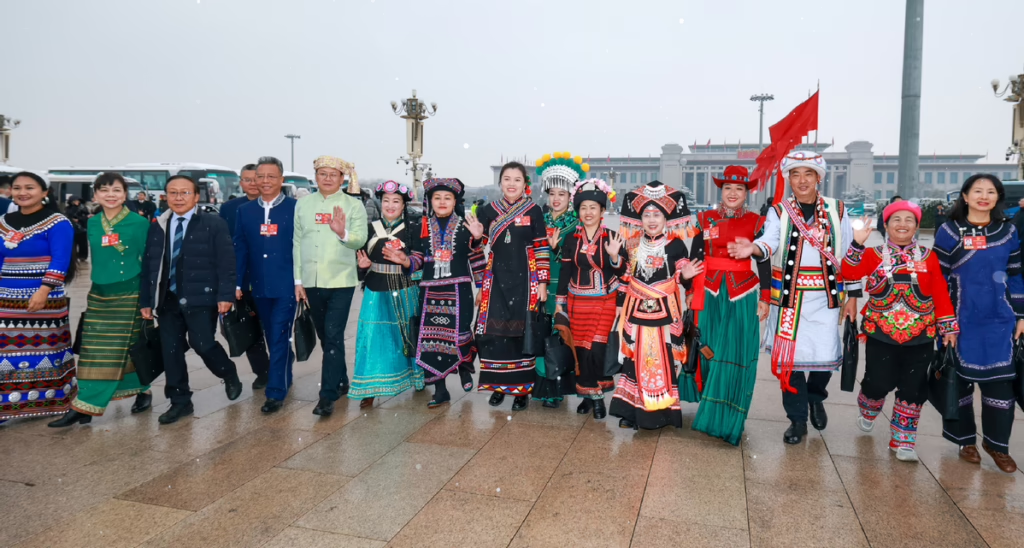
China’s new ‘Law on Promoting Ethnic Unity and Progress’, introduced on 12 March, formalises tightening ideological controls amid an intensifying and coordinated campaign to erase Tibetan identity.
From policy to statute: China’s new ethnic law
The PRC officially recognizes 55 ‘ethnic minority’ groups in addition to the Han Chinese majority. However, the very definition of ‘ethnic minorities’ or ‘nationalities’ in the PRC has been conceived by the state and does not reflect the self-identification of Tibetans, Uyghurs, or others who fall under this category – nor does the term convey the realities of their culture and history.[a]
It is not permitted in China to question the Party’s position that non-Han border regions, notably Xinjiang, Inner Mongolia and Tibet, belonged to the Chinese nation throughout history. Those who insist otherwise, basing their arguments on historical fact, are labeled as ‘separatists’. In Tibet, the PRC has developed systematic forms of repression and control in their efforts to insist – with no legal or historic basis – that Tibet was always a part of China.
Under Xi Jinping, who consolidated power in 2012, official policy has shifted decisively away from even nominal tolerance of distinct ethnic identities toward their active dissolution into a Party-defined cultural nationalism.[b] This so-called “second generation ethnic policy” approach emerged after critics within China suggested that ethnic distinctiveness and autonomous regions created the possibility of state disintegration, believing that China might share the fate of the former Soviet Union and Yugoslavia.
In both Tibet and East Turkestan (Xinjiang), the Chinese Party state now defines distinct ethnic identity and culture as existential threat to ‘social stability’ and national security—in effect, securitizing Tibetan and Uyghur ethnicity.[c] The underlying assumption is now one of ethnic guilt. For Uyghurs, this means that even just to bow one’s head in prayer is forbidden, and that fasting for Ramadan is banned.
The new law’s core concept is captured in the instruction that “forging the communal consciousness of the Chinese nation” is central to the Party’s ethnic policies, and it does so across education, religion, history, culture, tourism, media, and online.
During a visit to Tibet in 2021, Xi Jinping expressed the need for coercive assimilation through the metaphor of pomegranate seeds, saying that all ethnic groups must “remain closely united like the seeds of a pomegranate.” The imagery is deliberate, referring to surface diversity within an indivisible whole, controlled from the centre.
The March 2026 law is a watershed because it converts Xi’s political agenda into binding statute. Policies previously implemented through administrative directives, Party campaigns, and informal pressure now carry the force of national law, with enforcement mechanisms, criminal sanctions, and extraterritorial reach. The legislative journey of the new law demonstrates its importance. Last August, the Party revealed that the full Politburo had discussed a draft of the Law — the first such disclosure in almost four decades, according to the website NPC Observer.[6]
It is a sharp departure from the framework of the 1984 Regional Ethnic Autonomy Law, which specifically provided for education in Tibetan, Uyghur and other languages, and warned against majority Han chauvinism in an attempted reset after the devastation of the Cultural Revolution.[7]
In contrast, the new 2026 law mandates pre-school education in Mandarin, directs government authorities and private firms to give prominence to the display of Chinese characters over Tibetan or Uyghur in public settings, and instructs them to promote the “forging of national identity” as a component of all official work on families and family education.
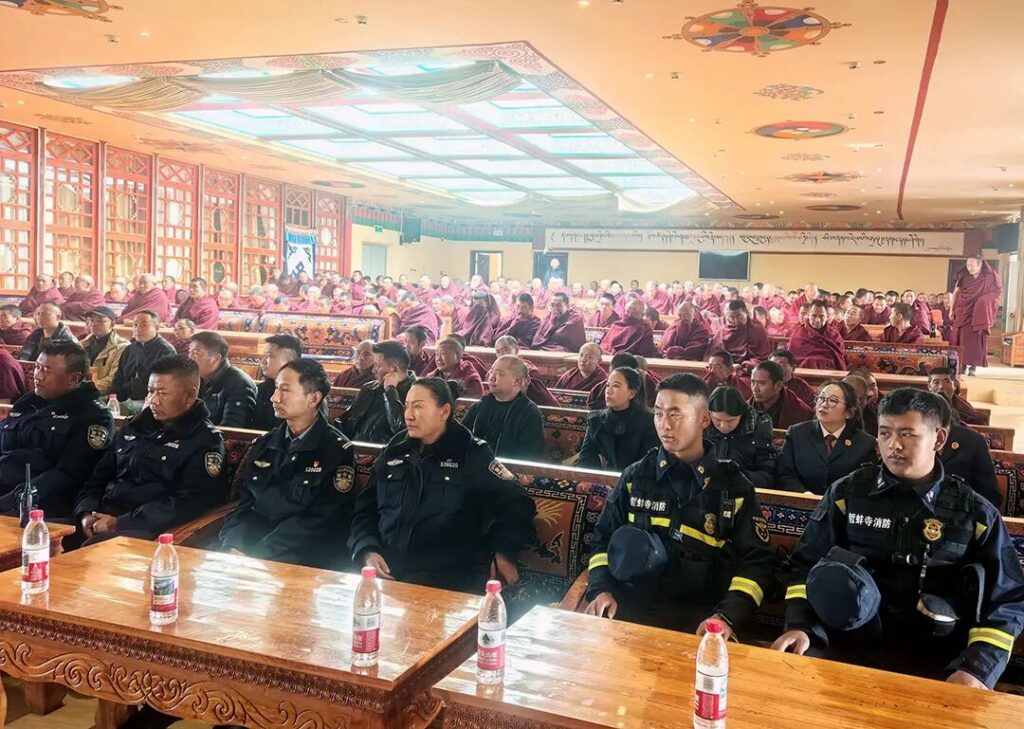
The United Front Work Department of the Lhasa Municipal Committee, in conjunction with relevant departments, organised activities at Drepung Monastery to promote the Chinese Constitution, the National Security Law, the Law on Promoting Ethnic Unity and Progress, and the Law on the General National Language and Script. 24 March 2026
Within days of the law’s introduction, the United Front Work Department of the Lhasa Municipal Committee organised activities at Drepung Monastery — one of Tibet’s most historically significant monastic institutions — to promote the new law alongside the National Security Law, demonstrating the securitisation of the religious environment. The choice of venue was a message to the monastic community that the law’s reach extends into the most protected spaces of Tibetan religious life.[8]
An architecture of erasure
Article 15 of China’s new law mandates Mandarin as the basic language of all education from preschool onwards, requires state organs to use Mandarin as the sole official language and script, and – where Tibetan language appears alongside Mandarin in public settings – requires Mandarin to be given visual prominence, and institutionally reinforced across schools, government, and media.
In their joint communication of 16 April, the eight UN Special Rapporteurs warned that the prohibition on anyone ‘obstructing’ citizens from learning Mandarin could be turned against educators, parents, or advocates who prioritise ethnic language instruction, and that this provision is against existing PRC regulations.[d]
Tibetan is the primary medium through which Buddhist scripture, oral tradition, traditional medicine and literature pass between generations. The canonical texts of Tibetan Buddhism, one of the most extensive philosophical and literary traditions in the world, exist in Tibetan. The lineages of teaching, commentary, and debate that animate monastic life are conducted in Tibetan. Removing it from the classroom and public spaces does not merely disadvantage Tibetans, it severs the intergenerational transmission of a civilisation.
Policies restricting Tibetan-medium education have been advancing for years. As early as 2010, Tibetan students were protesting the replacement of Tibetan-language instruction with Mandarin in secondary schools in Qinghai. Boarding schools separating Tibetan children from their families have expanded rapidly, and private schools teaching in Tibetan have been shuttered. Prominent, dedicated educators have been imprisoned. In December, Chogtrul Dorje Ten, head of Mintang Osel Thegchok Ling monastery and principal of Dorje Ten Nationalities Vocational Technical School in Chigdril (Jigzhi) county, Golog (Chinese: Guoluo), Qinghai, was detained, and the successful independent vocational school he founded, which served over 1,300 students, was abruptly closed.[9]
The 2026 law gives these suffocating restrictions the force of national statute, and removes any legal basis on which Tibetan educators or parents might contest them.
The assault on identity reaches into spaces more intimate still, including how parents name their children. Tibet Watch has learned that in one area of Ngaba (Chinese: Aba) in the Tibetan region of Amdo, present-day Sichuan,[e] children enrolling in state boarding schools have been ordered to abandon the name of Tenzin which is associated with the Dalai Lama, Tenzin Gyatso. His office has traditionally conferred it on newborns at their parents’ request.[f]
This mirrors what China has already done to Uyghur children. At least 29 names with Islamic cultural and religious associations, including ‘Muhammad’, have been prohibited under regulations targeting Uyghur naming practices.[10] The Party state is increasingly attempting to determine which identities are permissible before a child has even learned to speak.
A young Tibetan graduate from Kham who is now in exile but remains closely connected to the situation in the PRC told Tibet Watch: “At present, it is estimated that around 60 to 70 percent of young Tibetans under the age of 20 inside Tibet are unable to speak Tibetan fluently, and instead mix Chinese and Tibetan when they speak. In my view, this is not because they have no desire to learn or speak Tibetan — it is because an environment has been deliberately created in which Chinese language and Chinese-medium instruction surrounds them entirely.”
The former student added: “Since studying Tibetan at school has no bearing on grade advancement or university entrance examinations, students have no choice but to focus on Chinese instead. As mentioned above, even for specialist university students, all examinations and final theses must be written in Chinese — leaving no place for the Tibetan language whatsoever.”
Criminalising the family
Article 20 of the ‘Ethnic Unity’ law imposes legal obligations on parents directly, stating that parents and guardians “must not instil ideas in minors that are not conducive to improving ethnic unity and progress.”
In their formal statement to China made on 16 April, the UN Rapporteurs challenged China to clarify “what ideas are considered ‘not conducive to improving ethnic unity and progress’ that parents and guardians may not share with minors”, and to specify “what safeguards will be applied to prevent parents belonging to an ethnic community who educate their children in their minority language, culture, or religious traditions from being subject to sanctions under this provision.”[11]
In Tibet, criticism of government policy, advocacy for language rights, or expressing a distinctly Tibetan sense of historical and religious identity has been treated for years as endangering ‘ethnic unity.’ Article 20 brings this directly into the private sphere of the home, stating that parents and guardians are required to “educate and guide minors to love the Chinese Communist Party.”
Many Tibetans who took part in peaceful protests during the 1990s recall how they first learned at home of the injustices their families had endured during the invasion and the Cultural Revolution. Though they had never seen His Holiness in person, they understood from their parents what the Dalai Lama means to the Tibetan people. Today, however, as Xi Jinping seeks to instill the “red gene” in children as young as two, subjects such as the Dalai Lama and the teaching of Tibetan history have all become too dangerous to discuss, as well as the subtler transmission of a distinctly Tibetan sense of belonging.
“Because of the pervasive presence of government authorities at the local level, residential officials, and surveillance agents, infiltration exists everywhere,” a Tibetan graduate from eastern Tibet told Tibet Watch. “As a result, within villages, families, and among individuals — and even among people who know each other well or are closely related — it has become difficult to trust one another. This atmosphere has had a severe impact on social relationships and interpersonal connections.”
Speaking about Uyghur areas of the PRC, scholar Joanne Smith Finlay writes: “Having reconstructed the Uyghur body, mind, language, religion and culture as existential threats to the Chinese nation, the state is now using that threat to legitimate extraordinary and unprecedented interventions into Uyghur lives.”[12]
Engineering demography
The ‘ethnic unity’ law translates Xi’s concept of ‘ethnic mutual embedding’ – introduced in 2014 and elevated at the 2021 Central Conference – into concrete legal obligations. Articles 22 and 23 require county-level governments and above to incorporate ethnic integration into urban planning, housing policy, population management, employment, and social services.
The practical effect is to provide legal authority for policies already advanced in Tibet, notably the resettlement of Tibetan nomadic and rural communities into urban settlements, and the strengthening of Chinese Party cadre presence at a grass roots level.[h] These are engineered transformations designed to weaken the social bonds that sustain distinct Tibetan identity, and over time to make Tibet’s future a question about a population dispersed across a vast country rather than a people with a homeland.
Surveillance, media, and the public opinion war
The law’s obligations on media and digital platforms go beyond passive censorship: by requiring active algorithmic promotion of state-sanctioned ethnic narratives and mandating that internet service providers remove content deemed to undermine ‘ethnic unity’, the law converts the entire domestic information ecosystem into an instrument of public opinion warfare, directed both at the domestic population and, through the reach of Chinese-language media, at diaspora communities abroad.
Article 19 obliges all media – including online platforms – to promote ethnic unity and progress, and Article 31 encourages the use of modern technologies such as AI and big data to disseminate Party-approved narratives. Internet service providers are legally obligated to remove content deemed to undermine ‘ethnic unity’.
The entire domestic information ecosystem becomes an instrument of state narrative. And through the reach of Chinese-language media, that apparatus extends outward, into diaspora communities, into the spaces where Tibetans in the diaspora across Asia, the U.S. and Europe try to stay connected to home.
Emerging from a strategic framework adopted by the People’s Liberation Army (PLA) around 2003, the “Three Warfares” — psychological, media, and legal — are in practice operations designed to generate political power for the Chinese Communist Party. Their objectives include shaping perceptions abroad, sapping the strength and resilience of those perceived as opponents of the Party’s goals, and claiming the legal high ground — thereby deterring opposition and reducing the need for costly combat.[h]
The impacts are compounded by both the chilling effects of almost total surveillance, and the opaque nature of language in what constitutes a ‘crime’.
As the UN Rapporteurs observe, Article 58 criminalises violations without defining what constitutes a violation or specifying what punishment it would entail. This deliberate vagueness is consistent with Three Warfares doctrine as described in PLA literature, which holds that legal warfare should be used to “delegitimise an adversary” and create psychological deterrence.
This approach follows the pattern established by China’s counter-terrorism legislation in 2016.[13] By conflating “terrorism” with an undefined “extremism” linked to religion, the Counter-Terrorism Law of the PRC created scope to penalise almost any peaceful expression of Tibetan identity, non-violent dissent, or criticism of ethnic and religious policies – in a political climate in which the exiled Dalai Lama has been accused of inciting terrorism (China blamed him for a wave of self-immolations in Tibet from 2009). In Xinjiang, the Chinese state appropriated the language of the “war on terror” and labelled Uyghur opposition “religious extremism” to generate diplomatic capital for the ongoing repression of minority aspirations and to justify more forceful intrusions by the state security apparatus, a dynamic now formalised at the national level by the 2026 law.
Security scholar Professor Michael Clarke points out that the application of Three Warfares doctrine to ethnic minority governance demonstrates China’s deliberate blurring of the lines between ‘national security’ and ‘regime security.'[14] The 2026 law is an instrument for achieving strategic objectives — suppressing Tibetan, Uyghur, and Mongolian identity, projecting Chinese legal authority abroad, and doing both while presenting an external face of lawful, ‘minority’-protective governance.
The reach beyond China’s borders: Article 63
Article 63 of the law states that organisations and individuals outside the PRC who engage in acts deemed to “undermine ethnic unity” or “foment ethnic division” shall be held “legally accountable”. It demonstrates how China has moved from direct repression in Tibet to a matrix of control extending well beyond its borders, targeting diaspora communities of Tibetans, Uyghurs, Mongolians and their overseas supporters.
The Chinese international student whose sentencing to six years in prison was reported this week had attended two solidarity protests in Australia with Tibetans and Uyghurs.[i]

Zhang Yadi, also known as Tara, disappeared in July 2025 while on a visit home to see family. She was an international student due to start a course at SOAS, University of London.
Another Chinese international student, Zhang Yadi, disappeared in July while on a visit home to see family, and is believed to be being held in a detention centre in her home city of Changsha, in central China on suspicion of “inciting separatism”. Growing up a Buddhist, Zhang Yadi became increasingly interested in the Tibetan form of the religion at high school in China, began practising it soon afterwards, and became concerned about the problems affecting Tibetans, Uyghurs and Mongolians. She was writing for a platform promoting dialogue and cultural exchange, not ‘separatism’. The new law seeks to describe such actions as illegal.
In their formal communique to China last week, the UN Rapporteurs state that as acts that ‘undermine ethnic unity and progress or create ethnic division’ are not clearly defined, ‘the Law could position any external criticism or minority advocacy as hostile acts against the State.’ They further warned that Article 10 limits engagement on issues related to ethnic unity by prohibiting perceived ‘foreign forces’ from interfering, suggesting that human rights cannot be invoked to challenge China’s efforts — raising the risk that any human rights-based analysis of the law could itself be “negatively framed and mischaracterized as foreign interference.”
The Chinese government remains the most prolific perpetrator of transnational repression worldwide committing – at a conservative estimate by Freedom House – 272 incidents, or 22 percent, of recorded cases out of 1,219 total incidents by 48 governments across 103 countries between 2014 and 2024.[15] Article 63 gives that practice a new statutory foundation. Where before, repression abroad relied to an extent on administrative improvisation and deniable coercion, it now rests on PRC enacted law.
The prosecution cannot physically reach a Tibetan activist in London. But it can be used to target family members remaining in Tibet, and it can justify cyber operations against diaspora organisations. It can build dossiers on individuals for use if they travel home to see families, or to a country within China’s reach. It can function as a constant, low-level threat that does not need to be enforced to be effective.
A disturbing parallel: the National Security Law
The 2020 Hong Kong National Security Law established a disturbing precedent for the new Ethnic Unity Law. The NSL created four broadly defined criminal offences — secession, subversion, terrorism, and colluding with foreign forces — carrying sentences of up to life imprisonment, and applied extraterritorially to any breach of its provisions “by anyone, anywhere in the world.”[16]
Article 38 of the National Security Law applied criminal penalties for vague political offences globally, regardless of whether individuals had any substantial connection to Hong Kong. The chilling effect was immediate. Individuals and international organisations scrambled to adapt to China’s increasing extraterritorial reach, a number of organisations closed down entirely, and the exodus of refugees from Hong Kong increased.
Both the NSL and the Ethnic Unity law deploy the same legal warfare architecture: vague offence categories capable of expansive interpretation, long-arm extraterritorial jurisdiction, and the criminalisation of speech and advocacy abroad that would be entirely lawful in any liberal democracy. Taiwan’s officials have explicitly described Article 61 of the Ethnic Unity Law as “long-arm jurisdiction”, noting that it mirrors the extraterritorial provisions of the Hong Kong NSL, under which authorities issued bounties for 34 overseas activists.[17]
Chloe Cheung, who lives overseas, is among those pro-democracy activists charged by Hong Kong authorities with national security offences and subject to arrest warrants. Twenty-year old Cheung said her life completely changed when China put a HK$1 million (around £100,000) bounty on her head, saying: “I have to change my route every day, I have to look over my shoulder every day and I have to look at reflections on the street to make sure no one is following me. I have to be really careful when I meet new people as they could be a spy. I can’t tell people where I live. I can’t bring friends to my home.”[18]
Where the NSL targeted Hong Kong’s political opposition, the Ethnic Unity Law reaches further into the cultural, linguistic, religious, and family life of Tibetans, Uyghurs and Mongolians, and outward into their diaspora communities across the world.
A race against time: language, culture, and what survives
Inside Tibet, the new ‘ethnic unity’ law accelerates the consequences of language policy that are already visible in family life. A Tibetan graduate from eastern Tibet told Tibet Watch what is happening to the younger generation from personal experience: “In my own family, we have a small daughter. For her, speaking Chinese has become easier than speaking Tibetan, and she is no longer able to express herself fluently in Tibetan. Many others are in the same situation.”
But the same source described a counter-effect too. “In the past, many Tibetans — especially those who were literate and educated — used Chinese when posting on social media or communicating with one another. However, due to the recent education policies, Tibetans have been pushed to a breaking point. These policies have generated deep concern and pressure, but they have also led people to rediscover the urgent importance and value of the Tibetan language and script. Nowadays, even Tibetans living within China’s cities tend to post at least a few words or a small image in Tibetan on social media, and a trend has emerged in which people even write their own names in Tibetan on social media. In a way, these policies may unintentionally become a wake-up call that pushes Tibetans to become more conscious and aware.”
It is a fragile resistance, and the pressures working against it are structural and now statutory. The same Tibetan source, however, was direct about the longer horizon, saying: “I do not accept the idea that Tibet will disappear or be completely absorbed into Chinese as a result of this policy. On the contrary, I see the potential for Tibetan culture, traditions, and customs to exert influence on Chinese society and the international community. The main channels for protecting, preserving, and promoting Tibetan culture are arts, music and performing arts, writings, monasteries, and monastic institutions. These are the pillars of Tibetan culture.”
What China cannot manufacture, and what the 2026 law cannot compel, is the loyalty of people who know the difference between what is installed and what is real. A Tibetan Buddhist monk, now living in exile in India, told Tibet Watch: “There was a portrait of the Chinese-recognised Panchen Lama on the main throne of Tashi Lhunpo Monastery. I went past the throne and visited the bedroom of the previous Panchen Rinpoche, and his memorial stupa. Then I went back to Lhasa and planned my escape journey from Tibet.”
What governments should do
The 2026 law is built from a military doctrine, serves strategic objectives, and carries real consequences for people living in democratic countries as well as in Tibet.
For the UK government, the law requires a formal response. Article 63’s extraterritorial jurisdiction is a component of state-directed transnational repression — the pattern that the Defending Democracy Taskforce exists to address. It should be assessed as such, raised through bilateral diplomatic channels with Beijing, and brought formally to the attention of the UN Human Rights Council. UK asylum and refugee decision-making should recognise the elevated risk created by the law for Tibetan, Uyghur, and other applicants who have engaged in cultural or political expression in this country.
The law is a test of whether the international community is willing to engage with what is actually happening — not the face Beijing presents, but the mechanism underneath it.
As a matter of urgency, the UK government should raise the case of Chinese international student Zhang Yadi, who faces criminal charges for simply defending Tibetan culture, promoting dialogue between Tibetans and Chinese, and practising Buddhism, with China at the highest levels.

Endnotes:
Citations
[1] ‘Coordinated campaign in Dalai Lama birthday year targets influential monks, Buddhist monasteries’, Tibet Watch, 9 September 2025, https://tibetwatch.org/coordinated-campaign-in-dalai-lama-birthday-year-targets-influential-monks-buddhist-monasteries/
[2] Joint Communication to the Ambassador for China, Mandates of the Special Rapporteur on minority issues et al., OL CHN 5/2026, 16 April 2026, https://spcommreports.ohchr.org/TMResultsBase/DownLoadPublicCommunicationFile?gId=30922
[3] ‘Chinese international student who promoted Tibetan culture faces criminal charges’, Tibet Watch, 23 September 2025, https://tibetwatch.org/chinese-international-student-who-promoted-tibetan-culture-faces-criminal-charges/
[4] ‘Student allegedly jailed in China for six years after taking part in pro-democracy protests in Australia’, The Guardian, 21 April 2026, https://www.theguardian.com/australia-news/2026/apr/21/student-allegedly-jailed-china-after-pro-democracy-protests-australia
[5] ‘Ethnic Unity and Progress Law’, China Law Translate, 12 March 2026, https://www.chinalawtranslate.com/en/ethnic-unity-and-progress-law/
[6] NPC 2026: China Enshrines Xi-Era Ethnic Policy in New Law’, NPC Observer, last updated 12 March 2026, https://npcobserver.com/2026/03/05/china-npc-2026-ethnic-assimilation-unity-law/
[7] ‘Regional Ethnic Autonomy Law of The People’s Republic of China (Chinese and English text), United States of America Congressional-Executive Commission on China, 31 May 1984, https://www.cecc.gov/resources/legal-provisions/regional-ethnic-autonomy-law-of-the-peoples-republic-of-china-amended
[8] Published by the United Front Work Department of Lhasa, 24 March 2026, http://www.xztzb.gov.cn/zongjiao/1774348069847.shtml
[9] ‘Prominent Buddhist Lama and educator detained; school forced to close’, Tibet Watch, 12 December 2025, https://tibetwatch.org/prominent-buddhist-lama-and-educator-detained-school-forced-to-close/
[10] ‘Ban on “Islamic” names an absurd intrusion into Uyghurs’ private lives’, Uyghur Human Rights Project, 4 May 2017, https://uhrp.org/report/briefing-ban-islamic-names-absurd-intrusion/
[11] OL CHN 5/2026, 16 April 2026, https://spcommreports.ohchr.org/TMResultsBase/DownLoadPublicCommunicationFile?gId=30922
[12] ‘Securitization, insecurity and conflict in contemporary Xinjiang: has PRC counter-terrorism evolved into state terror?’, Joanne Smith Finley, Central Asian Survey, 11 March 2019, https://www.tandfonline.com/doi/full/10.1080/02634937.2019.1586348
[13] ‘China’s first counter-terror law and its implications for Tibet’, International Campaign for Tibet, 7 January 2016, https://savetibet.org/chinas-first-counter-terror-law-and-its-implications-for-tibet/
[14] ‘China’s Application of the ‘Three Warfares’ in the South China Sea and Xinjiang’, Michael Clarke, Orbis, vol. Spring 2019, 18 June 2019, https://www.fpri.org/article/2019/06/chinas-application-of-the-three-warfares-in-the-south-china-sea-and-xinjiang/
[15] ‘Ten Findings from Ten Years of Data on Transnational Repression’, Grady Vaughan, Yana Gorokhovskaia, & Nate Schenkkan, Freedom House, 6 February 2025, https://freedomhouse.org/article/ten-findings-ten-years-data-transnational-repression
[16] ‘Hong Kong’s National Security Law’, Antony Dapiran, The China Story, 2021, https://www.thechinastory.org/yearbooks/yearbook-2020-crisis/forum-down-and-out-in-hong-kong/hong-kongs-national-security-law/
[17] ‘Taipei Warns China’s New ‘Ethnic Unity’ Law Creates Legal Framework to Target Taiwanese Independence Supporters’, Asia Daily, 12 March 2026, https://asiadaily.org/news/12909/
[18] ‘The Exiles: Bounties and threats’, Henry Vaughan, Sky News, 22 September 2025, https://news.sky.com/story/i-dont-feel-safe-in-uk-the-exiles-with-100k-bounties-on-their-heads-13433909
Context Notes
[a] In Chinese, ‘ethnic minority’; has translated to shăoshù mínzu (少数民族) with mínzú (民族) meaning ‘nationality’; or ‘nation’ (as in ethnic group) and shăoshù (少數) meaning ‘minority’. This concept followed the Soviet practice under Stalin of identifying ‘nationalities’ in the sense of ethnic groups. An official process of classifying ethnicities began in the 1950s. After the break up of the Soviet Union, there was a shift in conceptions of ‘minorities’ in China. Officials warned of threats to the Party state from ‘minority groups’ whose societies often had a separate sense of identity, history or territory. Rather than defining them as ‘nationalities’, they became known as ‘ethnic groups’, focusing on their identity only in relation to the majority Han Chinese within PRC boundaries. These changes were reflected in official language – for instance, the official journal ‘Minzu Tuanjie’ changed its English name from ‘Nationality Unity’ to ‘Ethnic Unity’ in 1995. Similarly, the shift from the term the ‘Chinese people’ (中国人民 or Zhōngguó rénmín) to ‘Zhonghua minzu’ (Chinese: 中华民族, Chinese nation) indicated the transition in CCP-speak towards the concept of a multi-ethnic Chinese nation state with one single Chinese identity. This numbers among Xi Jinping’s ‘five identifications’ to guide people of all ‘ethnic’ groups together with the ‘great motherland’, Chinese culture, the Chinese Communist Party and ‘socialism with Chinese characteristics’.
[b] In his first two years in office, Xi Jinping chaired no fewer than eight gatherings of the Politburo or PBSC on ethnic work, including this May’s Second Central Work Forum on Xinjiang, while also personally touring ethnic minority communities in Gansu (February 2013), western Hunan (November 2013), Inner Mongolia (January 2014) and Xinjiang (April 2014). The State Ethnic Affairs Commission (SEAC) has even created a special website to highlight Xi and other PBSC members’ activities on ethnic affairs. James Leibold in the Jamestown China Brief, 11 July 2014, https://jamestown.org/a-family-divided-the-ccps-central-ethnic-work-conference/
[c] State securitisation can be considered in a broad sense, including not just obvious manifestations like increased deployment of military and public security personnel but also demographic securitization (accelerated Han in-migration, ethnic displacement), linguistic securitization (imposition of Chinese-medium education) and religious securitization (repression of Buddhist and Islamic practices). See Joanne Smith Finlay, “Securitization, Insecurity and Conflict in Contemporary Xinjiang: Has PRC Counter-Terrorism Evolved into State Terror?” Central Asian Survey 38, no. 1 (2019): 1–26.
[d] The statement, published on 16 April, was made by the following Special Rapporteurs and experts: Nicolas Levrat, Special Rapporteur on minority issues, Alexandra Xanthaki, Special Rapporteur in the field of cultural rights, Surya Deva, Special Rapporteur on the right to development, Farida Shaheed, Special Rapporteur on the right to education, Irene Khan, Special Rapporteur on the promotion and protection of the right to freedom of opinion and expression, Gina Romero, Special Rapporteur on the rights to freedom of peaceful assembly and of association, Balakrishnan Rajagopal, Special Rapporteur on adequate housing as a component of the right to an adequate standard of living and on the right to non-discrimination in this context and Nazila Ghanea, Special Rapporteur on freedom of religion or belief. They stated: “We observe that the Law could restrict minority language education. Article 15 requires the State to “fully promote the spread of the nation’s common language and script,” while “[s]chools and other educational institutions are to use the nation’s common language and script as the basic language and script for education and teaching.” This provision appears to contradict the rights set forth in article 37 of the Law of the People’s Republic of China on Regional National Autonomy, which provides for the use of textbooks in minority languages in schools and that such languages can be used as a medium of instruction. The requirement in the newly adopted Law that minority languages be subordinate to Mandarin “in position, order, and so forth” in public settings reinforces linguistic hierarchy.” Statement: https://spcommreports.ohchr.org/TMResultsBase/DownLoadPublicCommunicationFile?gId=30922
[e] Information from a source close to Tibet Watch indicates that this occurred in Rongwam Township (རོང་ཝམ་ཡུལ་ཚོ།).
[f] The first known instance of this conferral was his younger brother, Tenzin Choegyal or Ngari Rinpoche, who passed away in February at his exile residence in Dharamsala. Tibet Watch, 19 February 2026, https://tibetwatch.org/ngari-rinpoche-youngest-brother-of-the-dalai-lama-passes-away/
[g] Article 49 states: “The state is to implement the requirement of forging a strong sense of the community of the Chinese people throughout the entire process of training, selection, employment and management of cadres, strengthen the construction of cadre teams in ethnic minority areas, and attach importance to the training and use of ethnic minority cadres.”
[h] Guidelines to the PLA’s Political Work Regulations tasked the General Political Department with three new offensive aspects of wartime political work: public opinion warfare (舆论战), psychological warfare (心理战), and legal warfare (法律战). See:
‘The Three Warfares: China’s Political Warfare Doctrine’, Stewart Aaron McGurk, Stanford Digital Repository, 15 December 2017, https://purl.stanford.edu/yx245st1937
’Cognitive Combat: Understanding China’s Three Warfare Doctrine’, Taha Ali, 3 June 2025, https://www.geojuristoday.in/post/cognitive-combat-understanding-china-s-three-warfare-doctrine
‘China’s Three Information Warfares’, Major Morgan Martin, Proceedings, vol. 147/3/1,417, March 2021, https://www.usni.org/magazines/proceedings/2021/march/chinas-three-information-warfares
[i] The Guardian reported on 21 April 2026 that the Australian government has been urged to take stronger action to protect Chinese international students from political repression by authorities on their return after a Chinese student, who was not named in the article, was allegedly sentenced to six years’ imprisonment for joining pro-democracy protests in Australia. The Guardian reported: “A representative of the student’s family in Australia told the Guardian that the student was arrested and charged with secession for participating in pro-democracy protests in Sydney, including two solidarity protests for China’s ethnic minorities.” https://www.theguardian.com/australia-news/2026/apr/21/student-allegedly-jailed-china-after-pro-democracy-protests-australia