30 April 2026
‘From the land of snow, with hands folded in faith, I await the noble one, the protector whose eyes never close.’
Verse posted by monk Samten Gyatso prior to his imprisonment
Summary
Tibet Watch has documented a cluster of cases from across Tibet that reveal an intensifying pattern of repression targeting Tibetans for acts that belong to the ordinary cultural, religious and intellectual life of a Tibetan community. This report documents cases of Tibetan political prisoners who are in critical condition after torture, poor health after release from prison, or who have been ‘disappeared’. They show a system that is methodical, opaque and increasingly punishing even of private expressions of Tibetan identity.
- Monks Samten Gyatso and Jamyang Samten were detained by local Chinese police more than a year ago, and their families and monastery have no idea where they are or even if they are alive.
- Zeyga Gyatso, a prominent Tibetan language teacher and monk, was forcibly ‘disappeared’ for six months, and his family subjected to repeated harassment, interrogation and surveillance. He was released in very poor health, with eye problems that may be the result of prolonged exposure to strong lights during interrogation at a police facility in Xining.
- Yeshe Zangpo, who was involved in a peaceful protest in 2007 to protect Tibetan language learning, was released with serious ill-health on 25 March after serving a full 18-year sentence in a prison whose location was unknown to his family.
- Teacher and popular leading writer Gangkye Drubpa Kyab, whose articles include one entitled “Pain of this era”, is in critical health after enduring “cruel and inhumane” torture during a 14-year prison sentence, according to new information received by Tibet Watch. He has not been allowed a visit from his family since 2024.
- Tsering Dolma, who was sentenced to eight years alongside Drubpa Kyab in September 2022, sustained broken bones following beatings by police at the time of her arrest in April 2021, and continues to suffer severe pain and a cardiac condition.
Demonstrating a deepening crisis in Tibet rather than a series of isolated incidents, these developments include:
- An apparently intensifying pattern of enforced disappearance: families and monasteries are not informed of arrests, charges are not disclosed, and prisoners are held for months or years with no confirmed location.[1] In several cases, even the date of detention is unknown more than a year after it occurred.
- The conduct being criminalised has narrowed to the most intimate expressions of Tibetan cultural and religious life — a photograph of the Dalai Lama on a phone, a poem posted on WeChat, the teaching of Tibetan language, the possession of a book.
- Torture and the deliberate denial of medical care are producing prisoners who emerge with permanent physical and cognitive injury, or do not emerge at all.
- Release does not mean the end of state control: surveillance, coerced written pledges, and cycles of re-arrest mean that individuals remain effectively imprisoned long after they leave custody.
- Punishment affects the family and friends of a prisoner; family members of tortured or disappeared Tibetans have themselves fallen ill, suffered severe depression, or died, as a direct consequence of state-imposed silence and actions.
A pattern of oppression
The cases set out in this report span three Tibetan regions — Kanlho (in today’s Gansu Province), Tsolho (in Qinghai Province), and Kardze (in Sichuan Province). The individuals come from different walks of life: two are monks at a remote monastery in Machu County; one is a monastic language teacher; one is a writer and former schoolteacher; one is a woman who protested against Chinese policies; one is a villager who took part in a language rights demonstration nearly two decades ago. What links them is a shared experience of the Chinese Party state’s tightening grip on simply being Tibetan.[2]
The Chinese authorities have long prosecuted Tibetans for acts of visible dissent such as protests or self-immolations. The cases in this report show something that is harder to see from outside: the criminalisation of private, domestic and everyday expressions of Tibetan culture and faith, as a result of Xi Jinping’s policies of forced assimilation. They document a methodical tightening of the boundaries of permissible Tibetan life.
Monks Samten Gyatso and Jamyang Samten: enforced disappearance, detention without notification
Samten Gyatso and Jamyang Samten, both monks of Chukha-Ma Monastery in Machu (Chinese: Maqu) County, Kanlho Tibetan Autonomous Prefecture in the Tibetan area of Amdo, were taken into custody by local Chinese police more than a year ago. As of April 2026, they remain held incommunicado. Their families and their monastery know that they were arrested but have been unable to establish where the two men are, what they have been charged with, or whether they are alive and well. The exact date of their arrests is itself unknown — a measure of how comprehensively the Chinese authorities have sought to silence any outside scrutiny.
The two detentions followed different methods, according to Tibetan sources, both of which have become common features of disappearances in Tibet. One monk was taken directly from the monastery. The other was lured to a local police station under the pretext of collecting a mobile phone that had previously been confiscated, and was not released.
The full reasons behind the current detention of the two monks are not known, and ongoing surveillance has made it extremely difficult for anyone in the monks’ community to make contact with them or to monitor their situation. Tibetan sources have indicated a possible connection to images on the monks’ phones during a police search, which may have included a depiction of the Tibetan ‘snow lion’ flag, which is banned in Tibet.
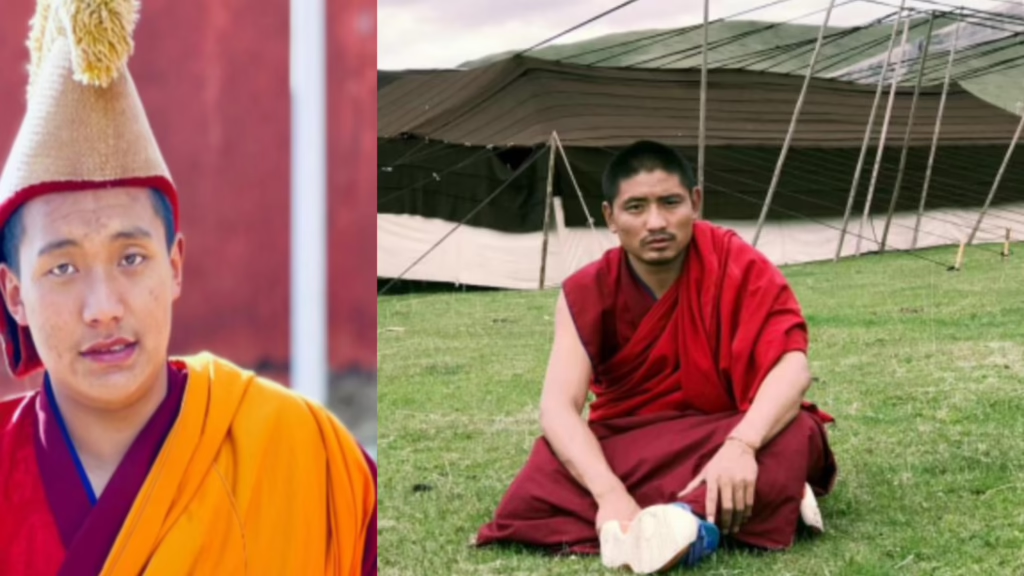
Samten Gyato (left) and Jamyang Samten (right).
Both men had been detained and interrogated multiple times in previous years based on various accusations against them.
Photographs or images of the Dalai Lama are enough to trigger police investigations. When the monastic quarters of Samten Gyatso were raided, a copy of a book entitled ‘The Buddha Came to the Land of Snow’ was confiscated.
On the anniversary of the Dalai Lama’s receipt of the Nobel Peace Prize on 10 December in 2017, Samten Gyatso had posted a short tribute on WeChat, for which he was summoned to a police station and severely interrogated. The four-line verse read: “From the land of snow, with hands folded in faith, I await the noble one, the protector whose eyes never close.”
He was released on that occasion. The later, ongoing detention for which there is no information is the second, more severe, consequence of the same pattern, according to Tibet Watch sources.
Jamyang Samten had previously been arrested on charges that he had created a WeChat group to share public announcements and had published a book without government authorisation and without an ISBN, according to Tibet Watch sources. Inside the PRC, all legally distributed books must carry a state-issued ISBN. The practical effect is that Tibetan religious and cultural material produced outside official channels, including material produced by monasteries for their own internal use, can be criminalised as illegal publication at any time.
Zeyga Gyatso, monk and Tibetan language teacher
Zeyga Gyatso, a 48-year-old monk from Tsang Monastery in Tsolho (Hainan Tibetan Autonomous Prefecture) in present-day Qinghai, the Tibetan area of Amdo, was taken into custody by Chinese security police around 2 July 2025 in the city of Xining. For the six months that followed, he was held incommunicado and released on 2 January (2026).
Before his arrest, Zeyga Gyatso had served as a Tibetan language teacher at Tsang Monastery’s Five Sciences School. The eldest of six siblings, he travelled to India in 2002, where he studied for approximately a year at Sera Monastery before returning to Tibet in 2003. Such study trips carry particular risks for Tibetan monks; time at monastic institutions in India usually involves attending religious teachings by the Dalai Lama, whom Beijing denounces as a “splittist,” and monks who have studied abroad frequently return to heightened suspicion and surveillance from Chinese authorities. After his return, Zeyga Gyatso continued his education at Ragya Sherig Norling School.
Since the arrest of a relative, Khedrub Gyatso, in 2008, he and other members of his family had been subjected to repeated harassment, interrogation and surveillance.[3]
Although it is not possible to ascertain full details, Zeyga Gyatso is now in very poor health, suffering from joint pain and eye problems, according to Tibet Watch sources. Tibetans familiar with conditions in Chinese police facilities believe his eye problems may be the result of prolonged exposure to strong lights during interrogation at a police facility in Xining.
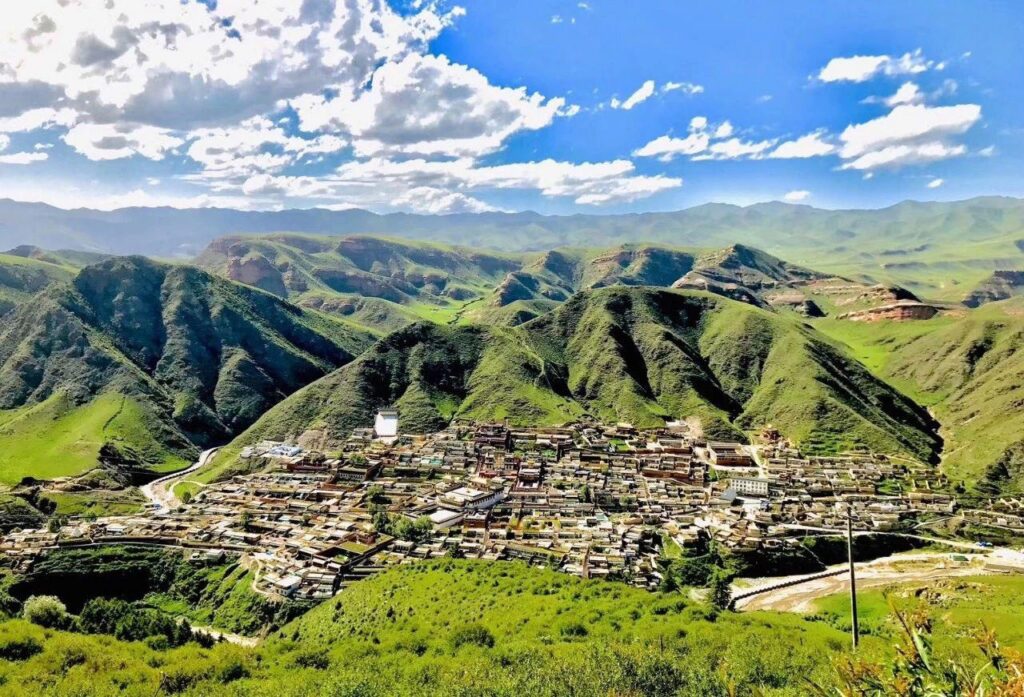
Tsang Monastic School (གཙང་དགོན་བཀྲ་ཤིས་རབ་བརྟན་གླིང་།), where Zeyga Gyatso worked as a Tibetan language teacher.
Three days after Zeyga Gyatso’s release, he was summoned back to Xining and required to sign a document pledging not to engage in any activities contrary to the wishes of the Chinese government. He was then permitted to return to his monastery in time for Losar, the Tibetan New Year, although his daily movements continue to be closely monitored.
The written pledge is a particular feature of post-release control in Tibet. It converts the former prisoner into an ongoing subject of conditional liberty; any activity the authorities later deem contrary to their wishes becomes both a political act and a breach of the signed undertaking. The pledge is often the only document in the entire arc of a detention that the individual is permitted to see or sign.
Gangkye Drubpa Kyab
Gangkye Drubpa Kyab, also known by the pen name Gang Methak (meaning Snow Flower) or Gangkye (Born From Snow), is among the most prominent Tibetan writers of his generation, with work published across Tibetan-language magazines and books. He was first detained in February 2012, when 20 police officers burst into his home.[4]
Gangkye Drubpa Kyab had been a teacher in Serthar County, Sichuan Province, for ten years, and is a well-known and popular writer in Tibet, authoring such pieces as: “Call of Fate”, “Pain of This Era” and “Today’s Tears of Pain”. His writings include a book about the suffering endured by Tibetans as a result of the violent crackdown following protests that swept across Tibet in 2008.
Gangkye Drubpa Kyab’s current imprisonment followed a raid on his home on 23 March 2021. In September 2022 he was sentenced to 14 years on charges of “inciting separatism” and “endangering national security”.[5]
Gangkye Drubpa Kyab’s condition is now critical, according to new information received by Tibet Watch. According to the source, the torture to which he has been subjected in Chinese prison has been “cruel and inhumane”. He suffers from cardiac and renal conditions, vision problems, amnesia and digestive complications. His family was permitted a single visit in 2024, when he was believed to be held at Sichuan Mianyang Prison. All visits since then have been denied. It cannot now be confirmed whether he is still held at the same prison, or whether — as has happened in other cases — he has been moved, which sometimes happens in the case of a well-known political prisoner.
In 2012, the writer’s arrest came less than three weeks after security forces opened fire on peaceful protesters in Serthar town, killing two. He was held incommunicado for 18 months, leaving his family completely in the dark on his location or wellbeing between the time of his arrest and sentencing.
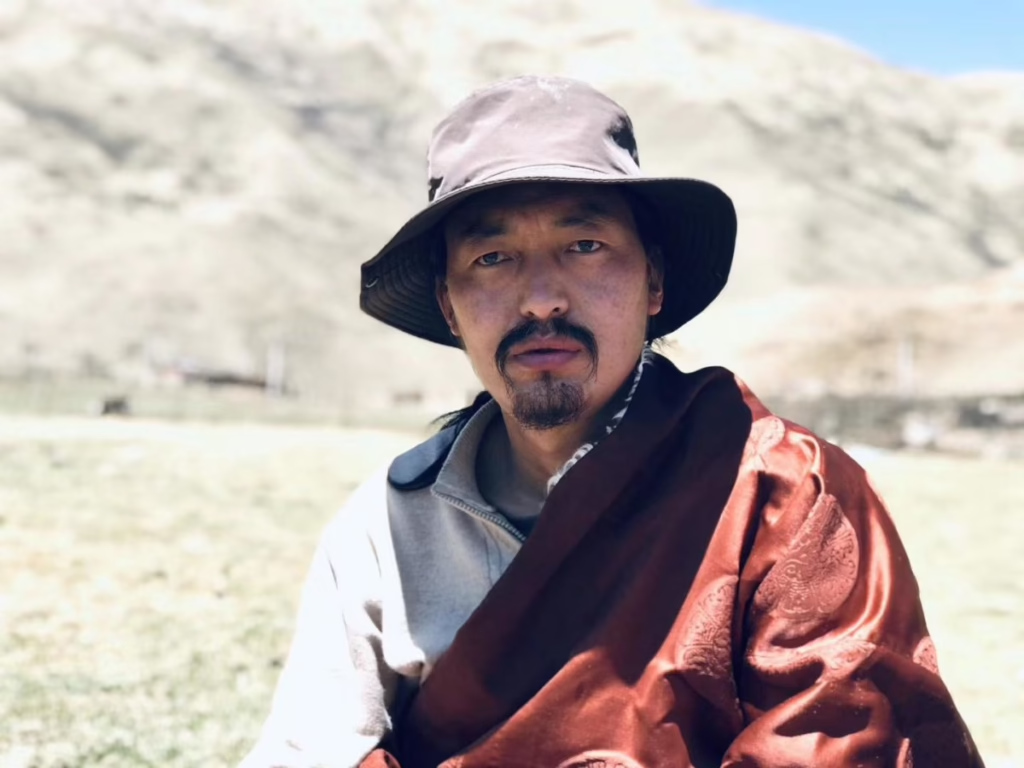
Gangkye Drubpa Kyab
Gangkye Drubpa Kyab was released in September 2016, but he was taken into custody again for 17 days, accused of placing a photograph of the Dalai Lama on his head, a traditional gesture of reverence, and after attending a reception in his honour, with Chinese authorities urging him to “change his thoughts.”[6]
Drubpa Kyab was born in Ki-Phen village, Rag-Tam Township, Serthar County, in Kardze (Chinese: Ganzi), Sichuan (the Tibetan area of Kham). He is married to Wangchuk Lhatso and has a daughter and a son, now in their late teens and early twenties. His 14-year sentence runs until the mid-2030s.
Tsering Dolma
Tsering Dolma, sentenced to eight years alongside Drubpa Kyab in September 2022, is also reported to be in critical health. According to Tibet Watch’s source, she sustained a broken hip or pelvic bone from beatings administered by Serthar County police at the time of her arrest in April 2021, and continues to suffer severe pain. She has since developed memory instability, a cardiac condition and, according to other reports, epileptic seizures. Her current location is not known.
Tsering Dolma, originally from Kangsta village in Serthar, Kardze, the Tibetan area of Kham, was previously arrested in 2008 alongside her father, and again in 2012, for participating in protests against Chinese rule. Between detentions, her movements were restricted through mandatory village registration. She is a mother of two sons.
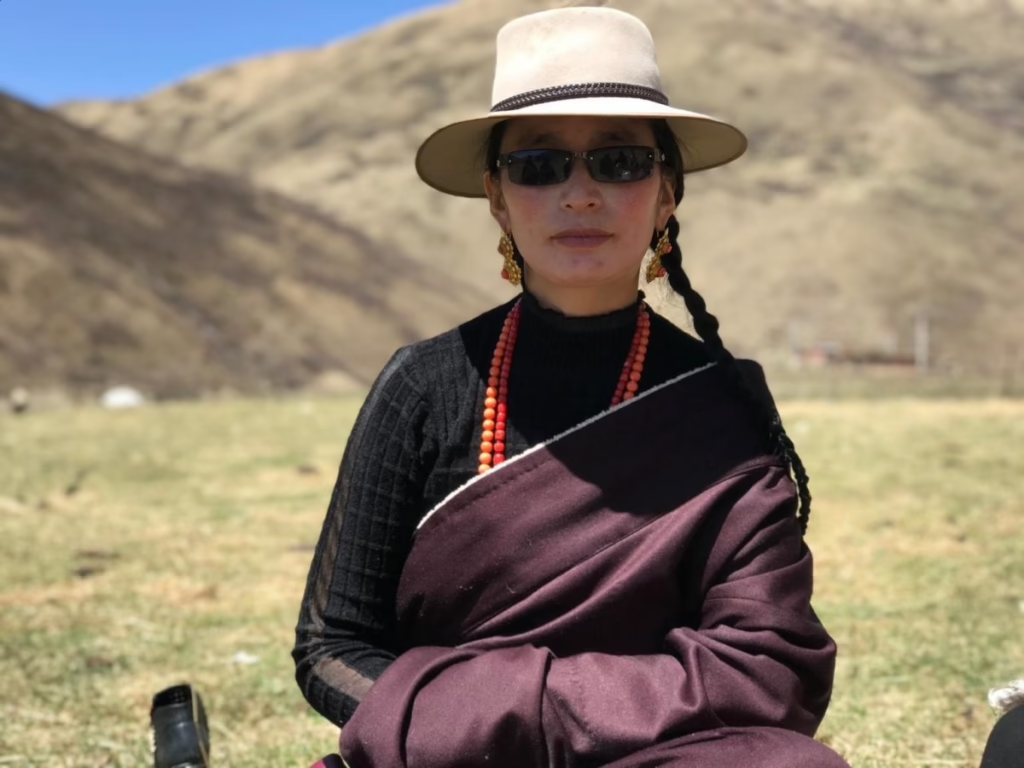
Tsering Dolma
Yeshe Zangpo
Yeshe Zangpo, 58 years old, from Bum-Nying village in Sershul County, in the Kham Kardze region of eastern Tibet, was released on 25 March 2026 after serving a full 18-year sentence. He was released in seriously poor health. The prison in which he was held and the court that sentenced him both remain unknown to his wife Tsering Dolma and family, who waited for him to return home for 18 years.
Yeshe Zangpo’s original arrest stemmed from a 2007 protest in Sershul County, at which he and his brother Lobsang, along with dozens of local Tibetans, demanded the right to freely teach and learn the Tibetan language. Chinese police severely beat the protesters, triggering a violent confrontation. Yeshe Zangpo was detained for several months, accused by local authorities of causing the death of a police officer and leading the protestors. He was sentenced to 18 years in May 2008.
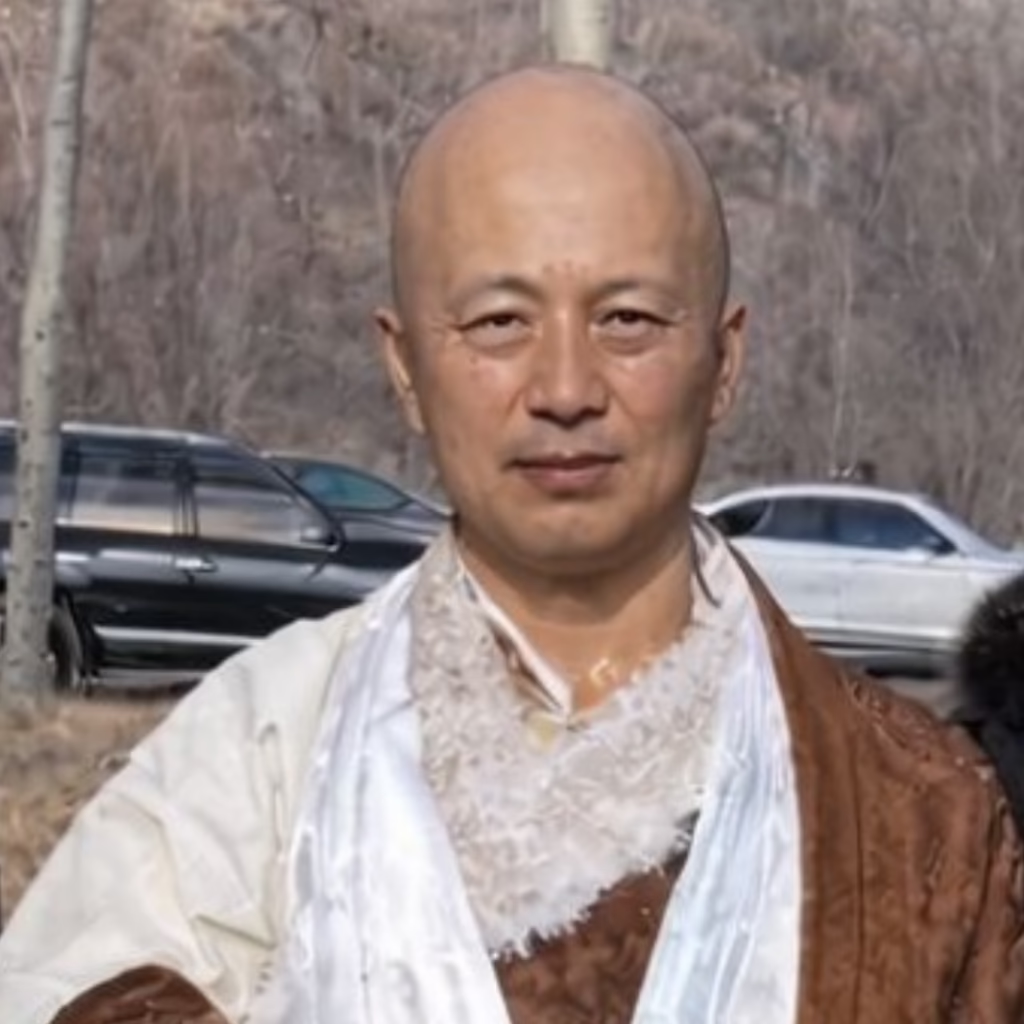
Yeshe Zangpo
Release Without Freedom: Surveillance, Pledges and Re-Arrest
For Tibetan political prisoners, release from custody does not mark the end of state control, it is a transition to a different, more pervasive mode of surveillance and monitoring.
Nearly every subject of this report has been detained more than once. Samten Gyatso was summoned to a police station and severely interrogated following his Dalai Lama tribute, then released, and then detained again. Jamyang Samten had previously been arrested for his WeChat group and his unauthorised publication, released, and then taken again. Gangkye Drubpa Kyab was arrested in 2012, released in 2016, re-detained the following day for seventeen days, and then rearrested in 2021 for the 14-year sentence he is now serving. Tsering Dolma was arrested in 2008 with her father, in 2012, and again in 2021.
Once an individual has been through the system, they remain on file, subject to intensified surveillance, and vulnerable to re-arrest at any future moment the political climate shifts or a new pretext presents itself. The cost of having taken any public stand on behalf of Tibetan language, culture or religion is not a single prison sentence, it is an indefinite condition, and is termed non-release release as a result.
Collective Punishment
The consequences extend well beyond the individuals named. Zeyga Gyatso’s family has been subjected to repeated harassment since the arrest of a relative in 2008 — a 17-year tail of surveillance attached to a single case. The families of the two disappeared Chukha-Ma monks live with an open-ended absence of information about their sons’ whereabouts and health.
Tibet Watch has documented how, in a number of cases, family members of tortured or disappeared Tibetans have themselves fallen ill, suffered severe depression, or died, as a direct consequence of the state-imposed silence surrounding their loved ones.
Taken together, these cases reveal a system that has moved beyond the prosecution of visible dissent into the management and control of Tibetan identity itself. It is a system designed to narrow the space in which Tibetan cultural and religious life can be conducted. The apparatus of detention has become deliberately opaque: the refusal to disclose charges, locations and dates is itself a policy, one that places families and monasteries in a position of permanent uncertainty.
Physical punishment and torture in custody remains routine and is compounded by the deliberate withholding of medical care, producing prisoners who emerge with permanent injury or who do not emerge at all.
Release is now a form of continuing control rather than an end point: the signed pledge, the daily monitoring, the re-arrest pattern, and the pressure brought on family and neighbours together mean that the state’s hold on an individual does not end with release from prison.
Recommendations
- Press the Chinese authorities, in bilateral human rights dialogues and at the United Nations, for immediate disclosure of the location, status and health of Samten Gyatso, Jamyang Samten, Gangkye Drubpa Kyab and Tsering Dolma.
- Call for independent medical examination and access to appropriate treatment for Gangkye Drubpa Kyab and Tsering Dolma.
- Raise the cases documented here at the UN Human Rights Council, including through the Special Rapporteurs on torture, on freedom of religion or belief, on the promotion and protection of the right to freedom of opinion and expression, and on the situation of human rights defenders.
- Request that China provide family access, legal representation and independent monitoring for Tibetan political prisoners, in line with its international human rights obligations.
- Note the specific acts — a WeChat post, a photograph, a schoolbook — that have triggered detention, rather than accepting broad official categories such as “inciting separatism”.

Endnotes
[1] ‘Tibetan Monk Sentenced in Secret After Pattern of Disappearances’, Tibet Watch, 31 March 2026, https://tibetwatch.org/tibetan-monk-sentenced-in-secret-after-pattern-of-disappearances/
[2] ‘China’s Legal Warfare Against Tibet and the Threat Beyond its Borders’, Tibet Watch, 24 April 2026, https://tibetwatch.org/chinas-legal-warfare-against-tibet-and-the-threat-beyond-its-borders/
[3] ‘Tibetan monk released after six-month detention, faces serious health issues and ongoing surveillance’, Phayul, 23 March 2026, https://phayul.com/tibetan-monk-released-after-six-month-detention-faces-serious-health-issues-and-ongoing-surveillance/
[4] ‘Gangkye Drupa Kyab: Popular Tibetan writer dragged away by authorities in front of his wife and child’, Free Tibet, latest version 4 March 2022 (accessed 29 April 2026), https://freetibet.org/freedom-for-tibet/political-prisoners/case-studies/gangkye-drupa-kyab/
[5] ‘Six Writers and Former Political Prisoners Sentenced to Prison in Eastern Tibet’, Tibet Watch, 26 October 2022, https://tibetwatch.org/six-writers-and-former-political-prionsers-sentenced-to-prison-in-eastern-tibet/
[6] ‘Tibetan Writer Detained Again One Day After Release’, Radio Free Asia, 23 September 2016, https://www.rfa.org/english/news/tibet/redetained-09232016132537.html