1 April 2026
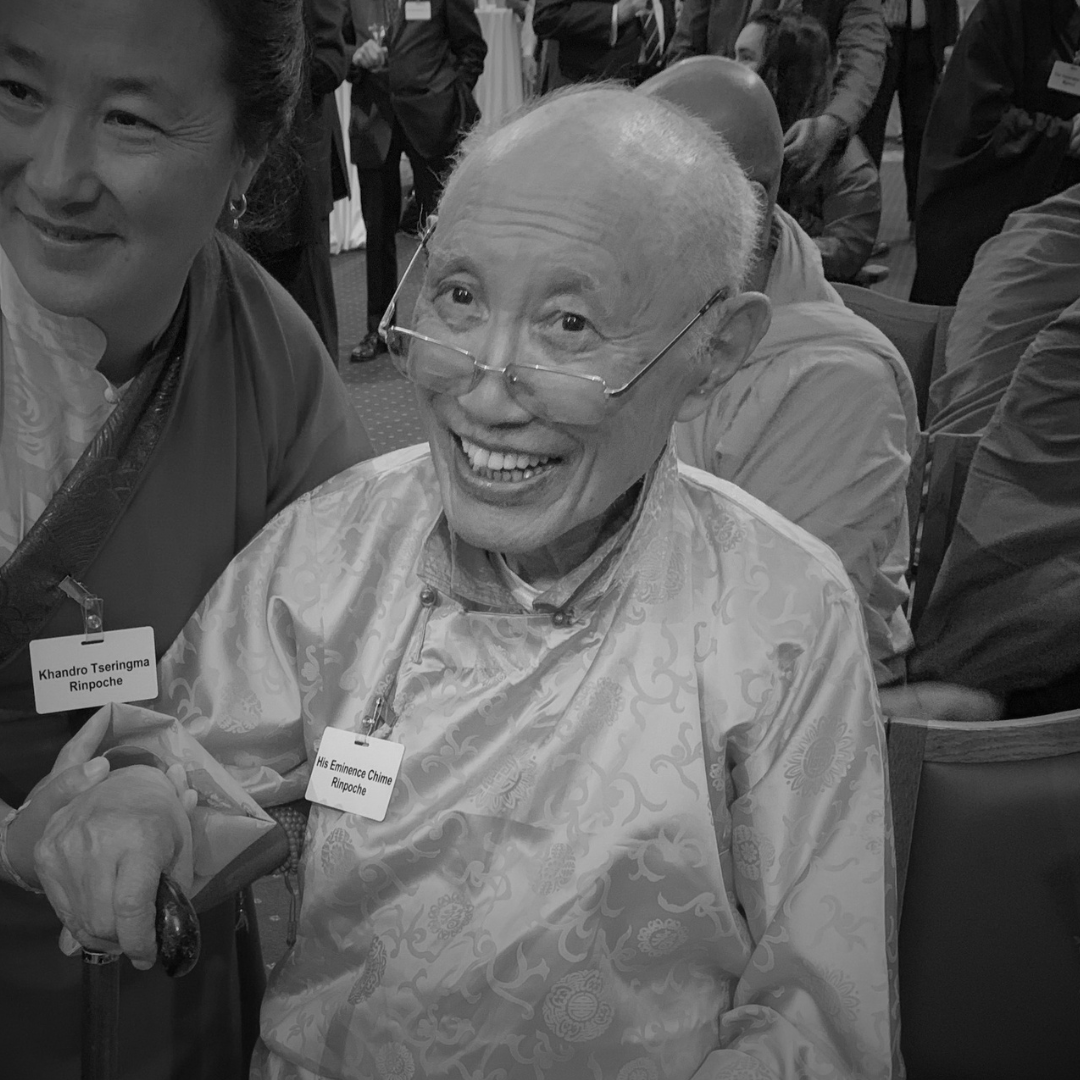
Lama Chime Tulku Rinpoche, one of the first Tibetan lamas to settle in Britain and a pioneering force in bringing the Dharma to the West who taught David Bowie meditation, died on 24 March at the age of 84.
Born in Jyekundo, Kham, East Tibet, Chime Rinpoche was recognised at a young age as a tulku, or reincarnated lama, and received a traditional monastic training. Following the Chinese invasion of Tibet in the 1950s, he fled into exile, eventually making his way to Britain in 1965.
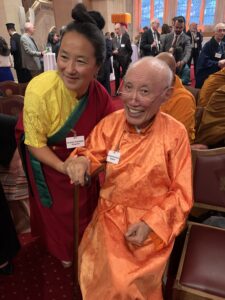
Chime Rinpoche with Khadro-la Rinpoche at an event in London
He admitted that when he came to the West, he worried that Tibetan Buddhism was ‘finished’ because of the deaths and destruction of monasteries in his homeland, but was surprised when Westerners started coming to him for teachings. He was a beloved and influential figure among Tibetans in the UK, serving as the first Chairman of the first Council of the Tibetan Community in Britain in 1970. He was a pillar to the community he helped to build, the same community that now honours his memory, and continues to thrive decades after his term as Chairman ended. Though he has passed, his legacy will remain, and live on in the lives of Tibetans that call the UK their home.
His students included David Bowie, who walked into Tibet House in London in the mid-1960s and encountered a lama in saffron robes who told him, in broken English: “Are you looking for me?” When Bowie confessed he wanted to become a monk, Rinpoche asked him what his talent was. Bowie said music. “So then don’t become monk; you do the music,” Rinpoche told him.
Bowie paid tribute to Chime Rinpoche in his song ‘Silly Boy Blue’, with lyrics about ‘Mountains of Lhasa… feeling the rain,’ and ‘Yak butter statues that melt in sun.’ Bowie later said that what had first appealed to him about Buddhism was: “The idea of transience, and that there is nothing to hold on to pragmatically; that we do at some point or another have to let go of that which we consider most dear to us, because it’s a very short life.” When Bowie died, Rinpoche issued a video tribute closing with the words: “I’ll meet him again in the next life.”
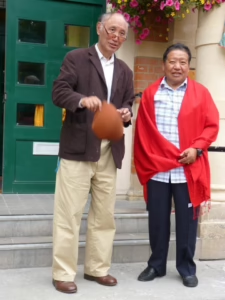
Chime Rinpoche with Akong Rinpoche
Chime Rinpoche was one of three exiled Tibetan lamas to arrive in Britain at around the same time – the first ever to come to the UK. He told journalist Mick Brown that he arrived “penniless but happy”, and shared a small flat in Oxford with his friends Chögyam Trungpa Rinpoche and Akong Rinpoche, who went on to found Samye Ling monastery in Scotland and the humanitarian organisation Rokpa. Akong Rinpoche was killed in a violent attack while visiting his educational and health projects in Chengdu in 2013. In those early days, Akong worked as a hospital porter, while Trungpa studied comparative religion on a Spalding scholarship and Chime taught meditation.
Chime Rinpoche remembered a British policeman asking him, “You come from Kham – we’ve never had anybody from there before. You are the first. He looked at the map, and said, how on earth did you get here? I would say, karma.”
Chime Rinpoche’s mother and brothers also escaped Tibet after China’s invasion, but he would never see his father again. In 1982 Chime discovered that he had been arrested by the Chinese and imprisoned for 22 years. “The Chinese said he came out. But people who were with him in prison said no, he died there.”
In 1974, Chime Rinpoche founded Kham Tibet House – later known as Marpa House – in Essex, which became a center for meditation, study, and retreat. He worked for many years at the British Library as a curator of Tibetan manuscripts, contributing to the preservation and study of Buddhist texts in the West. In this role, he would occasionally be asked by Russian and Chinese visitors which chair in the reading room Karl Marx had sat in while writing Das Kapital – visitors who had no idea of the remarkable story of the man they were asking.
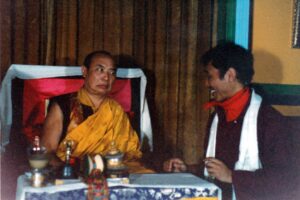
Chime Rinpoche with the 16th Karmapa
Chime Rinpoche chose to disrobe and marry, guarding his three children’s privacy with quiet devotion throughout his life. Renowned among his students for an irrepressible sense of fun and a dazzling, mischievous smile, he wore his own considerable stature lightly – remaining deeply humble before great lamas and teachers who made their way to the UK and other Western countries, among them the 17th Karmapa Ogyen Thrinley Dorje.
In his later years, Rinpoche maintained a serene equanimity toward death. “There is no death if there is no fear. I have no fear, and that means I have no death,” he once said. Upon his passing, Marpa House released a statement saying: “ Although physically unwell for some time, Rinpoche’s mind remained lucid and clear to the end.”