13 November 2026
China’s response to the Drachen earthquake
- Within days of the 22 October earthquake in Drachen, Nagchu, Tibetans were detained, penalised and in some cases compelled to make video ‘confessions’ for discussing the quake and its death toll.
- Tibetans were also prevented from travelling to help in the earthquake zone, or made to sign pledges agreeing to strict government restrictions before they did so. Tibetan sources indicate the death toll is likely to be higher than the official toll of 16.
- Displaced herders face winter at 4,800 metres in shelters exposed to bears, a danger made worse by state settlement, while according to Chinese state media nearly 1500 children from Drachen’s pastoral areas have been moved to a Chinese boarding school in Lhasa. It is not known if they will be returned to their grassland homes.
- China is following the script it used after the August mudslide at Kyirong: tightening online and on-the-ground controls to choke off information. Beijing’s wider refusal to share data on the plateau’s rivers and its ambitious dam-building in one of the most seismically active zones in the world has drawn sustained international criticism since the Kyirong catastrophe.
Within 24 hours of the magnitude 7.0 earthquake that struck Drachen (Chinese: Baqen) County in Nagchu (Chinese: Naqu) in the Tibet Autonomous Region on 22 October, China imposed a clampdown on sharing information and relief efforts. In a repeat of official reprisals following the flood catastrophe at Kyirong on the Tibet-Nepal border on 26 August, Chinese police detained netizens and others for speaking about the quake online, even forcing video ‘confessions’ as an example to others.
According to Tibet Watch sources, Chinese authorities restricted Tibetan monks and laypeople from travelling to the earthquake-hit area to help with rescue efforts. In a letter offering condolences to those affected, monks at the Lungkar monastery in Drachen close to the epicentre wrote that while they were not able to come to help, they were praying for all the deceased. Tibetans said that Chinese authorities are doing everything possible to cover up the true scale of the disaster, with one source noting that around 50 fatalities were confirmed within their immediate social circle alone, according to the Tibetan Centre for Human Rights and Democracy.
Although local Tibetans and volunteers attempting to travel to the affected region to provide emergency humanitarian assistance were in some cases forced to sign pledges agreeing to strict government directives before being permitted entry, many Tibetans from different parts of Tibet still managed to reach affected areas and distributed necessities like blankets, tents, and food.
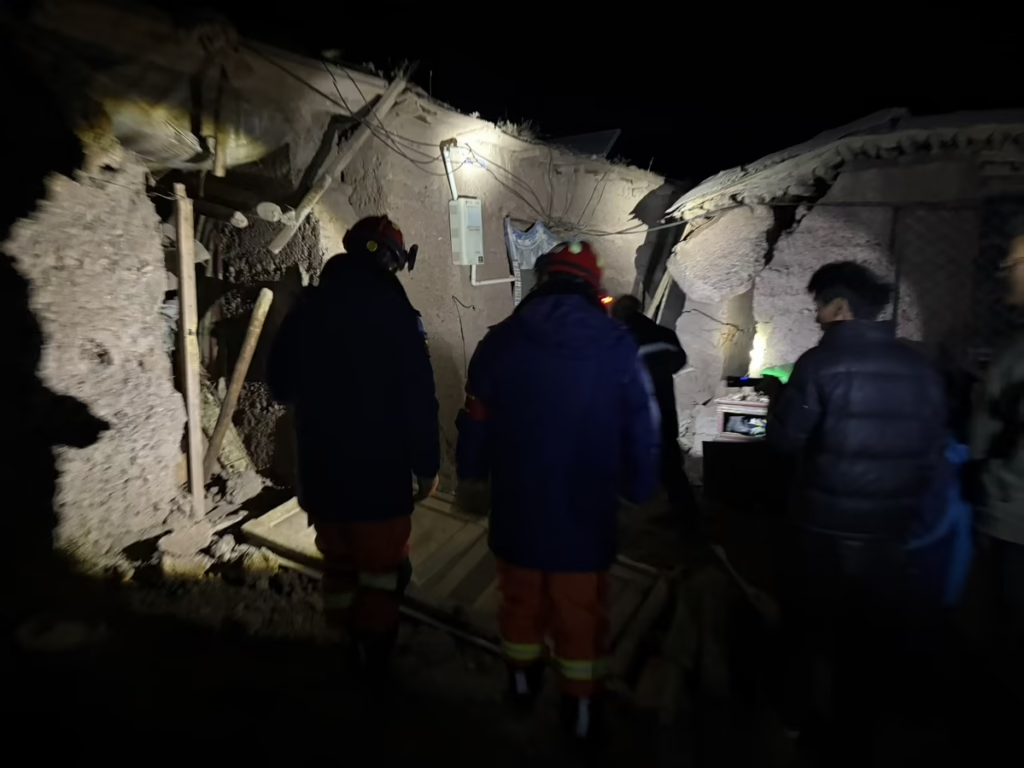
Firefighters inspect houses hit by the earthquake. Image from Chinese state media.
The epicentre of the earthquake, which struck at 10:33pm local time on 22 October, was Marru (Maru) Township in Drachen County, a high-altitude pastoral area about 400km north-east of Lhasa. By the following morning Xinhua was reporting 16 dead and more than 330 houses collapsed or damaged. Within two days, over 12,000 people had been moved to shelters.
One eyewitness said the shaking felt “as if several hundred yaks were running past us”.[1] Residents spent the first night outdoors in sub-zero temperatures, afraid that aftershocks would bring their homes down on them.
Over the following days the official injury count rose, from 32 to 46, then 65, then 76. Official figures now record 12,964 people relocated, 2,505 prefabricated housing units dispatched and more than 2,000 aftershocks, including a magnitude 5.7 tremor on 25 October. The death toll stayed at 16, and with no foreign media allowed access and people in Tibet penalised and threatened for speaking about the disaster, it is a figure that is impossible to verify.
The number of deaths and casualties are likely to be higher than those officially reported. According to one Tibetan source, more than 20 Tibetans, including 13 women, are believed to have died.
In the valley of Kyirong, nearly three months after a devastating flood of water, ice, rock and sediment, a catastrophic loss of life was compounded by a climate of fear as China punished those who expressed views or casualty figures that differed from those of the Party state. One netizen was penalised after they gave a higher figure for those missing than the official statistics and said that the Kyirong flood disaster was “heartbreaking”.
On the night after the earthquake in Nagchu (Chinese: Naqu) in the Tibet Autonomous Region, a Tibetan man was detained following his message in a WeChat group warning of a possible crack and collapse of the dam at the confluence of Sog River (སོག་ཆུ།) and LeyChu River (གླེ་ཆུ།) and suggesting that people downstream moved to higher ground. He was compelled to make a confession in a video, admitting to sharing information and concerns that, according to China, constitute false information and pose a threat to national security.[2]
The same official Chinese source said that another netizen, named as Bai from Chamdo (Chinese: Qamdo) was detained after he circulated casualty figures that differed from those of the Party state, while another internet user named as Luo in Shenzhen was detained, also for circulating information described by the authorities as false.[3] Two other netizens, one in Lhasa and one in Nagchu, received penalties for sharing casualty figures that may have differed from the official statistics.
Administrative detention is imposed by the police themselves, without charge or trial, for up to 15 days per offence. Confession videos carry no such limit: they remain online, attached to the faces and names of the people who made them, as a warning to others.
Crackdown in cyberspace and the global implications
Just a day after the earthquake struck, cyber police in Nagchu issued a notice entitled ‘Be Vigilant Against These Online Risks Following the Earthquake’, warning against the circulation of information that diverged from the authorities’ official account of the earthquake. The notice stated: “All disaster data, rescue updates, aftershock assessments and safety advisories must be based on authoritative official sources.” It further warned: “The internet is not above the law; those who fabricate or disseminate earthquake rumours, thereby disrupting public order, will be dealt with severely by the public security authorities in accordance with the law.”[4] The notice also stated that only provincial-level governments or higher have the authority to issue earthquake forecasts in China, while predictions made by individuals, social media influencers, ordinary organisations or foreign media outlets were described as invalid.
The detentions for online posts extend beyond Nagchu; the Tibetan Centre for Human Rights and Democracy has reported that public security bureaus in Sog, Lhorong (in Chamdo) and Chentsa (in Malho, Qinghai) counties penalised residents and detained more than ten Tibetans for discussing the earthquake and its death toll online. In Lhorong, police made a young Tibetan woman record a confession video after she posted on WeChat that more than 100 people had died; in the video she admits to “spreading unverified rumours of 32 deaths” and repeats the police line that cyberspace is not lawless.[5]
In Nagchu, China is following the script it used after the August mudslide at Kyirong: tightening online and on-the-ground controls to choke off information. Beijing’s wider refusal to share data on the plateau’s rivers has drawn sustained international criticism.[6]
The scrutiny has focused attention on China’s policies in Tibet of building dams, roads and tunnels at speed across some of the most seismically active mountains on earth, against the warnings of its own geologists. It does so in a region where fewer than two dozen of tens of thousands of glaciers are monitored on the ground, and which is closed to independent research.[7]
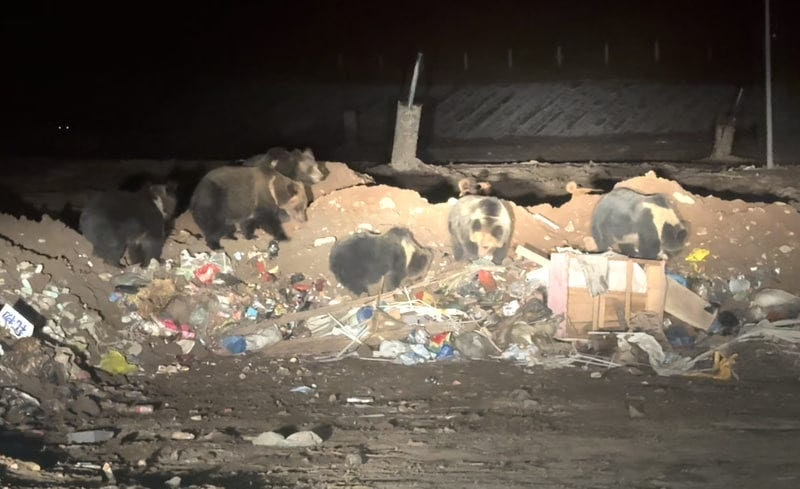
Several Himalayan blue bears enter the municipal solid waste landfill in Zhidoi County to forage. Image from Lhasa Spring: https://www.lhasaspring.org/p/blue-bear
Winter on a broken grassland: new threats faced by displaced pastoralists
Most people in the area affected by the quake are pastoralists, and most households live in single-storey houses, as videos circulating online show. Sources describe whole townships shattered, with damage to the grassland and mountainsides as well as homes. Snow was forecast within days of the earthquake, and winter at 4,800 metres is now setting in.
Displaced families in Drachen are sheltering in a county where bears are a known danger: in April, three broke into a village office there.[8] According to Tibet Watch sources, local people have asked for robust makeshift housing to protect them. This is not a new risk, and it is not a natural one. Ecosystem balance has been disrupted by enforced settlement of Tibetan nomads – displacing nomads from their land into fixed houses with stored food has given bears a target.
Traditionally, Tibetan herders lived in tents year-round, moving to new pastures each season. From the 1980s onwards, local governments encouraged them to move into permanent settlements at least for the winter, often permanently. When leaving for the summer pastures, they would leave food to use when they returned later in the year. The Tibetan blue bear is an omnivore, and the herders’ food stores make an easy target.[9]
The consequences have been profound, says Lobsang Dondrub, who grew up in Nyingtri close to the border with India, writing in Lhasa Spring: “Before modernization and modern regulation made their forceful entry into Tibetan pastoral society, a spontaneous order refined over a thousand years maintained a dynamic equilibrium between humans and bears.”[10]
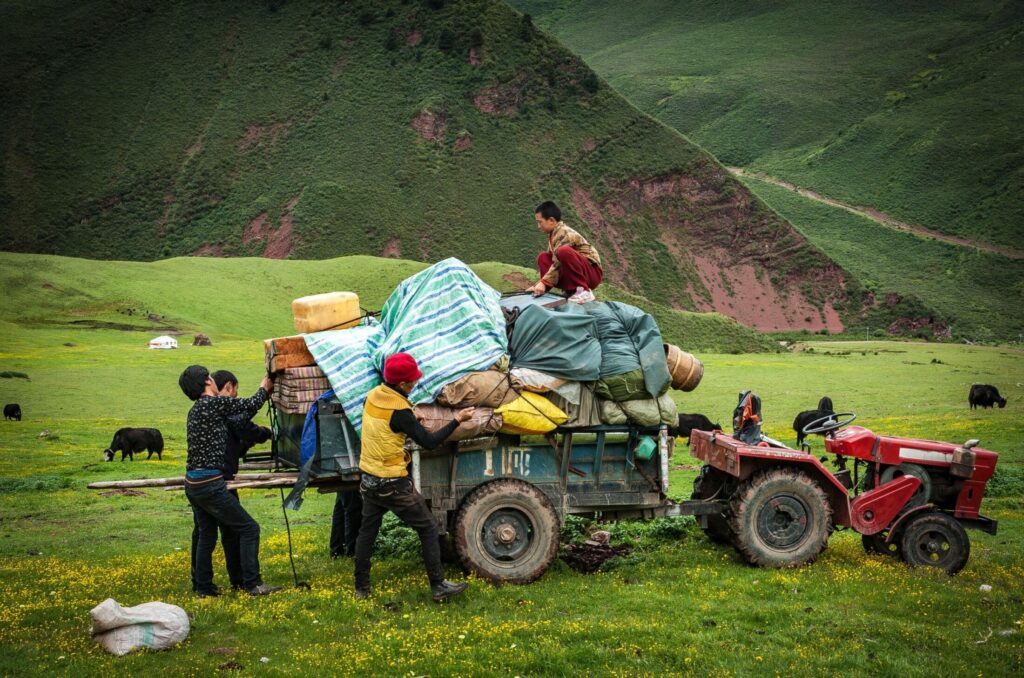
Seasonal migration of herdsmen. Image from Lhasa Spring: https://www.lhasaspring.org/p/blue-bear
On the Changtang (also known as Byang Thang, Chinese: Qiangtang) plateau in northern Tibet, a survey of 300 herding households found that bears had affected nearly half of them between 1990 and 2006, with conflict rising more than fourfold after wildlife protection policies took effect from 1993.[11] Herders cannot lawfully defend themselves: the bear is a protected species, killing one carries a prison sentence of up to ten years, and their guns have been confiscated. State campaigns to poison the plateau’s pikas, a staple prey, may have compounded the pressure.[12]
Compensation for local Tibetans is largely absent. And when bear attacks are discussed publicly, the response has been to police the reports. In May, officials in neighbouring Chamdo denied recent fatalities and warned that anyone spreading “rumours” would face the police.[13]
The earthquake has brought these policies together on one grassland. Families have lost the houses they were moved into, cannot lawfully defend themselves against the animals now entering the ruins, and can be detained for describing what has happened to them.
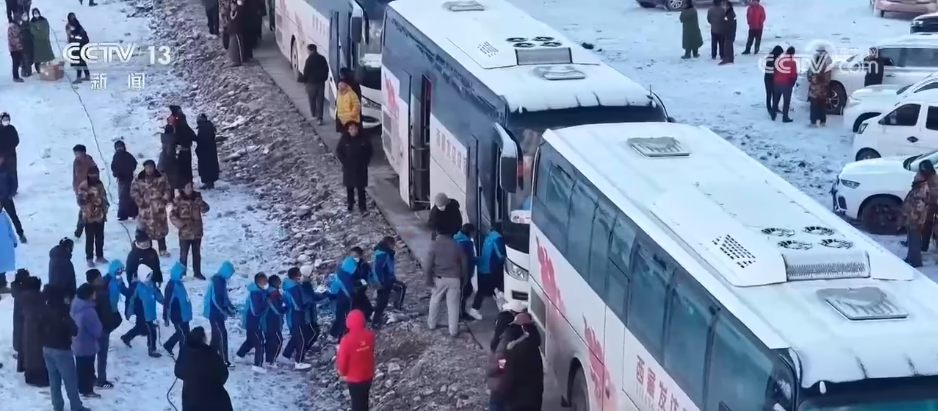
Children from areas affected by the earthquake have been relocated to a boarding school in Lhasa. Image from Chinese state media.
Children from earthquake zone moved to Lhasa boarding school
Within a fortnight of the quake, it was announced that nearly 1500 children from its pastoral areas were transferred to a boarding school in Lhasa to resume classes. Chinese state media reported that the mother of one child was “heartbroken to see her daughter leave home”.[14]
Maru and Gangchen were the worst-hit townships, and state media reported that some school buildings were too damaged for teaching to resume. Officials describe it as a temporary “relocated resumption of classes,” but no statement has said whether or when the children will go home once their schools are rebuilt.
Meanwhile 1,495 pupils, including first- and second-graders, are boarding at Lhasa Nagchu Complete Middle School, hundreds of kilometres from their families. The school’s first day back opened with the Chinese flag and anthem and political lessons on “gratitude to the Party” and “forging a strong sense of community for the Chinese nation.”[15]
The choice was not the only one available. Across the earthquake zone, 168 schools with over 59,000 students resumed in person locally and 31 more moved online, so only these two schools were sent to Lhasa.
Separating Tibetan children from their families, language and grasslands and placing them in state boarding schools is the core of China’s ‘Sinicisation’ policy in Tibet.
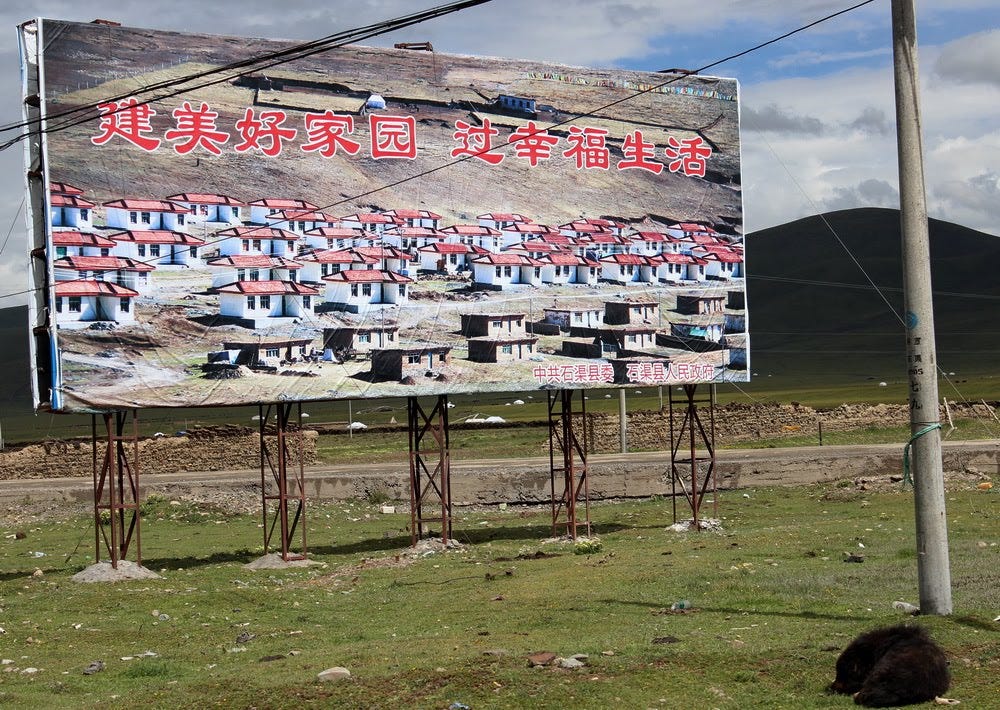
A propaganda billboard advertises the government-led forced relocation in Tibet. Image from Lhasa Spring: https://www.lhasaspring.org/p/blue-bear
Nagchu: intensive infrastructure development, coerced relocation, tough securitisation
The Nagchu area serves as an important northern gateway connecting Tibet with Qinghai and the rest of mainland China. The plateau’s largest logistics centre, situated at roughly 4,500 meters above sea level along the Qinghai-Tibet Railway, is a major high-altitude hub for freight transportation, warehousing, product processing, trading, and regional distribution covering Lhasa, Chamdo (Chinese: Qamdo), Ngari (Chinese: Ali) and Shigatse (Chinese: Rigaze). In 2021 a Politburo Standing Committee member opened the expressway linking Nagchu to Lhasa, halving the drive to three hours; Nagchu lies on the G317, the northern Sichuan–Tibet highway.
The October earthquake struck away from this corridor, with its epicentre about 191 km east-northeast of Nagchu town, at a shallow 10 km, in Maru township, Drachen county. China’s earthquake centre placed it in the Qiangtang Block, which has a history of magnitude-7 earthquakes.[16]
Alongside the infrastructure build-up, the authorities have for decades been moving Tibetans off their land. Since 2017 an “extremely high-altitude ecological resettlement” programme has moved Nagchu’s pastoralists to lower altitudes. Researchers found officials secured ‘consent’ by moving from incentives to warnings and intense pressure. “I would have preferred not to sign if I could refuse … [but] it was really a matter of whether I wanted to go against the state, a matter of those with power and those without power,” one Nagchu pastoralist told researchers. “Officials would not leave me alone until I signed.”[17]
While Chinese state media documented residents of Maru village being moved into temporary prefab residences, Drachen will likely be rebuilt in the same manner as other areas of Tibet following earthquakes.
After the 2010 earthquake in Kyegudo (Yushu), an entirely new town plan was imposed and Tibetans were shut out of decisions about the reconstruction of their own city, which many saw as cover for the settlement of nomads. A historic, culturally strong Tibetan trading town was transformed into a Chinese-style eco-tourism hub, with officials prioritizing large-scale state hotels and government complexes over traditional Tibetan architecture and community spaces.[18]
Dram, for decades one of the routes by which Tibetans left for exile in Nepal, and watched by the authorities for that reason, was emptied after the 2015 earthquake with its population was moved some 300 km away to Shigatse.[19] Four years later, when the port reopened to freight, officials said residents were still not allowed to return. The border crossing and the road to it were rebuilt first; the town has since been redeveloped as a state-run border port rather than restored as a Tibetan community.
After the Dingri (Tingri) earthquake close to the border of January 2025, rebuilt villages were moved off “earthquake belts” and flood-prone land, in line with the same “high-altitude ecological migration” policies to move Tibetans living above 4,000 metres to lower ground.[20]
Nor is Drachen neutral ground for the security state. During the 2013 crackdown in nearby Driru, when more than a thousand Tibetans were detained, a police notice ordered checkpoints in Lhasa and Nagchu to track Tibetans from the prefecture, assigning code letters to Driru (Biru), Sog and Drachen. Thirteen years later, the first response to the earthquake was again to police what Tibetans say. The silence imposed in the first 24 hours is not separate from the reconstruction that follows; it is how the state ensures that the rebuilding of Drachen happens on its terms
Endnotes
[1] Cited by the BBC, 23 October: https://www.bbc.co.uk/news/articles/ck5ynd1z6e83o
[2] Chinese official source, 30 October: https://news.china.com/socialgd/10000169/20261030/49828330.html
[3] Chinese official source, 30 October: https://news.china.com/socialgd/10000169/20261030/49828330.html
[4] WeChat post on 23 October by Nagchu Public Security: https://mp.weixin.qq.com/s/3ZIZoYWKe1GLvV-quWb3KA
[5] Tibetan Centre for Human Rights and Democracy report, 28 October: https://tchrd.org/2026/10/28/china-clamps-down-on-information-and-relief-effort-following-nagchu-earthquake
[6] Nagchu’s main river is the upper Salween (Gyalmo Ngulchu; Nu Jiang in Chinese), which flows through Yunnan into Myanmar. The Kyirong Tsangpo becomes the Trishuli in Nepal and joins the Narayani, which enters India as the Gandak and flows into the Ganges. India’s central concern is the Yarlung Tsangpo, which becomes the Siang and then the Brahmaputra. China broke ground on its planned massive Medog (Motuo) mega-dam in July 2025, in one of the most seismically active zones in the world.
[7] According to a new report, ‘A Resilient Himalaya: Protecting a Region at Risk and Securing Future Prosperity’, Systemiq, 9 September, “Less than 21 glaciers are currently monitored across the Hindu Kush Himalayas, including 16-17 in India (the Hindu Kush Himalaya region spans eight countries including China/Tibet); even where risks are known, science does not consistently translate into decisions.” The report also stated that Himalayan glacier mass loss was 65% faster in the last decade. https://www.systemiq.earth/wp-content/uploads/2026/09/Prosperous-Resilient-Himalayas-Report-1.pdf
[8] Beijing News video, 15 April 2026: https://m.bjnews.com.cn/detail/1776229665129109.html
[9] ‘Resolving human–bear conflict on the Qinghai-Tibetan Plateau’, Dialogue Earth, by Guo Hui and Liu Yanli, 4 August 2021: https://dialogue.earth/en/nature/resolving-human-bear-conflict-on-the-qinghai-tibetan-plateau
[10] Posted 26 May 2026: https://www.lhasaspring.org/p/blue-bear
[11] ‘Conflict between Nomadic Herders and Brown Bears in the Byang thang Region of Tibet’,
Journal of the International Association of Tibetan Studies, by John D. Farrington and Dawa Tsering, 2008-12: https://sources.mandala.library.virginia.edu/node/128165
[12] ‘Implementing a comprehensive approach to study the causes of human-bear (Ursus arctos pruinosus) conflicts in the Sanjiangyuan region, China’, abstract and author details online at: https://dsc.duq.edu/faculty/203/ ; the paper itself has been withdrawn.
[13] Cyberspace Administration, regarding communication from Dingqing County Forestry and Grassland Bureau, https://h5.ifeng.com/c/vivoArticle/v0020WJz51C7YZoWh3xWirhbZkYJNw4nTJRxT6k887WZjkk__
[14] CCTV via Qianlong website, 1 November: https://china.qianlong.com/2026/1101/8745746.shtml
[15] CCTV state media report, 5 November: https://www.xinouzhou.com/wenzhang/186556-xi-cang-ba-qing-zhen-qu-san-pi-shi-sheng-di-da-la-sa-kai-qi-yi-de-fu-ke
[16] Global Times, 25 October: https://www.globaltimes.cn/page/202610/1372929.shtml
[17] According to the researchers from the University of Colorado at Boulder, Emily Yeh and Yonten Nyima: “Under such conditions […] there is no clear distinction between voluntary and involuntary or coercion and consent.” Yonten Nyima et al, ‘The Construction of Consent for High-altitude Resettlement in Tibet’, The China Quarterly (2023). DOI: 10.1017/S0305741023000206. Provided by University of Colorado at Boulder Citation: ‘Investigating the difference between consent and coercion in ‘voluntary’ resettlement in Tibet’ (26 October 2023) retrieved 12 November 2026 from https://phys.org/news/2023-10-difference-consent-coercion-voluntary-resettlement.html
[18] International Campaign for Tibet report, 15 April 2011, link currently broken: https://savetibet.org/reconstruction-of-earthquake-hit-area-excludes-tibetan-participation-ignores-local-concerns-one-year-on-from-earthquake/
[19] Chinese state media reports, documented by the International Campaign for Tibet and Tibetan media including Voice of America Tibetan service at https://www.voatibetan.com/a/2813486.html
[20] China Daily and other state media sources, including on 4 March 2025: https://mobile.chinadaily.com.cn/html5/2025-03/04/content_006_67c6107ded50ccabe150de44.htm