11 August 2026
“As digging machines and people demolish the residences of nuns, the shadow of dust blocks the sun…Isn’t destroying us the same as destroying yourself?”
– Poem from Larung Gar by Woesel Nyima, expressing the feelings of religious practitioners about the demolitions and expulsions
Chinese authorities are implementing a new wave of demolitions at one of the world’s largest Buddhist institutes, Larung Gar in eastern Tibet, following a harsh political education campaign at the monastery linked to the imposition of China’s ‘ethnic unity’ law. A senior religious teacher at the institute had warned monks and nuns beforehand that the authorities were like “a hunter preparing to kill an animal – remaining silent and unnoticed before suddenly releasing a single arrow.”
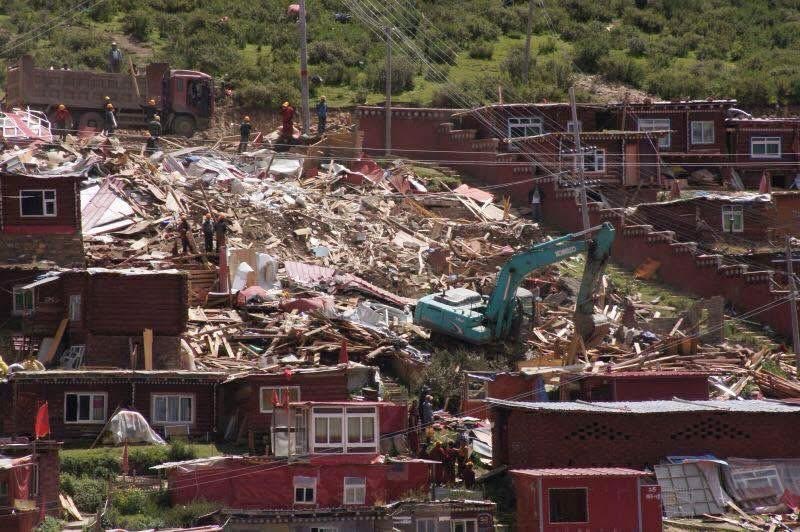
Demolitions began on 13 July, 12 days after the ‘ethnic unity’ law took effect, at the institute in Serthar (Chinese: Seda) county, Kardze (Ganzi) Tibetan Autonomous Prefecture, the eastern Tibetan area of Kham. Around 1,060 monks’ and nuns’ residences are slated for demolition, according to Tibetan sources, at an institute that has achieved widespread popularity among both Tibetans and Chinese as a non-political hub dedicated to monastic education, academic learning and Buddhist ethics. A Chinese blogger has described Larung Gar as one of “the most important places to visit in a lifetime”.
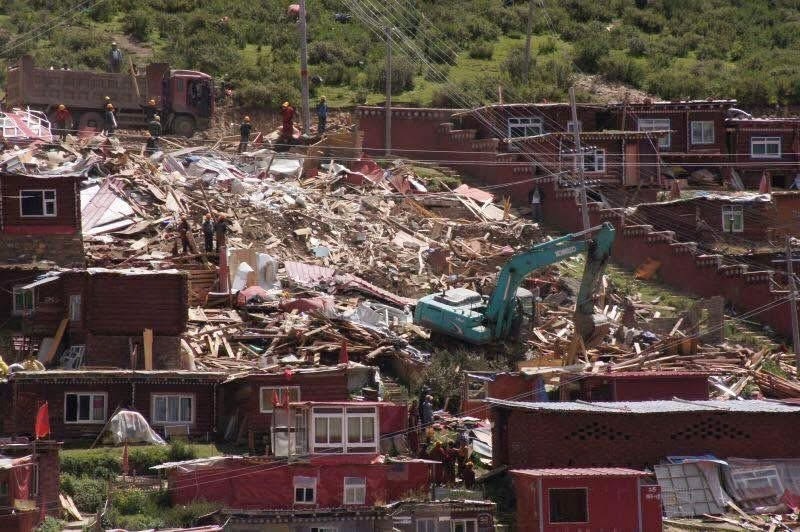
Image showing demolitions at Larung Gar. The date of the image could not be confirmed but is thought to be 2016, received by Tibet Watch.
Three months earlier the ideological groundwork to the July demolitions had been laid, in an intensive political education campaign at the academy in which monks were instructed on “safeguarding national security” and in compliance with the new ‘ethnic unity’ law.[1] As part of the campaign, officials visited monks’ residential quarters in April where they conducted outreach activities targeting more than 400 monks, distributing hundreds of national security handbooks, themed posters, and other propaganda materials aimed at promoting state security awareness and official policies.[2]
The ‘ethnic unity’ law formalises the securitisation of an entire ethnicity, treating Tibetan religious life as a threat to be managed and Tibetan identity as something to be assimilated out of existence. It took effect on 1 July amid intensifying surveillance and suppression of Tibetan Buddhist institutions and their leaders. Monasteries have been raided and images of the Dalai Lama confiscated; senior monks have disappeared or died after torture.
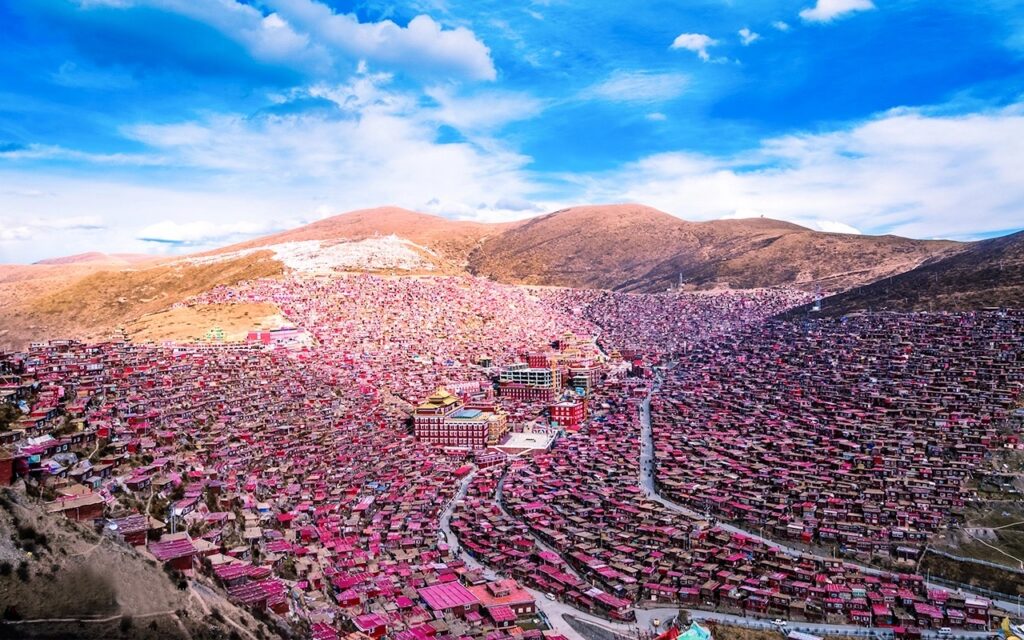
Since its establishment in the 1980s, Larung Gar has drawn in thousands of Buddhist practitioners. However, a campaign of expulsions and demolitions since 2001 threatens the site.
Both Larung Gar and the other important monastic encampment in eastern Tibet, Yachen Gar, have previously drawn thousands of Chinese practitioners to study Buddhist ethics and receive spiritual teaching since their establishment in the 1980s, and have bridged Tibetan and Chinese communities. Chinese Buddhists were among the first to be expelled from Larung Gar during the first round of expulsions in 2001. Now even Chinese tourists face increasing restrictions; on 30 June a Chinese visitor posted that tourists are now barred from entering the main area of the institute, saying on a vlog that “The latest changes at Serthar in 2026 […] can be summed up as ‘restrictions’ – all kinds of restrictions, including area restrictions, time restrictions, and even restrictions on shuttle bus schedules.”[3]
Tibetan sources told Tibet Watch that monks and nuns affected by the demolition are being compelled to return to their hometowns or monasteries in other provinces and regions. The effect is not simply to reduce the population of Larung Gar but to sever the relationships between teacher and student that give the institute its standing across the plateau. Monks and nuns expelled from Larung Gar will likely be compelled to undergo more political education; Tibetan sources have confirmed following previous waves of demolition and expulsion that ‘re education’ classes were being held for Larung Gar evictees across the region.[4]
Since last year, authorities have capped the number of monks permitted to remain at 1,000 and the number of nuns at 3,500, according to information conveyed to Tibet Watch. Everyone above those figures has already been removed. The combined ceiling of 4,500 sits below the limit of 5,000 imposed in 2016 – showing that the expulsions of the last decade were not an endpoint but a baseline from which the numbers have continued to be driven down.
According to Tibetan sources in exile, before this latest round of demolitions, a senior religious teacher at Larung Gar told monks and nuns: “Some people may think that because things seem calm at the moment, nothing serious will happen. But this apparent calm is actually a period of preparation. It is not that nothing is happening. The most worrying time is when everything appears quiet. It is like a hunter preparing to kill an animal – remaining silent and unnoticed before suddenly releasing a single arrow. For now, we must remain patient and endure.”
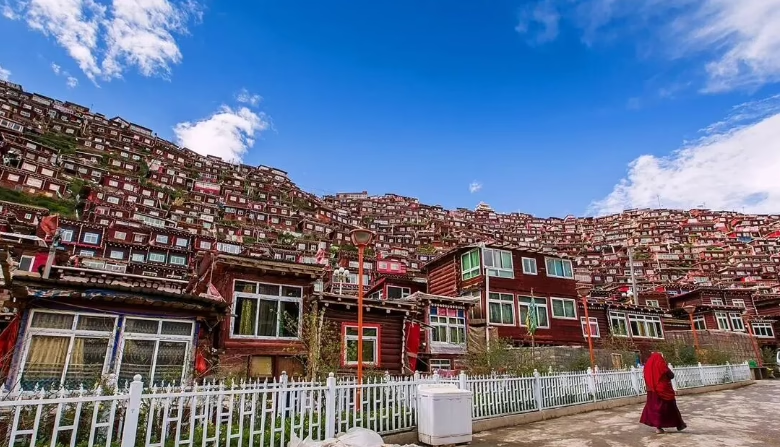
Larung Gar had been promoted as a domestic tourism site by Chinese Authorities hoping to capitalise on peoples’ interest in Tibetan Buddhism.
At the same time as undermining religious practice and teaching and stepping up intrusive security measures, China has used people’s interest in Tibetan Buddhism to attract domestic tourists, with infrastructure construction for tourists being deployed by the Chinese authorities as a tool to confront revivalist trends of Tibetan religious and cultural expression and contain monastic growth. The same Chinese vlogger said that visitors are tracked on an electronic pass available using their identity card, with two shuttle services into Larung Gar each day and a stay limited to an hour and a half.
Demolitions at Larung Gar have run in parallel with major construction in the valley below, as the authorities built out tourist infrastructure while monastic housing came down. Infrastructure construction for tourists is described as if this peaceful religious institute were a war zone, with the official media describing the work as a “tough political fight”.[5]
Larung Gar has been targeted under three consecutive Party administrations. Hundreds of homes were razed and monks and nuns expelled in 2001. In 2016 the government issued a directive limiting the population to 5,000; more than 4,500 monastic students were expelled, some loaded onto coaches and driven to distant parts of Tibet, and over 10,000 residential quarters were demolished during 2016 and 2017. In 2017 a management office was established at the academy, staffed by six Party members exercising control over its administration, its religious curriculum and the daily life of its residents.
Following the 2016 demolitions, six United Nations Human Rights Council experts made public a joint intervention made to the Chinese government saying that the developments at the Buddhist institutes violate international human rights laws and “seem to be concerted attacks on tangible and intangible cultural heritage, which constitute serious violations of cultural rights of current and future generations.”[6]
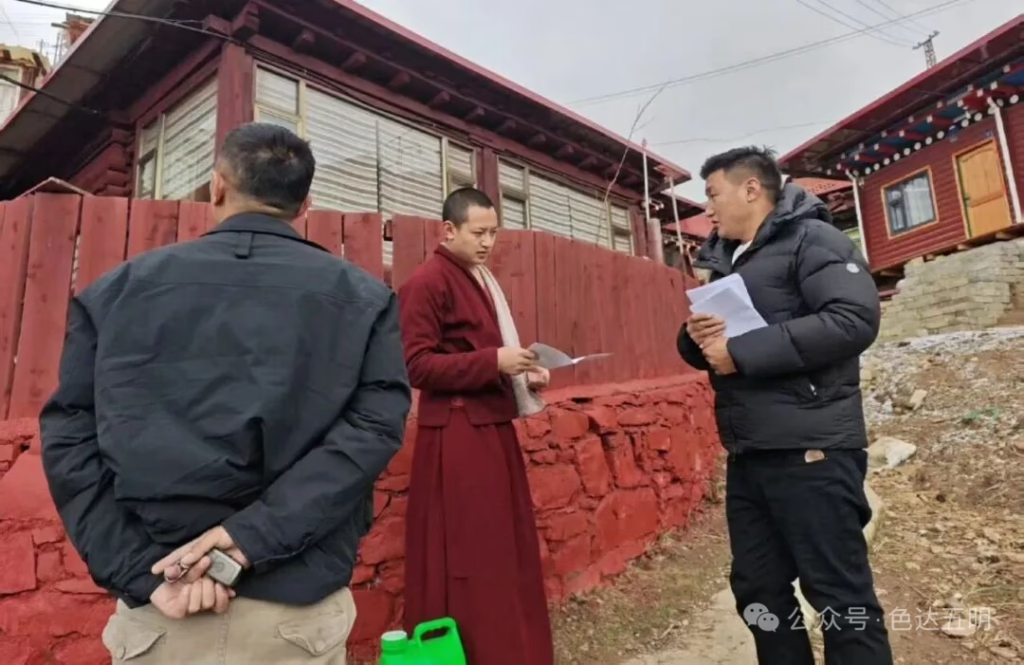
In April, Chinese authorities carried out a campaign of political and ‘national security’ education in Larung Gar. Source: Weixin/WeChat.
This year, the demolitions take place within the framework of a new legal architecture. The ‘Law on Promoting Ethnic Unity and Progress’ supplies a statutory basis for policies of assimilation that were previously pursued through directive and campaign, and the political education work carried out at Larung Gar in April was explicitly preparation for it. Demolition, quota, expulsion and surveillance are now presented as the ordinary operation of Chinese law rather than as exceptional measures.
During the round of demolitions in 2016, a Tibetan expressed the anguish of religious practitioners at Larung Gar in a prose poem, which was translated into English before it was taken offline. The Tibetan, who gave their identity as Woesel Nyima, wrote: “As digging machines and people demolish the residences of nuns, the shadow of dust blocks the sun. […] Tales of sadness fill the mountains and valleys. […] We, the humble people, are not allowed to remain in this place. Our houses cannot take roots on the sides of the hills. […] Students are forcefully taken away from their lamas. […] Isn’t my family yours? If so, isn’t it like cutting off your own head? Isn’t your path the same as mine? Aren’t we serving the same master? Isn’t destroying us the same as destroying yourself? I write about this in secret.”
Woesel Nyima concluded: “We have learned, contemplated and meditated shoulder to shoulder, and received teachings, debated and composed without fear. Dharma brothers and sisters; let us not allow them to break down the sacred knots of our bond. […] Those of us who are allowed to remain will stay strong. Truth is on our side.”[7]
Endnotes:
[1] ‘Larung Gar Buddhist Academy in Seda launched a series of activities to celebrate National Education Day and National Security Publicity and Education Month in 2026’, posted on 15 April (2026) on an official social media feed:
https://mp.weixin.qq.com/s/vjqX_ChA0Zy0_WKikPkCbA.
[2] ‘Larung Gar Buddhist Academy in Seda launched a series of activities to celebrate National Education Day and National Security Publicity and Education Month in 2026’, posted on 15 April (2026) on an official social media feed:
https://mp.weixin.qq.com/s/vjqX_ChA0Zy0_WKikPkCbA.
[3] Video footage posted on a QQ account, https://channels.weixin.qq.com/finder-preview/pages/sph?id=AlF3WGQC9R, reviewed by Tibet Watch.
[4] In 2016, a Tibetan source told Radio Free Asia, “All those who have been forced to leave Serthar have to undergo patriotic re-education for about six months on arrival in their home localities.” http://www.rfa.org/english/news/tibet/classes-11042016154905.html.
[5] Cited in International Campaign for Tibet report, ‘Shadow of dust across the sun: how tourism is used to counter Tibetan cultural resilience’, https://savetibet.org/shadow-of-dust-across-the-sun-how-tourism-is-used-to-counter-tibetan-cultural-resilience/.
[6] Full communication: https://spcommreports.ohchr.org/TMResultsBase/DownLoadPublicCommunicationFile?gId=22816. The UN Experts who issued the communication are as follows: Karima Bennoune, Special Rapporteur in the field of cultural rights; John H. Knox, Special Rapporteur on the issue of human rights obligations relating to the enjoyment of a safe, clean, healthy and sustainable environment; Maina Kiai, Special Rapporteur on the rights to freedom of peaceful assembly and of association; Leilani Farha, Special Rapporteur on adequate housing as a component of the right to an adequate standard of living, and on the right to non-discrimination in this context; Rita Izsák-Ndiaye, Special Rapporteur on minority issues; Ahmed Shaheed, Special Rapporteur on freedom of religion or belief.
[7] English translation by Bhuchung D Sonam of a prose poem in three parts entitled ‘From Larung Gar’ by Woesel Nyima that was posted on WeChat on 5 October, 2016, and translated by High Peaks Pure Earth, https://highpeakspureearth.com/from-larung-gar-by-woesel-nyima/ The original post has either been deleted or removed from WeChat.
UPDATE 25/08/2026: Image caption amended from ‘Image showing recent demolitions at Larung Gar, received by Tibet Watch.‘ to ‘Image showing demolitions at Larung Gar. The date of the image could not be confirmed but is thought to be 2016, received by Tibet Watch.‘ to more accurately reflect contents.