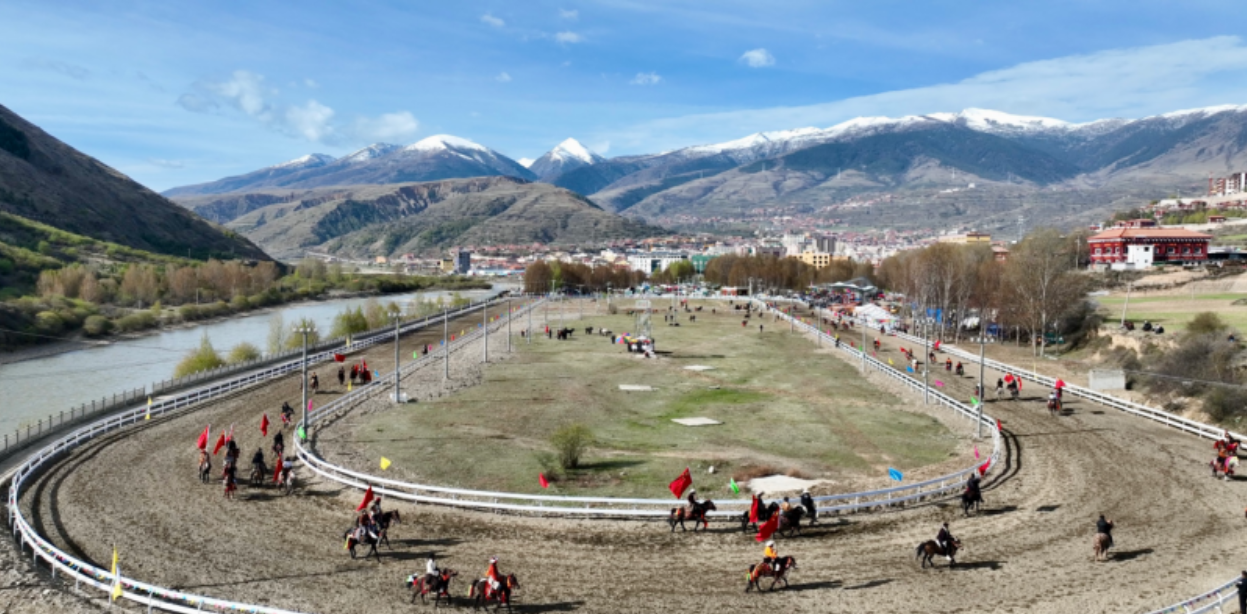
25 June 2026
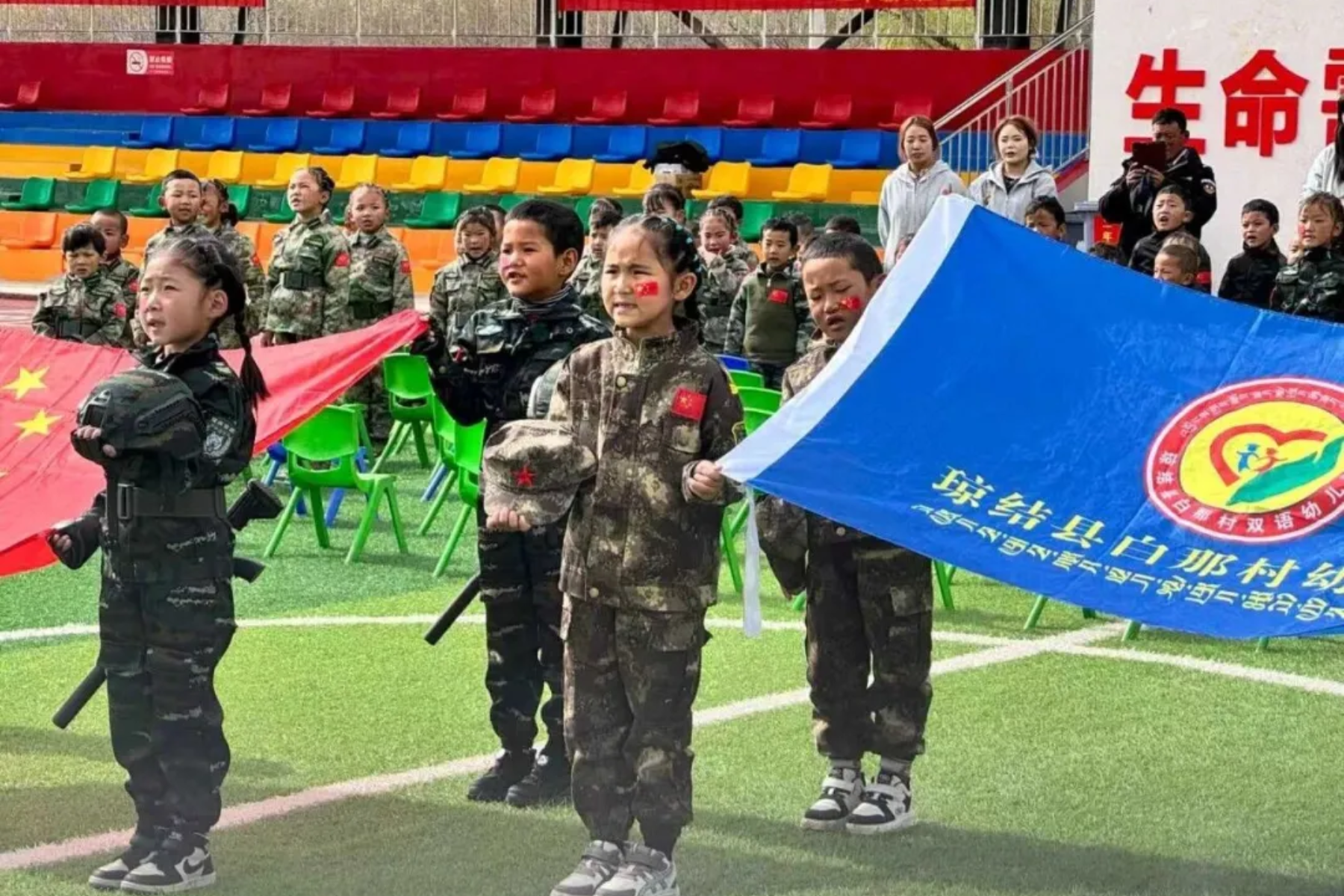
Chinese state media has shown Tibetan kindergarten children as young as two or three dressed in camouflage uniforms, depicted at the border with red flags and taking part in simulated combat drills with imitation rifles. The reports describe the military training exercises as designed to plant “seeds of patriotic defence” in young minds.
The developments in Tsona and other frontier regions are part of a broader context of indoctrination of children in schools and intensified militarisation as part of China’s ‘Sinicisation’ policy. Near-identical programmes appear in official sources from Xinjiang and elsewhere in China, with the proximity to the Indian border adding a strategic dimension to the reports from Tsona and other border areas.
One of the ‘national defence’ drills last month was at a kindergarten in Tsona (Chinese: Cuona), a heavily militarised border town opposite the Tawang region of Arunachal Pradesh, territory that Beijing claims as ‘South Tibet’.[1] The state media report describes preschool children being taught the Chinese Communist Party version of the 1962 Sino-Indian War – with India as the aggressor – as part of their core curriculum.[2] Another kindergarten in a border area, Gedang (Jiasi) in Medog (Chinese: Motuo), Nyingtri (Nyingchi) in the Tibet Autonomous Region (TAR), built “miniature military camp experience scenarios”, which it set up for “drill training, obstacle courses, and practical exercises”, according to an official social media account on 6 June.[3]
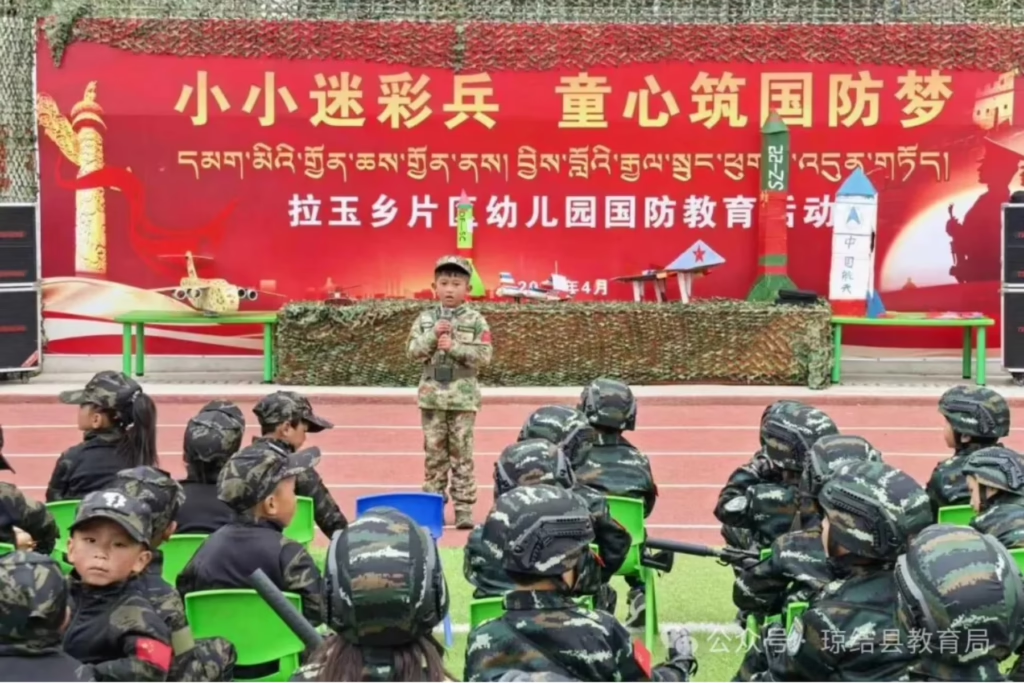
“Children’s Hearts Turn Toward the Motherland: Little Ones Learn About National Defence.”
Six other kindergartens also in the TAR in Lhayul in Chonggye (Chinese: Qonggyai) County, Lhoka (Shannan), held a national defense education theme week last month described as “Children’s Hearts Turn Toward the Motherland: Little Ones Learn About National Defence.”[4] These areas are among some of the richest cultural and religious landscapes in the Tibetan world. Tsona, Chonggye and the wider Lhoka region in southern Tibet are bound up with the earliest era of Tibetan civilisation; Chonggye’s valleys are dense with ancient monasteries, hermitages and sacred sites. But ‘national defence’ education emphasises teaching children as young as two, at the point where language and identity are first being formed, that their first loyalty is to the Chinese Communist Party, not their own culture.
Where a pilot programme in Nagchu documented by Tibet Watch installed army veterans as instructors inside schools, the PRC-wide defence education drive also embeds content directly into the curriculum through purpose-built materials including picture books, themed weeks, and ‘military training experiences’ for the pre-school classes.[5] The targeting of pre-verbal and newly-verbal children represents an earlier point of entry with the same political priorities.
Trip to securitised border by kindergarten class
In an image from official social media last month, small children are depicted standing with red flags and holding hands with their teachers at a section of the border “for a hands-on ‘I am a Little Border Patrol Guard’ experience activity”, according to an official post from the Shannan (Lhoka) education authority. “The children personally stepped onto the border line, directly experiencing the mission of guarding the border and deeply understanding that guarding the border is everyone’s responsibility, regardless of age,” stated the post about the visit by children from the Cuona (Tsona) City kindergarten. “This fostered a strong sense of border security and responsibility in children from a young age. The activity incorporated local border resources, promoting border defense culture, ethnic unity, and national security.”[6]
Border areas of the TAR are of high strategic significance to both China and India. Tsona in Lhoka is opposite Tawang in Arunachal Pradesh in India, which China’s official maps have long depicted as PRC territory, with successive updates drawing formal diplomatic protests from New Delhi.[7]
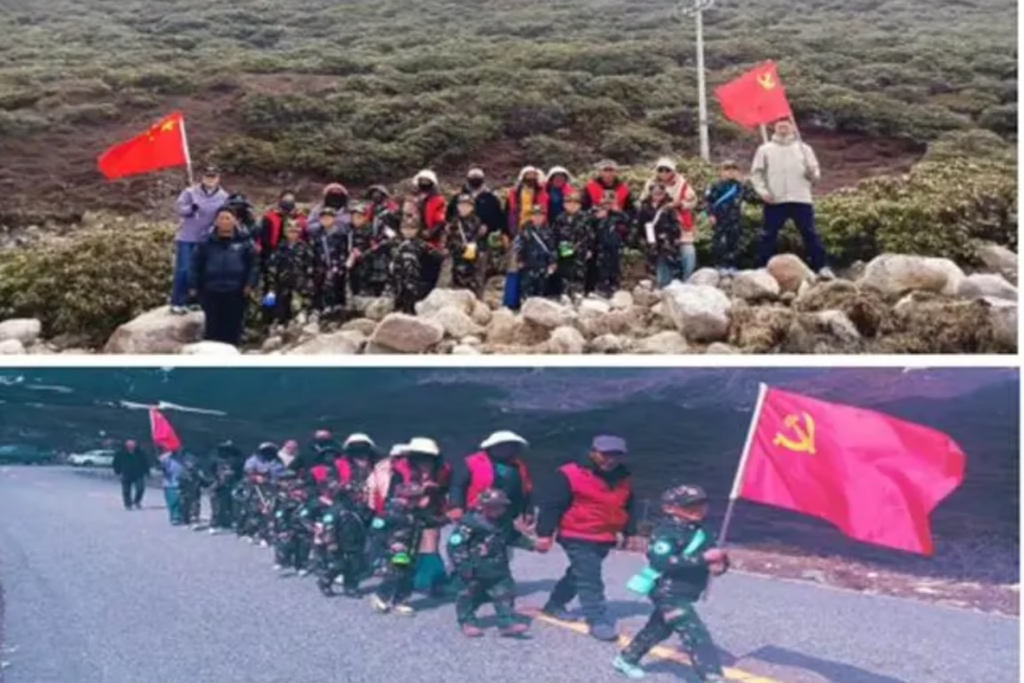
‘I am a Little Border Patrol Guard’ experience activity, Lhokha (Chinese: Shannan).
Xi Jinping’s announcement when he came to power that a major priority was to enhance ‘security’ along Tibet’s border with India sent a key signal of intent to exercise regional dominance and counter any perceived opposition or threat.[8]
The construction of border villages across the TAR under a programme explicitly linking civilian settlement to frontier security was a key element of this strategy, with the hallmarks of China’s ‘military-civil fusion’ policy, designed to assert territorial control while staying below the threshold of armed conflict. Tsona and Dzayul (Chayu), opposite Tawang and Walong respectively, are the sites of the two of the largest clusters of these settlements built in recent years, both locations that saw fighting in the 1962 war. The construction of these villages and towns has been accompanied by the resettlement of residents tasked with serving as plainclothes security alongside military and police units across the 21 border counties of the TAR, and a dramatic expansion of air bases and other heavy infrastructure construction.[9]
The intensified militarisation and infrastructure construction is being imposed in an area of high cultural and historic significance in the Tibetan Buddhist world. The Sixth Dalai Lama Tsangyang Gyatso was born in the territory of Monyul in present-day Tawang, the only one of the birthplaces of the Dalai Lama freely accessible to pilgrims. And after crossing the border in 1959, the current Dalai Lama sought refuge in Tawang’s historic Tibetan Buddhist monastery.
Army veterans teach national defence in state boarding schools
Tibet Watch has previously documented a pilot programme deploying People’s Liberation Army veterans into state boarding schools in Nagchu (Chinese: Naqu), TAR, delivering military training and political education to Tibetan children as young as four in an area already subjected to intensely oppressive policies.[10] This was an outcome of the amended National Defence Education Law, framed around intensifying ‘Sinicisation’ and preparing youth for military service, with Tibetans increasingly regarded by Chinese authorities as an asset for high-altitude warfare in areas of the TAR close to the Indian border.
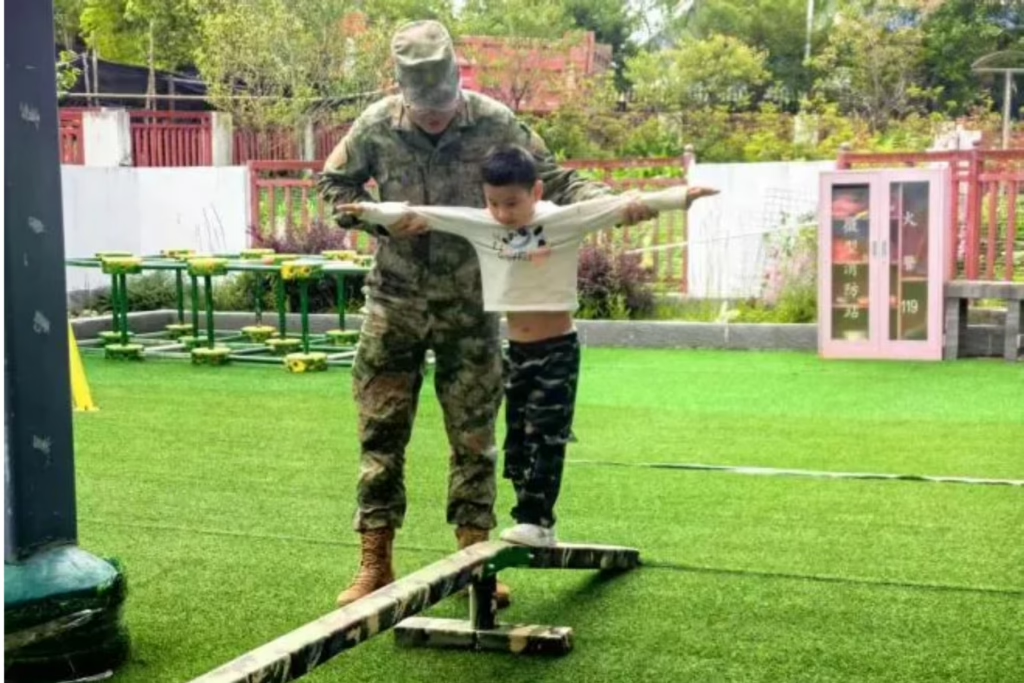
“Miniature military camp experience scenarios” Nyingtri (Nyingchi) in the Tibet Autonomous Region
The Nagchu pilot was not without precedent; a Tibetan source told Tibet Watch that in April 2020, PLA personnel from the Nagchu city armed forces visited primary and secondary schools in the region to deliver political education sessions, promote border defence awareness, and read ‘red stories’ which glorify the Party and the PLA to Tibetan children.[11] The initiative may also be linked to local authorities’ objectives in providing employment to demobilised soldiers.
In another area of the TAR, Chamdo (Chinese: Changdu) – regarded by China as a strategic bridge between the TAR and the provinces of Sichuan, Yunnan and Qinghai – schoolchildren were taught the importance of: “integrating moral education with national defense education, so that the awareness of patriotism, respect for the military, and concern for national defense can take root in the hearts of students”.[12] Tibetans in Chamdo were active in the 2008 protests across Tibet in defending their national and cultural identity, prompting a determined effort from 2009 onwards to intensify securitisation, with the Chamdo authorities emphasising a “readiness to defend to the death key sites, key aims, and key areas at sensitive and highly critical periods.”[13]
A political and now legal imperative: teaching ‘revolutionary culture’
The teaching of ‘revolutionary culture’ is a legal requirement across the PRC under the 2025 Preschool Education Law, referring primarily to the history of revolutionary heroes and to military achievements by the People’s Liberation Army (PLA). This can involve Tibetan toddlers in kindergartens being required to dress up as soldiers from the former Red Army or from the PLA and acting out killing Japanese soldiers or members of the Chinese Nationalist Party, the political party the PLA under the Chinese Communist Party fought to gain supremacy in 1949.[14]
Like Tibetan children in secular schools, Tibetan children recognised by the Party state in China’s database of ‘official’ reincarnate lamas are also taken to so-called ‘red sites’ like the birthplace of Mao Zedong.
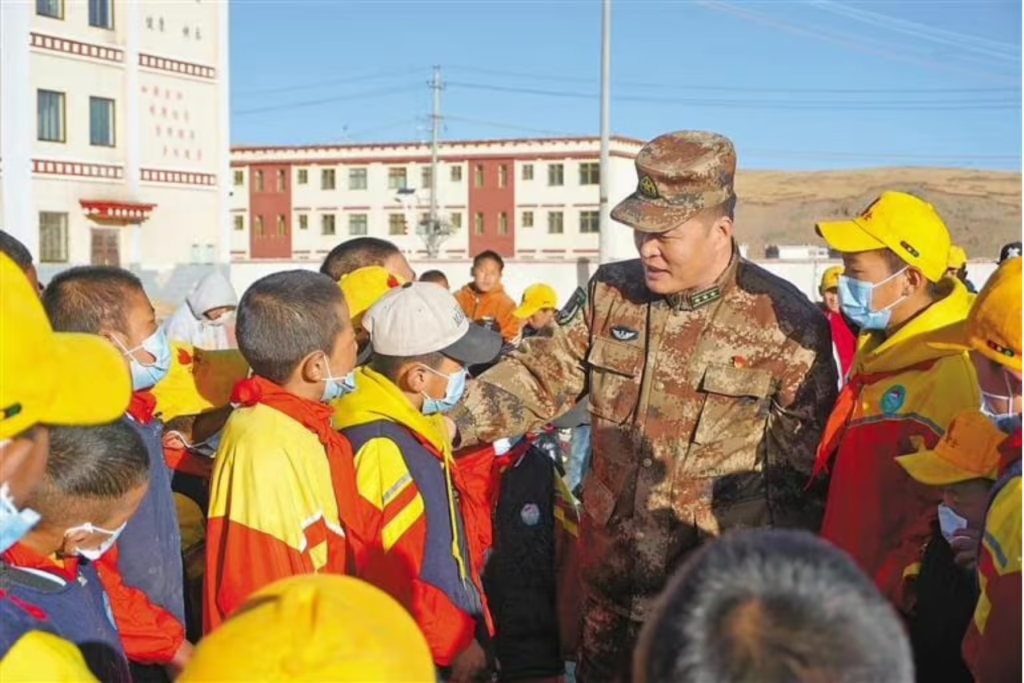
People’s Liberation Army of Nagchu City, Tibet Autonomous Region
The amended National Defence Education Law, in force across the PRC since September 2024, broadens the reach of defence education across the age range, and the Preschool Education Law makes the teaching of “revolutionary culture” a legal requirement in kindergartens.
This legal framework is reinforced by China’s new ‘Law on Promoting Ethnic Unity and Progress’, which comes into force on 1 July and mandates pre-school education in Mandarin, directs that Chinese characters be given prominence over Tibetan or Uyghur in public settings, and instructs all official work on families and family education to promote the “forging of national identity”.[15] The new law places particular emphasis on children’s Chinese-language education, stating that if it is not implemented, parents, teachers, the government, and children all bear legal responsibility, effectively criminalising families who do not prioritise Chinese-language teaching or who encourage speaking Tibetan in the home.
In Tibet, criticism of government policy, advocacy for language rights, or expressing a distinctly Tibetan sense of historical and religious identity has been treated for years as endangering ‘ethnic unity.’ Article 20 of the new law brings this directly into the most private spheres, stating that parents and guardians are required to “educate and guide minors to love the Chinese Communist Party.”
In a new report on kindergartens in Tibet published last month, Human Rights Watch documented the consequences of a shift from mandating for the first time the use of the Chinese language as the medium of instruction and care in all preschools across the PRC.
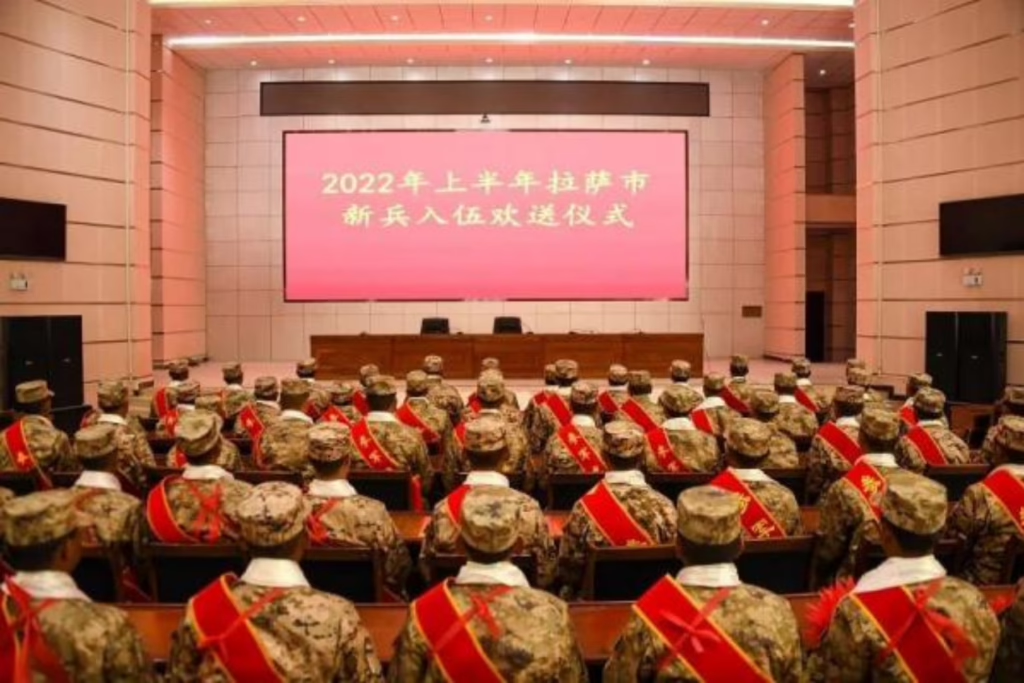
The farewell meeting for new soldiers conscripted into the army in the spring of 2022 in Lhasa was held at a militia training base
In a rare first-person account of a residential kindergarten, a non-Tibetan teacher recalled that children generally slept two or three to each sheepskin mattress, and in some cases, children had to be strapped to their beds to prevent them from falling. The former teacher said that during the two-hour afternoon recess, the children slept at their desks, and that “toys were confiscated from the children, but I don’t know why they were not allowed to play with them.”[16]
Human Rights Watch cited various Chinese academic studies of residential kindergartens in rural China that documented significant psychological harm, developmental delays, and functional challenges among children placed in these institutions. For instance, a 2013 study of a rural boarding kindergarten in Yunnan described children’s behavior and activities as “greatly restricted,” referred to cases of children trying to run away, and detailed conditions that overall were “extremely detrimental to the construction of a healthy mind for children.”[17]
Taken together, the breadth of the new ‘ethnic unity’ and national defence legislation and its implementation represents a dangerous acceleration of policies aimed at hollowing out Tibetan Buddhist culture and identity, reflecting the strategic weight the Chinese Communist Party attaches to Tibet, and Xi Jinping’s determination to remove religion and cultural distinctiveness as barriers to Party state consolidation.
While the Tsona kindergarten presents itself as a model for ensuring that the “red gene is passed down from generation to generation”, the Tibetan families subject to these policies have no say in what their children are taught to remember, or to forget.
Endnotes:
- In 2023 Tsona County was formally upgraded to city status, confirmed by Chinese state media and the TAR authorities, with the administrative change being explicitly linked to strengthening border governance opposite Tawang.
- ‘Guarding the Border with Children’s Hearts – Cuona City Kindergarten Conducts National Defense and Ethnic Unity Themed Education Activities’, Cuona (Tsona) City United Front Work Department, 26 May 2026, http://www.xztzb.gov.cn/zongjiao/1779790260734.shtml
- https://mp.weixin.qq.com/s/Ti1srvRodHLBCI55gYjvFQ
- ‘Children Learn National Defense from Their Motherland – Six Kindergartens in Layu Area, Qonggyai County, Conduct National Defense Education Themed Week Activities’, Qonggyai County Education Bureau, 6 May 2026, https://mp.weixin.qq.com/s/MStFzawIyjJJ0KETVcP6vw
- https://tibetwatch.org/china-deploys-military-veterans-in-kindergartens-and-schools-in-tibet/
- Lhokha (Chinese: Shannan) education bureau, 29 May 2026, official WeChat, https://mp.weixin.qq.com/s/-WWMpgTSWTU2cElfU-zMuA
- A fourth batch of standardised Chinese place names, covering 30 locations in Arunachal Pradesh, was published by China’s Ministry of Civil Affairs in April 2024, and Beijing has reinforced this cartographic assertion through six successive batches of standardised Chinese place names published by its Ministry of Civil Affairs since 2017. This covers a cumulative total of over 100 locations within the Indian state, with the most recent batch issued in April 2026. ‘Thread of Beads: An analysis of China’s renaming of 62 locations in the Indian State of Arunachal Pradesh since 2017’ by Tenzing Dhamdul, Tenzin Sherap and Tenzin Younten, Foundation for Non-Violent Alternatives, Delhi, 10 April 2024, https://fnvaworld.org/thread-of-beads-an-analysis-of-chinas-renaming-of-62-locations-in-the-indian-state-of-arunachal-pradesh-since-2017/
- Matthew Akester, presentation for the Foundation for Non-Violent Alternatives, Delhi, 13 September 2021, https://www.youtube.com/watch?v=9ZX7eTqrTJs&t=36s
- Although India has responded with its own accelerated infrastructure drive, including a major highway along the Line of Actual Control (LAC) and the Sela Tunnel to improve troop mobility in the eastern sector, Indian and international analysts have noted that China’s construction pace along the eastern LAC is formidable and the gap difficult to close. “[China’s] activities may ostensibly appear geared towards improving the lives of residents in Tibet and Xinjiang, but they also serve clear military objectives,” said Dr Y Nithiyanandam of the Takshashila Institution in India.“The sophisticated defence mechanisms and infrastructure at these airbases reflect China’s preparedness for air combat operations, potentially reshaping the regional power dynamic.” ‘’Rapid Military Infrastructure Expansion in Tibet: A Satellite Imagery Analysis’,
Takshashila Geospatial Bulletin, 30 September 2023: https://geospatialbulletin.takshashila.org.in/p/4-rapid-military-infrastructure-expansion Also ‘The Strategic Postures of China and India: A Visual Guide’ by Frank O’Donnell and Alexander K. Bollfrass, https://www.belfercenter.org/publication/strategic-postures-china-and-india-visual-guide - https://tibetwatch.org/china-deploys-military-veterans-in-kindergartens-and-schools-in-tibet/
- Interview with a Tibetan in 2022 by Tibet Watch. Since 2020, in the aftermath of the border clashes with the Indian army at the Galwan valley, China has intensified militarization of its border areas, conducted more military drills and run active army recruitment drives aimed at Tibetans. Another Tibetan source told Tibet Watch in 2021: “Tibetan families in regions bordering India have been instructed to send their children to compulsory military training beginning in January 2021.”
- ‘Schools throughout the city carried out a series of national defense education activities’, 3 April 2025, https://scjg.changdu.gov.cn/cdsscjg/c101255/202504/da587b6f71ff4e5598f016b9e74f3bba.shtml
- International Campaign for Tibet report, ‘Determination to resist repression continues in ‘combat-ready’ Chamdo, frontline of ‘patriotic education’, 2 December 2009, https://savetibet.org/determination-to-resist-repression-continues-in-combat-ready-chamdo-frontline-of-patriotic-education/
- For instance, two sources cited in Human Rights Watch major new report on kindergartens in Tibet, ‘Start with the Youngest Children: China’s Use of Preschools to “Integrate” Tibetans’, published 4 May, https://www.hrw.org/report/2026/05/04/start-with-the-youngest-children/chinas-use-of-preschools-to-integrate-tibetans : “The local kindergarten children were taken to visit the Chamdo Branch Military Sub-District Military History Museum and took part in practical activities on the theme of national defence education. The little friends listened carefully to the history of the Party and the Army…” See “ཆབ་མདོ་གྲོང་ཁྱེར་གྱི་དམག་དཔུང་དང་ས་གནས་ཀྱིས་མཉམ་ལས་བྱས་ཏེ་རྒྱལ་སྲུང་སློབ་གསོའི་བརྗོད་དོན་གཙོ་བོའི་ལག་ལེན་བྱེད་སྒོ་སྤེལ་བ།” (Chamdo Municipality’s military and local authorities cooperate to conduct education on the main theme of national defense,” Tibet Daily, August 13, 2024, https://e.xzxw.com/fzbzw/202408/13/content_268904.html; See for example “雪域雄鹰观阅兵,爱国种子悄发芽——拉萨市江苏实验幼儿园开展“中国人民抗日战争暨世界反法西斯战争胜利80周年”主题教育活动” (Snowy eagles watch the military parade, and the seeds of patriotism quietly sprout —Lhasa Jiangsu Experimental Kindergarten holds a themed educational event on the 80th anniversary of the victory of the Chinese People’s War of Resistance Against Japanese Aggression and the World Anti-Fascist War), 拉萨市江苏实验幼儿园 (Lhasa Jiangsu Experimental Kindergarten), 3 September, 2025, https://mp.weixin.qq.com/s/Mde5Wk9L4ntgEpdk5ze8lw.
- Tibet Watch analysis, 24 April 2026, https://tibetwatch.org/chinas-legal-warfare-against-tibet-and-the-threat-beyond-its-borders/
- The diary says that she was one of 200 trainee kindergarten teachers, most of them non-Tibetans, selected by the Gansu Province Education Department from “relevant universities,” in her case Northwest Normal University in Lanzhou, to teach as interns in kindergartens in Tibetan areas of Kanlho TAP. It was first discovered by Professor Gyal Lo and featured in Tibet Action Institute’s report, ‘Separated from their families, hidden from the world: China’s vast system of colonial boarding schools inside Tibet’, December 2021, https://tibetaction.net/colonial-boarding-school-report/. See Ann (pseudonym), “甘南支教:想说爱你不容易” (Gannan Volunteer Teaching: It’s Not Easy To Say I Love You), February 17, 2018, https://zhuanlan.zhihu.com/p/33843383. Cited in ‘Start with the Youngest Children: China’s Use of Preschools to “Integrate” Tibetans’, published 4 May, https://www.hrw.org/report/2026/05/04/start-with-the-youngest-children/chinas-use-of-preschools-to-integrate-tibetans
- Sun Yajuan and Li Shanze, “乡村幼儿的寄宿制生活 *——基于云南德宏M乡A幼儿园的批判民族志研究” (Rural children’s residential life-based on critical ethnography study on a kindergarten in Mangshi township), 学前教育研究 (Studies in Early Childhood Education), 2013, https://www.cnki.com.cn/Article/CJFDTotal-XQJY201311005.htm, p. 27-31, cited in Human Rights Watch report, https://www.hrw.org/report/2026/05/04/start-with-the-youngest-children/chinas-use-of-preschools-to-integrate-tibetans